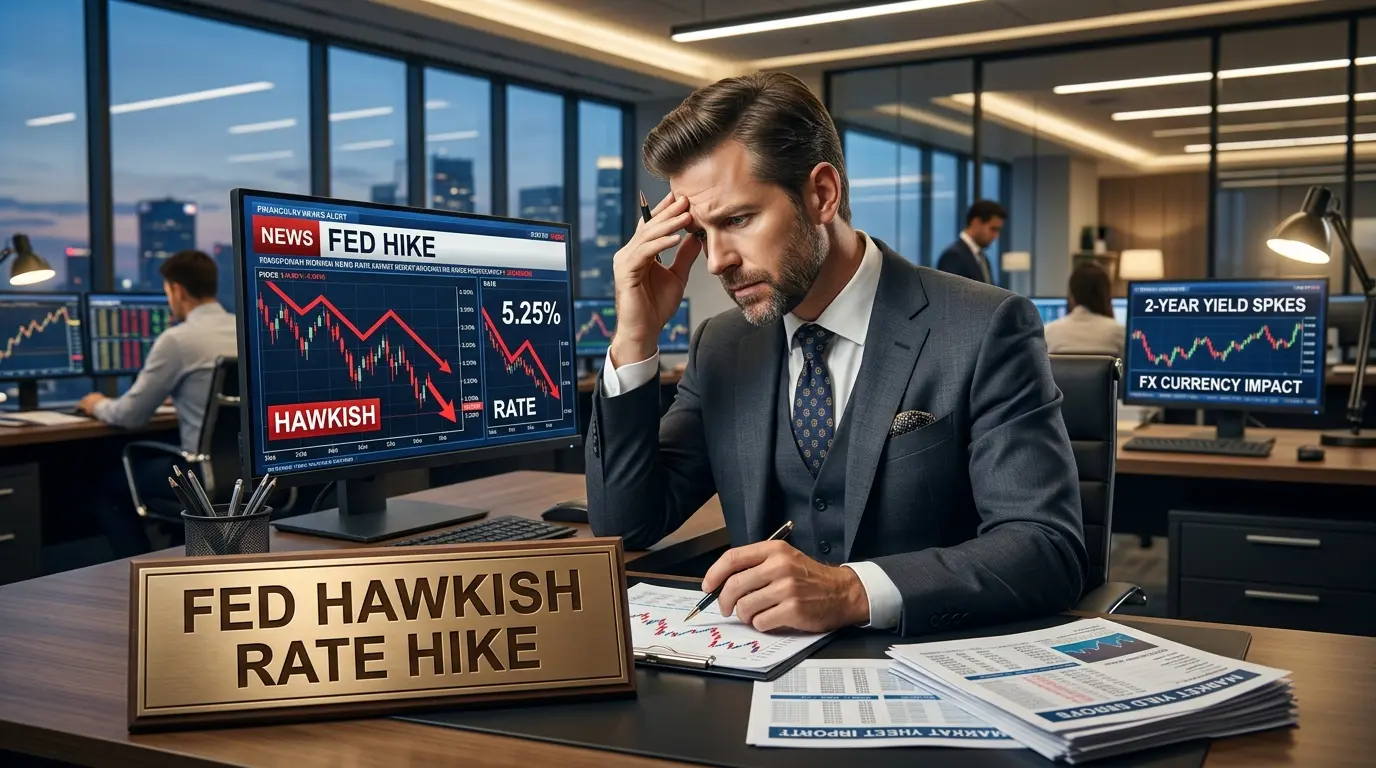
Federal Reserve Governor Lisa Cook stated on August 5, 2026, that the central bank is prepared to raise interest rates if inflation does not begin to ease, immediately triggering a repricing across forex and futures markets. The unexpectedly hawkish warning forces proprietary traders and retail participants to rapidly adjust their risk models, as the prospect of further monetary tightening upends the market's recent consensus positioning around a dovish policy path.
Key takeaways
- Federal Reserve Governor Lisa Cook confirmed the central bank remains ready to hike interest rates if inflation data remains stubbornly high.
- The August 5, 2026, comments force forex traders to re-evaluate structural US Dollar strength in a previously dovish-leaning environment.
- Index futures traders are now pricing in the tail risk of higher prolonged borrowing costs, increasing market sensitivity to upcoming economic prints.
- The hawkish pivot complicates the broader macro narrative, forcing trend-following algorithms to adjust their near-term Treasury yield models.
What happened
On August 5, 2026, Federal Reserve Governor Lisa Cook delivered a clear warning regarding the central bank's inflation mandate. According to reporting by Investing.com, Governor Cook explicitly stated her readiness to raise interest rates if inflation fails to show meaningful signs of easing. This intervention pushes back against market participants who had prematurely priced in a transition to an aggressive rate-cutting cycle.
For much of the preceding quarter, market consensus had skewed toward a sequence of steady rate cuts, driven by sporadic softness in labor market data. Governor Cook's remarks aggressively challenge this narrative, emphasizing that the inflation fight is far from over and that the Federal Reserve's dual mandate currently heavily weights price stability over maximum employment. The timing of Governor Cook's statement is critical for market mechanics, signaling that the terminal rate may not have been reached and demanding immediate attention from macro traders managing cross-asset portfolios.
Why it matters for traders
For retail forex and futures traders, central bank rhetoric directly dictates intraday volatility and structural trend development. Governor Cook's willingness to resume rate hikes shifts the baseline assumption for the US Dollar. When the Federal Reserve threatens to tighten policy while other global central banks consider easing, the resulting interest rate divergence provides a structural bid for the US Dollar Index.
Forex traders operating during the New York session are adjusting their playbooks. The traditional 'bad news is good news' paradigm—where weak economic data fuels equity rallies on the hope of rate cuts—is severely compromised when the Federal Reserve explicitly targets stubborn inflation. If incoming data shows resilient consumer spending, the US Dollar will likely experience aggressive bidding against the Euro and the Pound, as the yield differential widens in America's favor. The market was already highly sensitized to shifts in central bank language, building on the volatility generated when Fed Chair Warsh ended forward guidance. Governor Cook's statements serve as a reminder that the Federal Reserve remains entirely data-dependent.
In the futures market, the prospect of further rate hikes introduces a severe headwind for equity indices. For futures traders specializing in the E-mini S&P 500 or Nasdaq 100, the mathematical reality of higher-for-longer rates crushes multiple expansion. When Governor Cook conditions future policy on inflation easing, she effectively caps the upside momentum of risk assets. Retail traders attempting to blindly buy the dip in equity futures face elevated risks of being caught in liquidity vacuums, a dynamic familiar to those who were already repricing a potential Fed rate hike earlier in the summer.
Furthermore, this hawkishness arrives at a complex time for global liquidity. Traders are already navigating a fragmented macroeconomic environment, particularly considering how Middle East tensions and the earnings flood are colliding in the markets. Governor Cook's hawkish baseline means that any geopolitical supply shock to commodities will immediately translate into rate-hike fears, rather than just isolated inflation concerns.
What to watch next
Proprietary traders and macro funds will immediately pivot their focus to the next tier-one inflation prints. The upcoming Consumer Price Index (CPI) and Personal Consumption Expenditures (PCE) reports are no longer just gauges of economic health; they are the exact triggers for Governor Cook's threatened rate hikes. If the next inflation print shows acceleration, the market will rapidly price in a 25-basis-point hike for the next Federal Open Market Committee meeting.
Attention shifts to the short end of the Treasury yield curve, specifically the two-year yield, as it serves as the most accurate proxy for near-term Federal Reserve policy expectations. A breakout in the two-year yield will signal that institutional money believes Governor Cook's warning, paving the way for further dollar strength.
Frequently asked questions
How do rate hike threats impact the US Dollar?
When Federal Reserve officials like Governor Lisa Cook threaten to raise interest rates, it typically strengthens the US Dollar. Higher interest rates attract foreign capital seeking better yields, which increases demand for the dollar relative to other currencies with lower yields.
Why are equity index futures sensitive to inflation warnings?
Equity index futures, particularly tech-heavy indices like the Nasdaq, represent companies whose valuations rely heavily on future cash flows. When the Federal Reserve warns of rate hikes due to sticky inflation, the discount rate applied to those future cash flows increases, mechanically lowering their present value and triggering algorithmic selling.
How do prop firm traders manage Fed-speak volatility?
Proprietary traders navigating strict daily drawdown limits typically reduce their position sizing and widen their stop-losses during periods of aggressive central bank rhetoric. Market depth often thins out when Federal Reserve Governors speak, leading to erratic price action and severe slippage that can easily breach a prop firm's risk parameters.
Trading carries a substantial risk of loss; past performance and prior market reactions do not guarantee future results. This is market commentary, not advice.