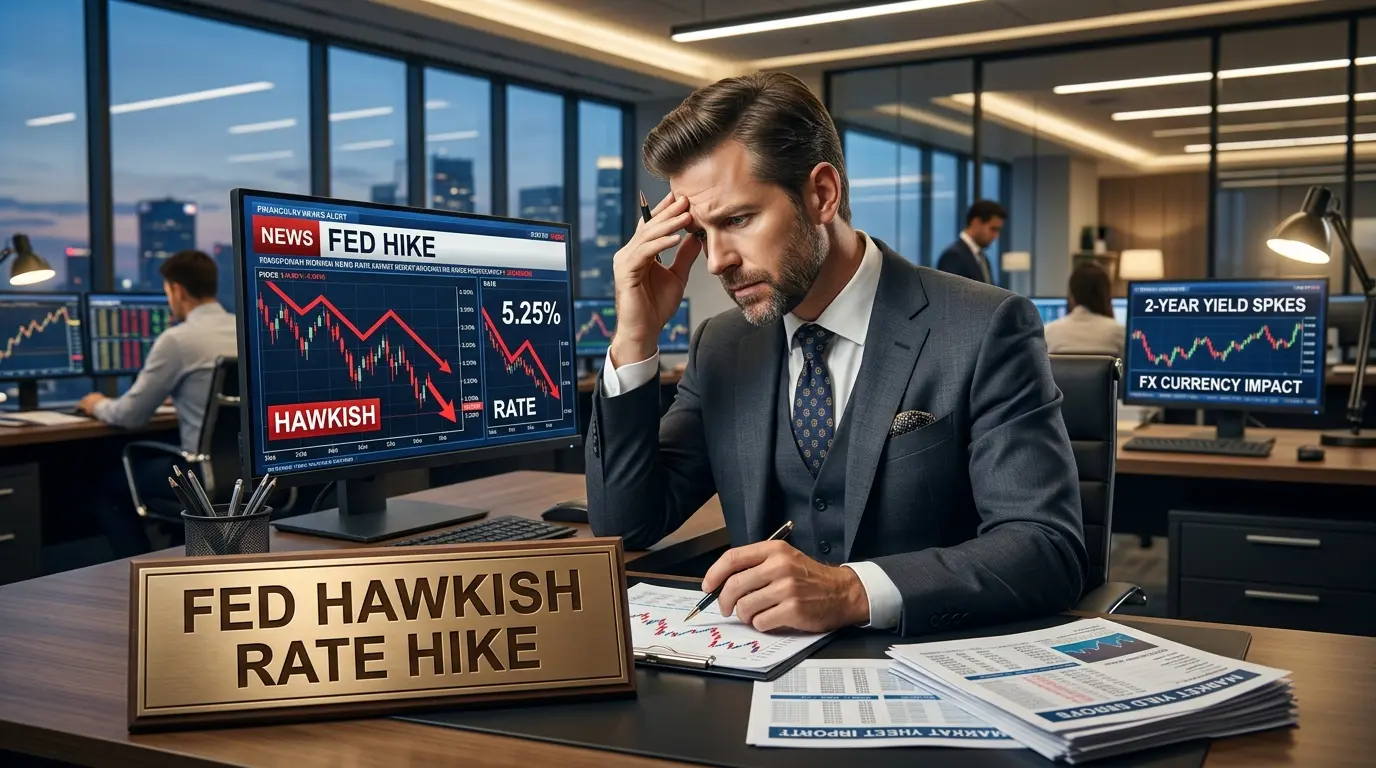
The Federal Reserve faces an exceptionally high bar to deliver an interest rate hike at this week's July 2026 policy meeting, yet derivatives markets stubbornly refuse to price out the chance of a tightening move. For forex and futures traders, this lingering hawkish premium creates a precarious volatility trap, where the divergence between a likely policy hold and speculative hedging sets the stage for violent post-decision repricing.
Key takeaways
- The Federal Reserve is widely expected to hold interest rates steady this week, with the threshold for an actual hike remaining severely elevated.
- Markets are maintaining a fractional probability of a rate increase, forcing institutional traders to hedge against a hawkish surprise.
- US Dollar pairs and Treasury futures remain highly sensitive to the Federal Reserve's forward guidance rather than just the immediate rate decision.
- Traders are closely monitoring the post-meeting press conference to see if the central bank validates or crushes these residual hike expectations.
What happened
According to a July 28 report by Investing.com, the bar to a Federal Reserve rate hike this week remains high, even as markets see a residual chance of an increase. Entering the late-July 2026 policy window, the overarching consensus is that the central bank requires overwhelming evidence of re-accelerating inflation to justify resuming its tightening cycle. However, speculative markets are actively refusing to entirely price out a hawkish move.
This tension means that while the baseline expectation is a policy hold, the pricing structure in interest rate derivatives reflects a persistent doubt about the definitive end of the Federal Reserve's hiking cycle. The divergence highlights a broader market environment that is unwilling to fully trust a neutral stance. As long as traders perceive a non-zero probability of higher rates, risk premiums remain elevated across major asset classes, dictating the flow of capital heading into the official announcement.
Why it matters for traders
This specific dynamic—where the primary expectation is a policy pause, but a statistical chance of a hike remains—forms the analytical core for this week's trading sessions. For forex traders, the US Dollar acts as the primary release valve for this tension. If the Federal Reserve holds rates but delivers rhetoric that acknowledges the market's pricing, the dollar could squeeze significantly higher against major pairs like the Euro and the Japanese Yen. The underlying bid under the greenback relies entirely on the Federal Reserve keeping the door open to future tightening. Understanding why traders are repricing the Fed provides crucial insight into these underlying pressures on the broader bond market.
For index futures traders, the lingering chance of a rate hike acts as a persistent headwind against sustained rallies. Equity futures inherently price in the cost of capital. As long as markets see a chance of higher rates, attempts to push the S&P 500 or Nasdaq 100 futures higher are vulnerable to sudden, sharp pullbacks. The famously "high bar" to a hike provides some downside cushion, but the fact that the risk is priced in at all severely limits upside velocity. Furthermore, recent market action regarding surging Treasury yields has consistently demonstrated exactly how sensitive risk assets remain to any hint of central bank hawkishness.
Volatility is the unavoidable secondary consequence of this setup. The current pricing structure virtually guarantees that the actual Federal Reserve decision will spark a significant repricing event. If the central bank explicitly rules out a hike and shuts down the hawkish whispers, the risk premium collapses, likely leading to a dovish relief rally in index futures and a sharp US Dollar sell-off. Conversely, if officials validate the cautious hedging, the sudden shift from a mere chance to a tangible reality will trigger aggressive downside momentum in equities and a massive dollar bid as traders scramble to cover their exposure.
What to watch next
The immediate catalyst is the Federal Reserve's official policy statement release, followed shortly by the Chairman's highly anticipated press conference. Traders must meticulously monitor the specific language used by the central bank to describe future policy paths. Any mention of keeping options open or remaining explicitly data-dependent in the face of sticky economic metrics will be aggressively seized upon by the market as validation of the lingering rate hike chance.
Conversely, if the Federal Reserve emphasizes the excessively high bar to further tightening, traders should expect a rapid unwinding of these hawkish hedges. Beyond this week's immediate meeting, the focus will rapidly shift to incoming tier-one economic data, as these future prints will ultimately either justify the market's persistent caution or confirm the central bank's reluctance to move rates higher.
Frequently asked questions
Why do markets price in a rate hike when the bar is high?
Markets price in probabilities based on asymmetric risk, not just the base-case consensus. Even if a Federal Reserve rate hike is deemed highly unlikely, institutional traders must actively hedge against the worst-case scenario. This defensive hedging activity registers in derivatives markets as a statistical chance of a hike, keeping risk premiums alive.
How does a potential Federal Reserve rate hike impact the US Dollar?
A potential interest rate hike generally strengthens the US Dollar. Higher central bank interest rates offer better yield returns on dollar-denominated assets, attracting global capital flows. When markets price in even a fractional chance of a hike, it creates a persistent underlying bid for the dollar against other major fiat currencies.
What is a volatility trap in futures trading?
A volatility trap occurs when market pricing deliberately diverges from the most likely fundamental outcome. Heading into this Federal Reserve meeting, futures traders positioned purely for a definitive policy pause might be caught off guard by sudden, violent price swings if the central bank's language accidentally triggers the residual hawkish bets, causing rapid liquidations.
Trading carries a substantial risk of loss; past performance and prior market reactions do not guarantee future results. This is market commentary, not advice.