
A perpetual futures funding rate is a periodic payment between longs and shorts that keeps a perp's price close to spot. At prop firms it becomes a holding cost that counts against your drawdown. Some firms pass Hyperliquid's live funding through every hour, while others charge a fixed swap of about 0.03% a day on both sides. Knowing which one your firm uses changes how long you can hold a position.
Rules and fees checked on each firm's official site on 17 October 2026.
Key takeaways
- When funding is positive, longs pay shorts. When it's negative, shorts pay longs. The payment is position notional × funding rate.
- Hypernova, Propr and E8 Perpetuals pass Hyperliquid's live funding through, so depending on the sign it can cost you or pay you.
- At Hyperliquid's baseline rate (0.00125% an hour), a long pays the same 0.03% a day that a fixed swap charges, while a short receives it.
- MyFundedPerps and Tradeify 247 charge a fixed daily swap instead (0.03% and 0.033% a day on crypto), and both longs and shorts pay it.
- Funding and swap charges hit your balance and equity, so they count toward the daily loss limit and the max drawdown.
- Closing a position before the next charge skips that charge.
Holding costs at five perps prop firms
| Firm | Holding cost | Rate | When charged | Who pays |
|---|---|---|---|---|
| Hypernova | Live funding | Hyperliquid's rate per symbol | Every hour, on the UTC hour | Longs or shorts, depending on the sign |
| Propr | Live funding | Hyperliquid's periodic rate | Automatically, as Hyperliquid funds | Longs or shorts, depending on the sign |
| E8 Perpetuals | Live funding | Hyperliquid's rate | As on Hyperliquid (hourly) | Longs or shorts, depending on the sign |
| MyFundedPerps | Fixed swap | 0.03%/day crypto, 0.005% forex, 0.015% stocks, indices and commodities | Hourly, 1/24 of the daily rate | Both longs and shorts |
| Tradeify 247 | Fixed swap | 0.033% of position value per day | Once a day at the 22:00 UTC reset | Both longs and shorts |
What is a perpetual futures funding rate?

Funding moves money between the two sides of the market, not to the exchange.
A funding rate is a recurring payment between traders holding long and short positions in a perpetual futures contract. A perp has no expiry date, so nothing forces its price back to spot the way a delivery date does. Funding does that job. When the perp trades above spot, the rate is positive and longs pay shorts, which makes holding a long more expensive and pulls the price back down. When the perp trades below spot, the rate turns negative and shorts pay longs.
The money moves between traders. It isn't a fee to the exchange. CoinDesk's explainer on perps describes the same self-correcting mechanism used across major derivatives exchanges. Hyperliquid's own funding documentation sets out the mechanics most perps prop firms price from: funding is paid every hour, and its rate combines a premium (how far the perp sits from the oracle price) with a fixed interest component of 0.01% per 8 hours, or 0.00125% an hour, paid to shorts. When the perp trades exactly at the oracle price, longs still pay that baseline. For the wider picture of how perps prop accounts work, see our guide to perpetual funded accounts.
Why the sign matters more than the size
Most of the time crypto funding is small and positive, which means a slow drip from longs to shorts. When a market is crowded on one side, the rate climbs, and the crowded side pays more every period. A high positive rate says many traders are paying to stay long. That tells you about the market, but it isn't a trade signal on its own.
How is funding calculated and when is it charged?

Only positions open at the funding boundary pay or receive.
The payment is simple: position notional × funding rate, taken at the funding boundary. Leverage doesn't change the rate, but it raises your notional, so it raises the payment in dollars. Hypernova's fee docs set out the mechanics for a Hyperliquid-priced account: funding is charged every hour on the UTC hour, uses Hyperliquid's live rate for each symbol, and is sized on the position's notional at the oracle price.
A worked example
Suppose you hold a $40,000 BTC long on a $100K account (0.4x account leverage) and funding sits at Hyperliquid's baseline of +0.00125% an hour:
- Hourly payment: $40,000 × 0.00125% = $0.50, paid by you to shorts.
- One day: 24 × $0.50 = $12.
- One week: $84, before any trading commission.
Flip the sign to −0.00125% and the same long receives $84 over the week. Close the position before the next hourly boundary and that hour's payment never happens, because only positions open at the boundary pay or receive funding. Resting orders that haven't filled never pay.
Live funding vs fixed swap: how perps prop firms charge holding costs
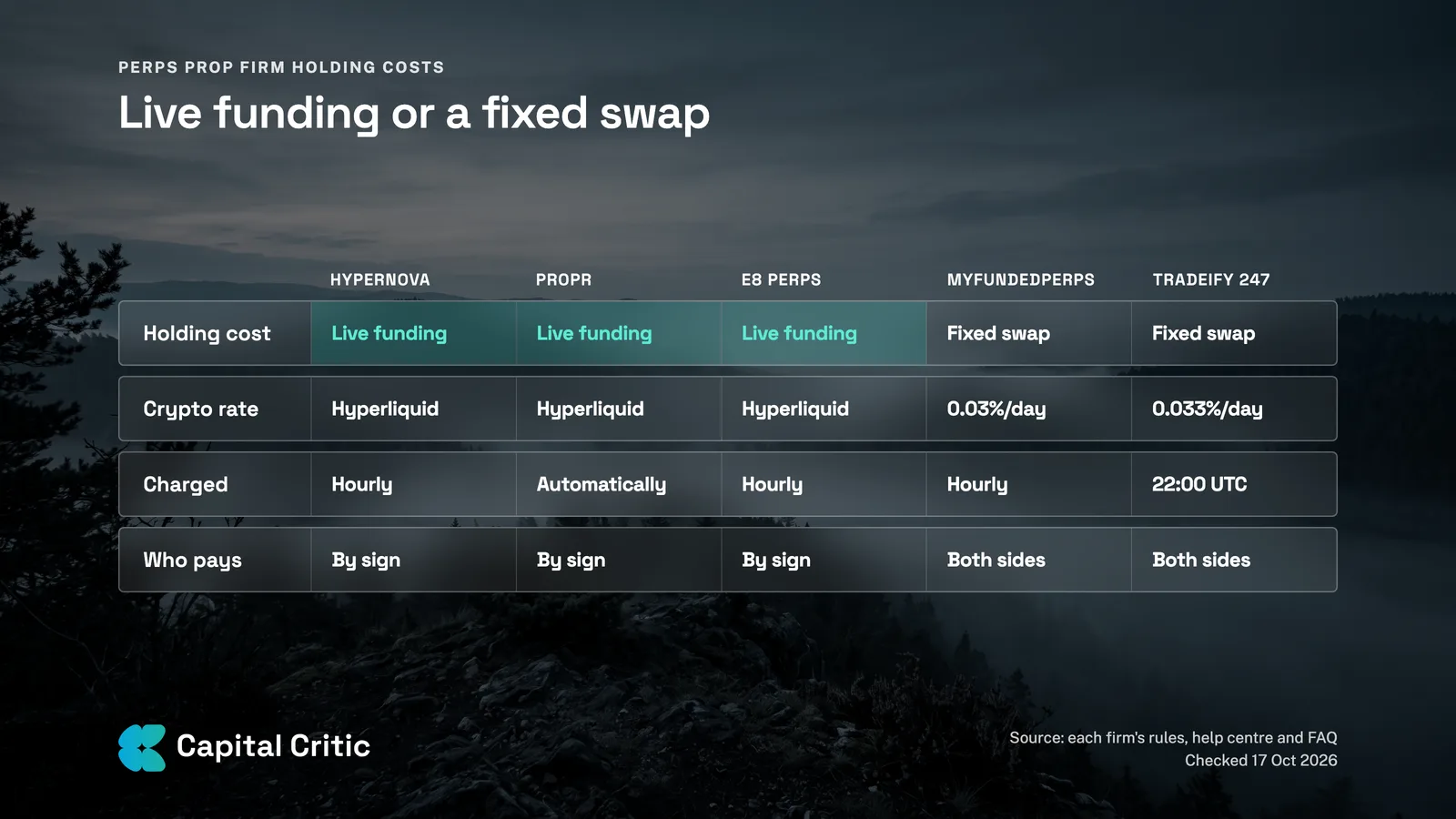
Source: each firm's rules, help centre and FAQ pages, checked 17 Oct 2026.
Perps prop firms split into two camps. Hypernova, E8 Perpetuals and Propr pass Hyperliquid's live funding through to your simulated account. MyFundedPerps and Tradeify 247 replace funding with a fixed daily swap that both sides pay.
Live funding (Hypernova, Propr, E8 Perpetuals)
All three price from Hyperliquid, credit or debit funding automatically and count it in your equity. Propr passes Hyperliquid's trading fees through at cost with no markup. E8's help centre says spreads and funding rates on its perps market behave as they would live, and it points traders to Hyperliquid's funding documentation; its crypto fees are 0.015% maker and 0.045% taker. The upside: a short in a positive-funding market earns funding, and a long earns when funding is negative. The downside: the cost moves with the market, so a crowded trade can get expensive just as you're holding it.
Fixed swap (MyFundedPerps, Tradeify 247)
MyFundedPerps charges a swap of 0.03% a day on crypto (0.005% on forex, 0.015% on stocks, indices and commodities), taken hourly at 1/24 of the daily rate, and its FAQ says venue funding shown in the terminal is informational only. Tradeify 247 charges 0.033% of position value per day at its 22:00 UTC daily reset, weekends included. That's about $3.30 a day on a $10,000 position, on top of its 0.04% commission each way. With a fixed swap you always pay to hold, long or short, and the cost is the same in calm and frantic markets.
Neither model is cheaper by default. At Hyperliquid's baseline rate, a long on live funding pays 0.03% a day, the same as MyFundedPerps' crypto swap, while a short receives it. Live funding costs more on a crowded long, and a fixed swap is predictable but never pays you. See how the firms compare on everything else in My Funded Perpetuals vs Propr.
How funding affects your drawdown and daily loss limit
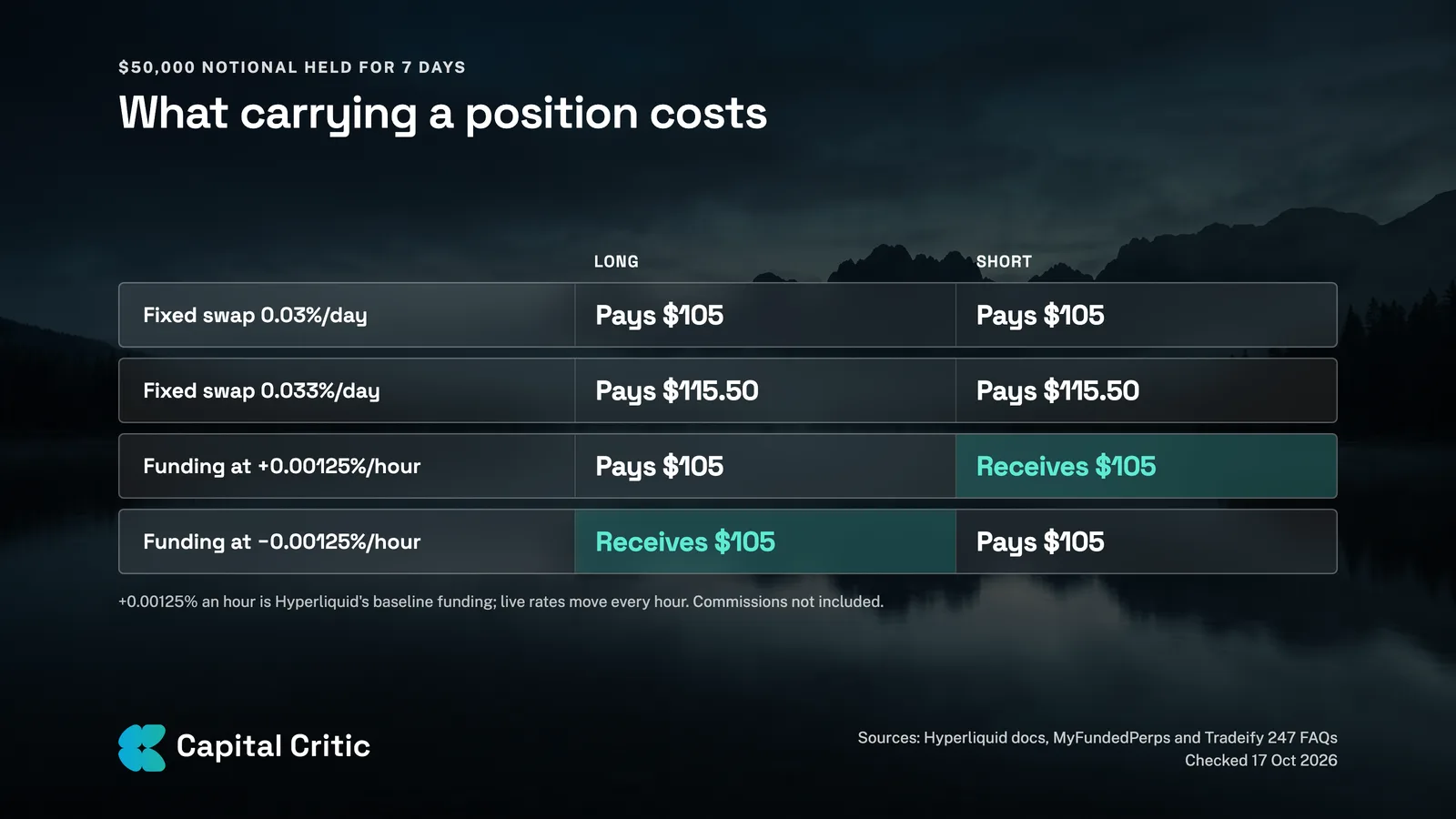
Sources: Hyperliquid funding docs and the MyFundedPerps and Tradeify 247 FAQs, 17 Oct 2026.
At all five firms, holding costs are deducted from the account and show up in equity, so they count toward your loss limits the same way a losing trade does. Hypernova and Propr say explicitly that funding is included in the equity calculation that their daily loss limit and max drawdown are enforced on.
Here is how the same $50,000 notional, held for seven days, works out under each model:
| Holding cost model | Long, 7 days | Short, 7 days |
|---|---|---|
| Fixed swap 0.03%/day (MyFundedPerps crypto) | Pays $105 | Pays $105 |
| Fixed swap 0.033%/day (Tradeify 247) | Pays $115.50 | Pays $115.50 |
| Live funding at Hyperliquid's +0.00125%/hour baseline | Pays $105 | Receives $105 |
| Live funding at −0.00125%/hour | Receives $105 | Pays $105 |
On a $100K account with a 6% max drawdown ($6,000 of room), $115.50 is about 2% of the buffer used up before price moves at all. That's small for one week, but swing traders who stack positions, or hold through a crowded week, can spend a meaningful slice of the daily limit on carry alone. The baseline is where funding sits when a perp trades at the oracle price; live rates move away from it every hour.
A funding checklist for perps prop traders
Funding rarely ends an account on its own, but it decides whether a swing trade is worth holding. Run through these before you hold over a boundary:
- Know your firm's model. Live funding or a fixed swap? Check the firm's rules page, not just the terminal display. MyFundedPerps shows venue funding that doesn't touch your balance.
- Check the sign and size before holding. On live-funding firms, a short in strongly positive funding earns carry. A long in the same market pays it every hour.
- Time your exits around the charge. Hourly at Hypernova, E8 Perpetuals and MyFundedPerps, once a day at 22:00 UTC at Tradeify 247. Closing a minute before the charge skips it.
- Size for the cost, not just the stop. Notional drives the payment, so higher leverage raises the dollar cost of every hour you hold.
- Don't try to farm funding across accounts. Opposite positions across two accounts, or against another firm, count as cross-account hedging, which Hypernova's rulebook and MyFundedPerps' FAQ both prohibit.
Prop accounts are simulated, and funding is one more cost on top of the evaluation fee. For a side-by-side of firm rules, see our reviews of Propr and MyFundedPerps, or the best 1-step perpetual prop firms.
Frequently Asked Questions
What does a positive funding rate mean?
The perp is trading above spot, so traders holding longs pay traders holding shorts at each funding boundary. A negative rate reverses the direction.
How do you calculate a funding payment?
Multiply your position's notional value by the funding rate for that period. A $40,000 position at 0.00125% pays or receives $0.50 for that period.
Do prop firms charge funding rates on perpetuals?
Most charge some kind of holding cost. Hypernova, Propr and E8 Perpetuals pass Hyperliquid's live funding through. MyFundedPerps and Tradeify 247 charge a fixed daily swap that both longs and shorts pay.
Does funding count toward my drawdown?
Yes. Funding and swap charges reduce your balance and equity, so they count toward the daily loss limit and the max drawdown.
How can I avoid paying funding?
Close the position before the next charge. On live-funding firms, holding the side that receives funding also avoids paying it. Fixed-swap firms charge both sides.