

Hypernova is a one-step perpetuals prop firm: you pay a one-time fee from $25, hit a 9% or 10% profit target without breaching two equity limits, and then keep 80% of funded profits, paid in USDC on Arbitrum within seconds. There's no time limit, no minimum trading days and no consistency rule. The two loss limits are the whole game.
Rules and prices checked on Hypernova's official rulebook, docs and stats page on 17 October 2026.
Key takeaways
- Every Hypernova assessment is one step. Tight Risk needs 9%, Low and Medium Risk need 10%, and the funded account has no target.
- Fees are one-time and run from $25 (Tight, $5K) to $1,950 (Low, $200K). Medium Risk stops at $100K.
- Both loss limits are enforced on equity, including open trades. One touch ends the account permanently, with no reset.
- Payouts are 80% to you, on demand whenever you're flat, settled in USDC on Arbitrum, and capped at $10,000 of profit per day during the closed alpha.
- Hypernova's own stats page shows $1.70M in lifetime payouts across 290 recipients and a 20.9% pass rate on paid assessments.
Hypernova key facts
| Item | Hypernova (17 Oct 2026) |
|---|---|
| Steps | 1-step assessment, then funded |
| Risk tiers | Tight, Low, Medium (High Risk restricted to eligible traders) |
| Account sizes | $5K to $200K ($5K to $100K on Medium Risk) |
| Fee | $25 to $1,950, one-time, paid in USDC |
| Profit target | 9% (Tight) or 10% (Low, Medium) |
| Daily loss limit | 3% / 3% / 4% of the prior day's closing balance |
| Max drawdown | 3% / 6% / 7%, static from the starting balance |
| Profit split | 80% trader / 20% Hypernova |
| Payouts | On demand when flat, USDC on Arbitrum, $10,000/day cap during alpha |
| Combined limit | $300,000 starting capital across active accounts; two assessments at a time |
What is Hypernova and how does its assessment work?

Sign-up, fees and payouts all run through an embedded USDC wallet on Arbitrum.
Hypernova is an on-chain prop firm for perpetual futures. You buy a one-step assessment, trade a simulated account priced from live Hyperliquid market data, and get a funded account the moment your balance reaches the profit target. Orders fill on Hypernova's own engine and are not routed to Hyperliquid, so this is evaluation trading, not a live exchange account. If perps are new to you, start with our guide to how perpetual funded accounts work.
Sign-up is wallet-based. Hypernova creates an embedded wallet for you, you pay the fee in USDC over Arbitrum, and payouts land in the same wallet. Identity verification (photo ID plus a selfie, through Sumsub) is needed before the funded account is activated, not to sign up or take the assessment.
Choose a market package
Every assessment is bought with one of three market packages:
- Crypto: 79 crypto perpetuals.
- TradFi: 61 equity, ETF, commodity, index and FX perpetuals.
- All Markets: both sets, 140 pairs.
Hypernova's docs list a 5x leverage cap across tiers, while the rulebook sets the cap per symbol and shows it next to the leverage selector in the terminal. Check the symbol you trade before sizing a position.
Fast Track and the closed beta
Hypernova still describes itself as a closed beta. Its Fast Track lets you connect trading history from Hyperliquid, Binance or Bybit for a free score, and traders who qualify can get a free or discounted assessment or skip it entirely. The firm doesn't publish the qualifying threshold.
Hypernova risk tiers and fees compared
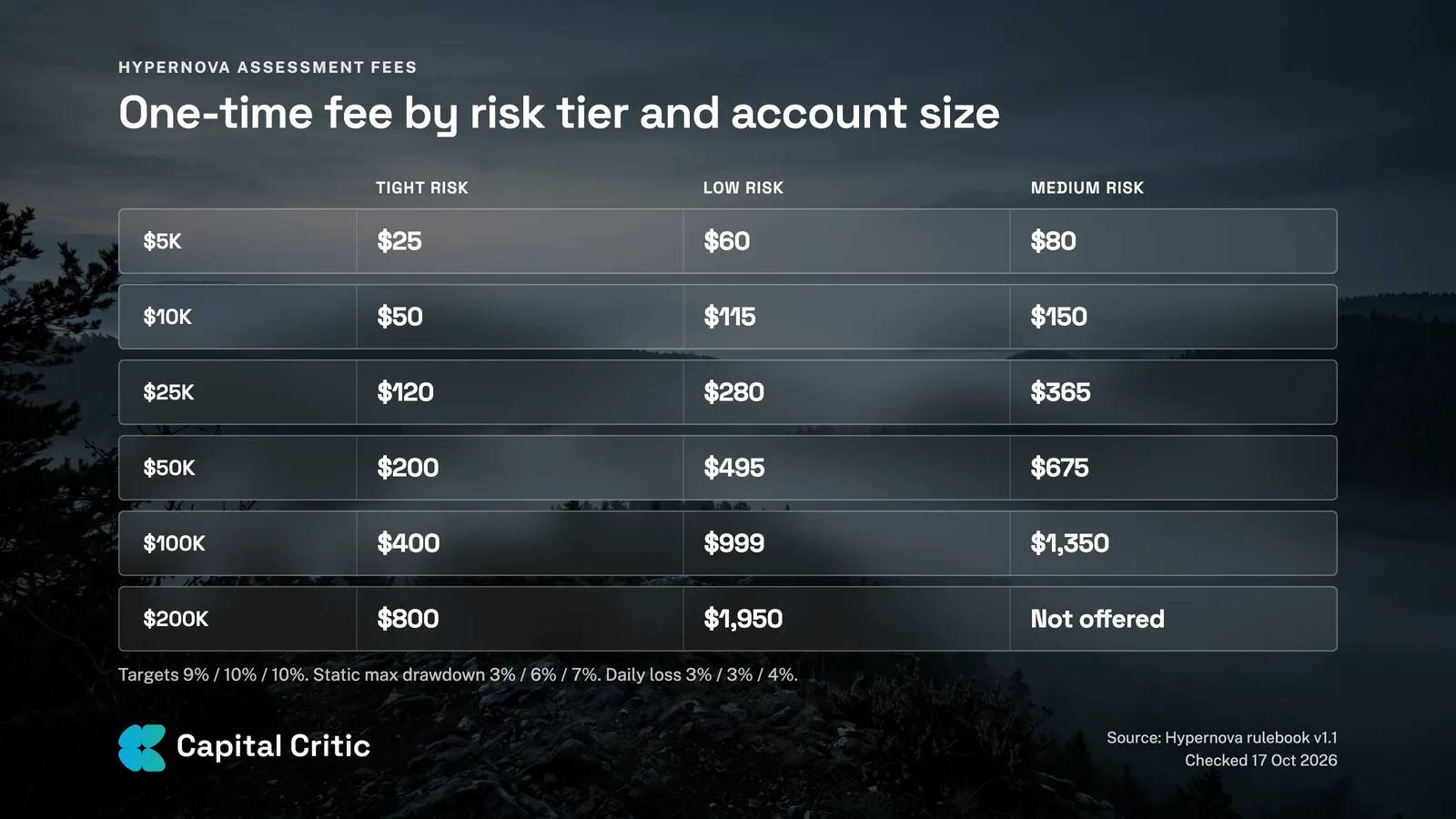
Source: Hypernova rulebook v1.1, checked 17 Oct 2026.
The risk tier is the main decision, because it sets your target, both loss limits and the fee. Tight Risk is the cheapest by a wide margin. The catch: its 3% max drawdown is the same size as its 3% daily limit, so one bad day can end the account.
| Account size | Tight Risk fee | Low Risk fee | Medium Risk fee |
|---|---|---|---|
| $5K | $25 | $60 | $80 |
| $10K | $50 | $115 | $150 |
| $25K | $120 | $280 | $365 |
| $50K | $200 | $495 | $675 |
| $100K | $400 | $999 | $1,350 |
| $200K | $800 | $1,950 | Not offered |
The rules behind each tier:
| Rule | Tight Risk | Low Risk | Medium Risk |
|---|---|---|---|
| Profit target | 9% | 10% | 10% |
| Daily loss limit | 3% | 3% | 4% |
| Max drawdown (static) | 3% | 6% | 7% |
| $100K target / floor | $9,000 / $97,000 | $10,000 / $94,000 | $10,000 / $93,000 |
A fourth tier, High Risk (5% daily, 8% drawdown), appears in the rulebook but is restricted to traders with a verified record, and its fees are listed as TBD. Fees come from Hypernova's rulebook v1.1. The configurator on the homepage showed $275 for the default Low Risk $25K card on the same day, against $280 in the rulebook, so confirm the figure in the app before paying.
How are Hypernova's daily loss and max drawdown enforced?

Two limits, both on equity: a daily floor that resets at 00:00 UTC and a static floor that never moves.
Hypernova uses two equity limits in both the assessment and the funded stage, and a breach of either is final. Positions close, the account is disabled, and there is no reset or appeal. Both limits count open trades, so a losing position can breach the account before you close it.
The daily loss limit resets at 00:00 UTC
Each day at 00:00 UTC Hypernova snapshots your balance (closed P&L only) and sets the day's equity floor at that balance minus your tier's daily percentage. Suppose you trade a $100K Low Risk account and close a day at $103,000. The next day's floor is $99,910, which is $103,000 minus 3%. If you close the day at $98,000 instead, the next floor drops to $95,060. The limit moves with your balance in both directions.
The max drawdown never moves
The max drawdown is a fixed floor set from the starting balance: $94,000 on that same $100K Low Risk account, whatever you earn. Profits widen the gap between your balance and the floor, and payouts don't raise it. Per Hypernova's payout docs, a payout taken during the day is added back to that day's loss budget, so withdrawing doesn't count as a loss.
On Tight Risk the two limits overlap: a 3% static floor and a 3% daily limit mean the first day's loss allowance and the account's entire life allowance are the same $3,000 on $100K. Treat Tight Risk as a cheap, unforgiving ticket rather than a discount on Low Risk.
How do Hypernova payouts work?
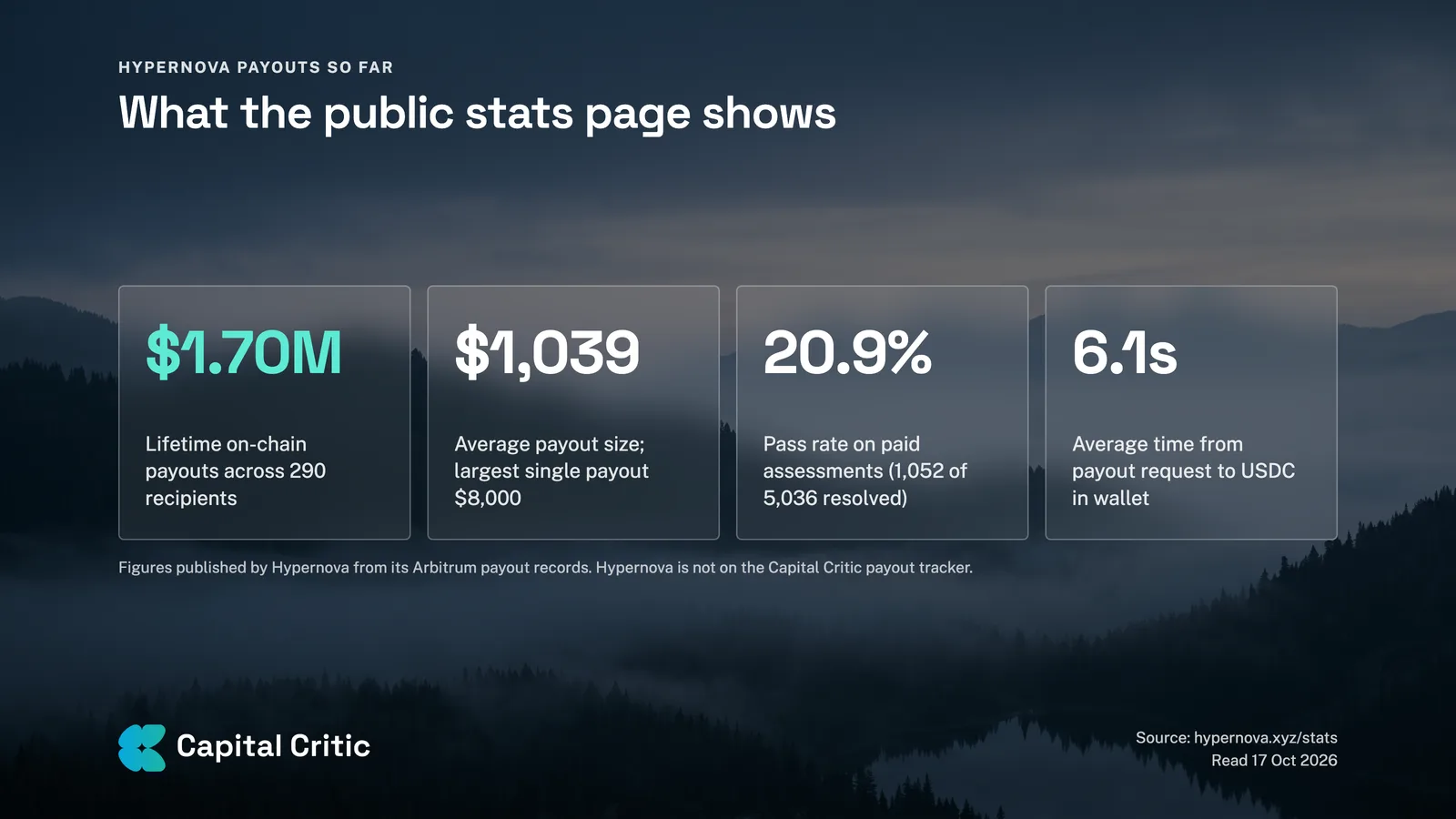
Source: hypernova.xyz/stats, read 17 Oct 2026. Figures published by Hypernova.
Funded traders keep 80% of profits and can withdraw any time the account is flat, with no minimum amount, no waiting period and no limit on the number of requests. The payout is (balance minus starting balance) × 80%. The account then returns to its starting balance, while the drawdown floor stays where it was.
- Close every open position and order. The account settles on-chain.
- Click Submit Payout on the funded dashboard and pick an amount.
- Sign once. Hypernova pays the gas.
- USDC arrives in your embedded wallet on Arbitrum, and you can send it on to an exchange or another wallet.
Two limits apply. During the closed alpha, payouts are capped at $10,000 of profit per user per day, and the cap will be lifted later. Hypernova may also withhold a payout where sanctions or restricted-jurisdiction rules require it.
What the payout record shows
On 17 October 2026, Hypernova's stats page showed $1,698,222 in lifetime payouts across 290 recipients, an average payout of $1,039, a largest single payout of $8,000 and a 6.1-second average time to pay. Of 1,205 traders who paid for an assessment, 433 reached a funded account and 290 of those received a payout. These are Hypernova's published figures, drawn from its Arbitrum records. Hypernova isn't on the Capital Critic payout tracker, so we haven't verified them independently. Our prop firm payouts page covers the firms we track. Like every on-chain figure, these are a floor, not a full count of what traders received.
What's banned at Hypernova, and who does it suit?
Hypernova lets you trade any style inside the two limits. News trading, weekend holds, scalping, grid strategies and your own bots are all allowed, and there's no stop-loss or risk-per-trade rule. The bans are about how you use accounts, not how you trade:
- hedging or arbitrage across two Hypernova accounts, or against another firm
- copy trading, signal services, community trade ideas and off-the-shelf "pass the challenge" strategies
- account sharing, or several accounts from one household, device or IP without approval
- exploiting platform errors, latency or price-feed anomalies
- switching to a materially different strategy once funded
- trades that couldn't be replicated live, such as positions at risk of auto-deleveraging
Costs beyond the fee
Trading fees come off your balance and count in your P&L. Crypto is 0.01% maker / 0.04% taker. TradFi makers pay nothing, and takers pay 0.03% on equities and 0.005% on FX, commodities and indices. Funding is charged hourly from Hyperliquid's live rates, and longs pay shorts when the rate is positive. There are no monthly, inactivity, platform or withdrawal fees, although accounts freeze after three months with no trades.
Who it fits
Hypernova suits a perps trader who wants fast stablecoin payouts and no consistency or day-count rules, and who can live with equity-based limits that end the account on first touch. It suits traders who rely on others' signals or copy services much less. Accounts are capped at $300,000 of combined starting capital, with no more than two open assessments at a time. For other one-step options, see our best 1-step perpetual prop firms roundup, the Propr evaluation explained, or see our Hypernova review. Prop trading fees are a cost of trying, and most traders who pay don't reach a payout, so size the fee as money you can lose.
Frequently Asked Questions
Is Hypernova a one-step or two-step prop firm?
One step. You pass by reaching a 9% (Tight Risk) or 10% (Low and Medium Risk) profit target without breaching the daily loss limit or the static max drawdown, with no time limit and no minimum trading days.
How much does a Hypernova account cost?
Fees are one-time and paid in USDC: $25 to $800 on Tight Risk, $60 to $1,950 on Low Risk and $80 to $1,350 on Medium Risk, depending on account size.
Does Hypernova have a consistency rule?
No. There's no consistency rule, no minimum trading days and no profit cap. The only trading limits are the daily loss limit and the max drawdown.
How fast are Hypernova payouts?
Payouts settle on-chain in USDC on Arbitrum. Hypernova's stats page reported a 6.1-second average on 17 October 2026. During the closed alpha, payouts are capped at $10,000 of profit per day.
Does Hypernova require KYC?
Yes, before the funded account is activated. You need a government photo ID and a selfie, and you must be 18 or over. You can sign up and take the assessment before verifying.
Can I trade news or hold over the weekend on Hypernova?
Yes. News trading, weekend holding, bots you run yourself and all trading styles are allowed, as long as you stay inside the two equity limits.