

FundedNext is the most direct FTMO alternative if you want futures, a cheaper Lite challenge or shorter payout cycles, but it is not automatically cheaper. At $100,000, the FundedNext 2-Step costs $549.99, or $511.49 with code CRITIC, against FTMO's €540 list price (about $604). Both firms refund the 2-Step fee with your first reward.
Rules and prices checked on each firm's official site and checkout on 13 and 14 October 2026. FTMO prices its challenges in euros; dollar figures use the ECB reference rate of 13 October 2026 ($1.1188 per euro).
Key takeaways
- At $100K, the FundedNext 2-Step lists at $549.99 against about $604 for FTMO. FTMO's pricing page showed €439 (about $491) on 14 October, which made FTMO the cheaper of the two that day.
- The 2-Step rules are close: both use a 5% daily loss limit and a 10% static maximum loss. FundedNext's targets are lower (8% and 5% against 10% and 5%), FTMO needs fewer minimum days (4 against 5 per phase).
- On 1-Step challenges, FTMO gives more room: a 10% maximum loss, no minimum days and a 90% split from the first reward. FundedNext allows 6%, needs 2 days and pays 80%, but refunds the fee with the third reward.
- Both firms now sell futures. FTMO Futures bills monthly ($119 to $269), FundedNext Futures charges a one-time fee.
- FundedNext made $14,330,940 in payouts across 9,051 on-chain transfers in the last 30 days, a floor rather than a full total. FTMO pays by bank, card, Skrill and crypto and is not on our on-chain tracker.
Key facts: $100K 2-Step challenge
| Rule | FTMO 2-Step | FundedNext Stellar 2-Step |
|---|---|---|
| Price | €540 list (about $604); €439 shown on 14 Oct | $549.99 ($511.49 with CRITIC) |
| Profit targets | 10% then 5% | 8% then 5% |
| Daily loss limit | 5%, reset from the midnight balance | 5% |
| Maximum loss | 10% static | 10% static |
| Minimum trading days | 4 per phase | 5 per phase |
| Profit split | Up to 90% (90% through the Scaling Plan) | 80%, 90% after FundedNext Pro scale-up |
| Fee refund | 100%, with the first reward | With the first reward |
| First payout | From day 14 after the first funded trade | After a 21-day first cycle, then every 14 days |
| Scaling ceiling | $2,000,000 | $4,000,000 |
FundedNext vs FTMO at $100K: how do the challenge rules compare?
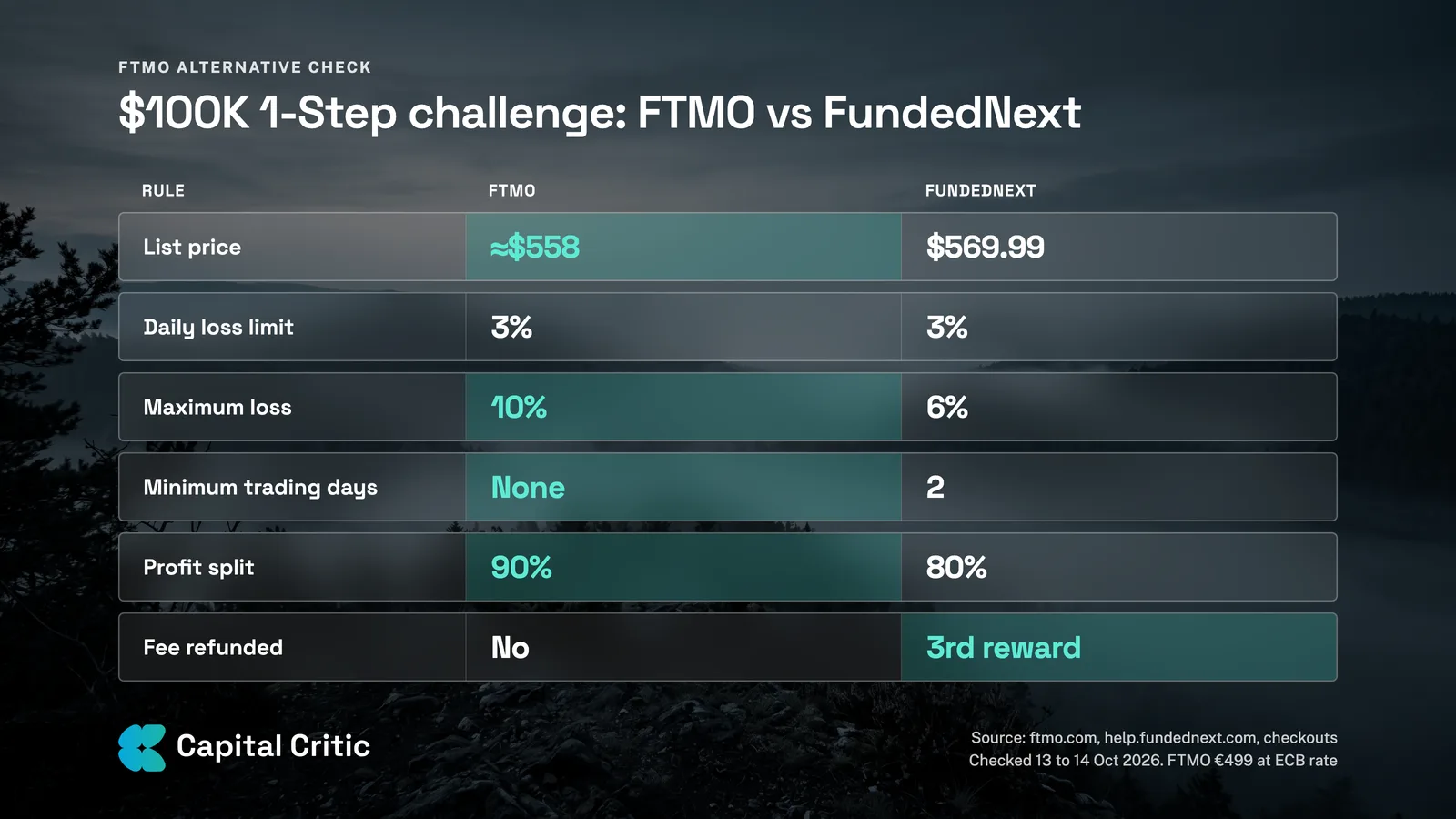
Source: ftmo.com, help.fundednext.com and both checkouts, 13 to 14 Oct 2026.
On the 2-Step, the two firms are closer than their marketing suggests; the real differences sit in the 1-Step and in the small print of each rule set.
2-Step: lower targets at FundedNext, fewer days at FTMO
Both 2-Step challenges allow a 5% daily loss and a 10% static maximum loss, so on a $100K account you can never fall below $90,000. FundedNext asks for 8% in Phase 1 and 5% in Phase 2. FTMO asks for 10% and 5%, which means $2,000 more profit before you reach verification. FTMO needs at least 4 trading days per phase, FundedNext 5. Neither firm sets a time limit. Every FundedNext rule, price and payout option is covered in our FundedNext Stellar 2-Step guide.
1-Step: FTMO gives more room, FundedNext refunds the fee
| $100K 1-Step | FTMO 1-Step | FundedNext Stellar 1-Step |
|---|---|---|
| Price | €499 list (about $558); €399 shown on 14 Oct | $569.99 ($530.09 with CRITIC) |
| Profit target | 10% | 10% |
| Daily loss limit | 3% | 3% |
| Maximum loss | 10%, end-of-day trailing | 6% |
| Minimum trading days | None | 2 |
| Profit split | 90% from the first reward | 80%, 90% after scale-up |
| Fee refund | No | Yes, with the third reward |
| Payout cycle | From day 14 after the first funded trade | Every 5 business days |
FTMO's 1-Step allows 10% of total loss against FundedNext's 6%, but FTMO's limit trails the highest end-of-day balance, so it moves up as you make money. FTMO also applies a consistency rule to the 1-Step: since 12 October 2026, new orders must keep the best day at or below 50% of total profit before passing or taking a reward. Missing it is not a breach; you keep trading until the ratio is met.
News trading
FTMO blocks order execution 2 minutes before and after selected news releases on funded accounts, apart from Swing accounts; challenges are not restricted. FundedNext counts only 40% of the profit from trades placed within 5 minutes of a high-impact release on a correlated pair. Neither rule bans news trading outright, but both cut what a news scalper keeps.
What does each firm charge, and do you get the fee back?
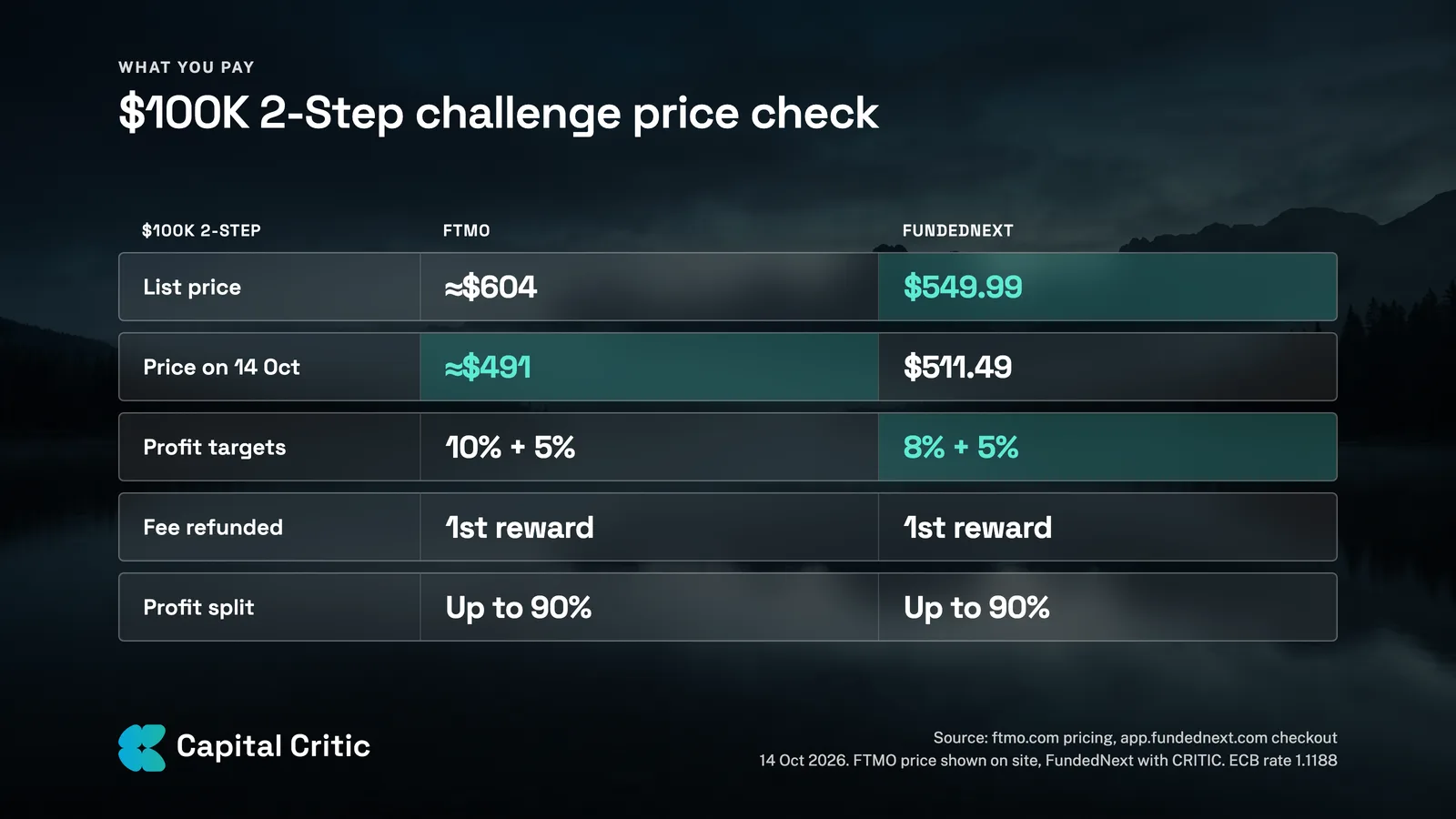
Source: ftmo.com pricing and app.fundednext.com checkout, 14 Oct 2026.
FundedNext is cheaper at list price at almost every size; the exceptions are FTMO's $100K 1-Step and the price cuts FTMO ran on its own site. The tables use each firm's checkout price, with no add-ons.
| 2-Step size | FTMO | FundedNext list | FundedNext with CRITIC |
|---|---|---|---|
| $25,000 | €250 (about $280) | $199.99 | $185.99 |
| $50,000 | €345 (about $386) | $299.99 | $278.99 |
| $100,000 | €540 (about $604); €439 shown on 14 Oct | $549.99 | $511.49 |
| $200,000 | €1,080 (about $1,208) | $1,099.99 | $1,022.99 |
| 1-Step size | FTMO | FundedNext list | FundedNext with CRITIC |
|---|---|---|---|
| $25,000 | €199 (about $223) | $219.99 | $204.59 |
| $50,000 | €319 (about $357) | $329.99 | $306.89 |
| $100,000 | €499 (about $558); €399 shown on 14 Oct | $569.99 | $530.09 |
| $200,000 | €999 (about $1,118) | $1,099.99 | $1,022.99 |
The only size where FTMO's list price undercuts FundedNext is the $100K 1-Step (about $558 against $569.99), and CRITIC reverses that at $530.09. FTMO's own price cuts on 14 October (€439 for the 2-Step and €399 for the 1-Step at $100K) made FTMO the cheaper firm at that size for both models. FTMO also sells a $10K size (€89 for the 2-Step, €79 for the 1-Step); FundedNext's 2-Step and 1-Step start at $6K, then $15K.
Refunds
FTMO refunds 100% of the 2-Step fee with your first reward and refunds nothing on the 1-Step or the Instant Account. FundedNext refunds the 2-Step fee with the first reward, the 1-Step and Lite fees with the third reward, and nothing on Stellar Instant. FundedNext also pays a 15% reward on the challenge profit target for 1-Step and 2-Step accounts once you reach its Pro scale-up; US traders are excluded from that reward.
Discounts
Code CRITIC takes 7% off FundedNext CFD challenges at checkout. It matches FundedNext's best available offer rather than stacking on top of it. FTMO does not use discount codes; see our FTMO offers page for what is current, and the guide to FTMO discount codes for why the codes you see elsewhere do not work.
How do payouts and scaling work at FundedNext and FTMO?

Payout timing is where the two firms differ most: fixed short cycles at FundedNext, a 14-day start at FTMO.
FundedNext pays on fixed short cycles and processes requests within 24 hours of approval; FTMO opens the first reward on day 14 and usually pays within a few business days.
FTMO
An FTMO Trader can request a reward from the 14th day after the first trade on the funded account. FTMO reviews the request within 1 to 2 business days and usually sends the money within 1 to 2 business days after the invoice is approved. Methods are bank wire, Visa Direct or Mastercard Send (up to $20,000), Skrill (up to $3,000) and crypto, with no FTMO fee. FTMO states it has paid more than $650 million in rewards since 2015; that is the firm's own figure.
FundedNext
The cycle depends on the model. The Stellar 2-Step runs a 21-day first cycle and 14-day cycles after that, or 14 days from the start with the paid Bi-Weekly add-on. The 1-Step pays every 5 business days and Stellar Lite every 10 business days. FundedNext's help centre says reward requests are processed within 24 hours of approval, and its checkout advertises a 24-hour guaranteed payout.
What the on-chain data shows
FundedNext made $14,330,940 in payouts across 9,051 transfers in the 30 days to 14 October 2026, according to our FundedNext payout tracker. That figure covers the whole company (CFD and futures) and is a verified on-chain floor, not complete payout volume: payouts sent by bank wire, card or PayPal leave no public trace and are not counted. FTMO is not on the tracker, so we have no independent figure for it.
Scaling
FTMO's Scaling Plan (2-Step only) adds 25% to the account every 4 months, up to $2,000,000 across all your FTMO Accounts. You need 4 months as an FTMO Trader, at least 10% net profit over that period, 2 processed rewards and a positive balance. FTMO also caps total allocation at $400,000 per trader before scaling. FundedNext Pro adds 25% per qualifying cycle up to $4,000,000 after 4 rewards with at least 4% growth in each qualifying cycle and 2 months of activity, and raises the split to 90%. Stellar Lite accounts are not eligible.
Is FundedNext a better FTMO alternative for futures traders?

FTMO Futures and FundedNext Futures both trade CME products in a simulated environment.
Not by default: both firms now sell futures evaluations, and the choice comes down to billing and payout rules. FTMO Futures went live in beta at the end of August and launched officially on 17 September 2026, according to Finance Magnates and FTMO's own press release.
| $50K futures account | FTMO Futures Growth | FTMO Futures Pro | FundedNext Rapid Daily | FundedNext Direct |
|---|---|---|---|---|
| Price | $119 per month | $139 per month | $299.98 one-time ($169.99 with CRITIC) | $283.99 one-time ($169.99 with CRITIC) |
| Evaluation | $3,000 target | $3,000 target | $3,000 target | None, funded from day one |
| Maximum drawdown (end-of-day trailing) | $2,000 | $3,000 | $2,000 | $2,000 |
| Daily loss limit | None in evaluation; $1,000 soft limit when funded | $1,000 | $1,000 | $1,000 |
| Consistency rule | 40%, evaluation only | 50%, evaluation only | None | 20%, permanent |
| Payout condition | 4 days of $150 or more | 5 days of $200 or more | End-of-day balance at $52,100 | $2,100 buffer plus the 20% rule |
| Payout cap | $2,500, up to 50% of profit | $5,000, up to 100% of profit | $1,200 | $1,200 |
| Profit split | 90% | 90% | 90% | 90% |
FTMO keeps charging the monthly fee until you pass, while FundedNext charges once. A trader who needs three months to pass a $50K evaluation would pay $357 for FTMO Growth against $169.99 for FundedNext Rapid Daily with CRITIC. FTMO's case is the higher payout caps on the Pro plan and no consistency rule once funded. FundedNext also sells Flex ($50K at $141.99, or $74.99 with CRITIC) and Rapid Pro; the full breakdown is in our FundedNext Futures account types guide. CRITIC takes 47% off FundedNext Futures; there is no code for FTMO Futures.
Instant and Lite accounts: cheaper or faster ways in
FTMO's new Instant Account skips the evaluation at a high price; FundedNext covers both ends with a cheap Lite challenge and a small Instant account.
| Account | FTMO Instant | FundedNext Stellar Instant | FundedNext Stellar Lite |
|---|---|---|---|
| Sizes | $5K to $100K | $2K to $20K | $5K to $200K |
| Price example | €339 for $10K (about $379) | $299.99 for $10K ($278.99 with CRITIC) | $399.99 for $100K ($371.99 with CRITIC) |
| Evaluation | None | None | 2 phases, 8% then 4% |
| Daily loss limit | 3% | None | 4% |
| Maximum loss | 10%, trailing the closed balance | 6%, trailing | 8% |
| Consistency rule | 30% for rewards | None | None in the model rules |
| Profit split | 90% | 70%, 80% from tier 3 | 80% |
| Fee refund | No | No | With the third reward |
At $10K, FundedNext's Instant account is cheaper ($299.99 against about $379). FTMO's goes much larger, up to $100K for €2,999 (about $3,355), but allows only one active Instant account per trader, and its maximum loss does not reset after a reward. FundedNext Stellar Instant is capped at $20K but scales up to 10 times the starting balance and then to $2,000,000. Stellar Lite is the cheapest route to a $100K evaluation at either firm: $399.99 list, against €540 for FTMO's 2-Step. FundedNext cut Lite's minimum trading days from 5 to 2 per phase for accounts bought from 12 October 2026 on the standard 10-day payout option, though its checkout card still showed 5 days on 13 October.
A note on risk: both firms run simulated accounts, most traders do not pass an evaluation, and a fee is only refunded after you earn a reward. Treat the fee as money you can afford to lose.
Verdict
FundedNext is a real FTMO alternative, not a cheaper copy. It wins on choice and cost flexibility: lower 2-Step targets, a $399.99 Lite route to $100K, one-time futures fees, short payout cycles and a $4 million scaling ceiling. It also refunds the 1-Step fee, which FTMO does not. FTMO wins on room and simplicity: its 1-Step allows a 10% loss with no minimum days and pays 90% from the first reward, its 2-Step fee comes back in full, and its own price cuts can undercut FundedNext at $100K. If you trade futures and want to pay once, or want the cheapest way into a $100K evaluation, start with FundedNext and use CRITIC. If you want one large 1-Step account with the most loss room, FTMO is the stronger pick. For a rule-by-rule view, see our FTMO vs FundedNext comparison and the reviews of FTMO and FundedNext.
Frequently Asked Questions
Is FundedNext cheaper than FTMO?
At list price, yes at almost every size: the $100K 2-Step is $549.99 against about $604. The exception is the $100K 1-Step, where FTMO lists about $558 against $569.99 (or $530.09 with code CRITIC). FTMO's own price cuts, €439 and €399 at $100K on 14 October 2026, made FTMO cheaper at that size that day.
Which pays out faster, FundedNext or FTMO?
FundedNext's 1-Step pays every 5 business days and its requests are processed within 24 hours of approval. FTMO opens the first reward on day 14 after the first funded trade and usually pays within 1 to 2 business days after approving the invoice.
Does FTMO offer futures now?
Yes. FTMO Futures launched in September 2026 with Growth and Pro plans at $119 to $269 per month and a 90% profit split. FundedNext Futures charges one-time fees instead.
Is there an FTMO discount code?
No. FTMO does not use discount codes; it runs its own time-limited price cuts on its site. Code CRITIC applies to FundedNext only: 7% off CFD challenges and 47% off futures accounts.
Which firm has better scaling?
FundedNext's ceiling is higher at $4,000,000 against FTMO's $2,000,000, and both add 25% per step. FTMO scales every 4 months on 2-Step accounts; FundedNext scales after 4 qualifying rewards with at least 4% growth each.