
Alpha Futures sued NinjaTrader Group LLC and Tradovate LLC in federal court on 24 July 2026, bringing four claims: misappropriation of trade secrets, defamation, tortious interference and conversion. The complaint alleges Tradovate took Alpha's client lists and used them to solicit its traders, and that it cut off platform access days after promising a 90-day orderly transition.
When we covered the Alpha Futures–NinjaTrader split and the payout U-turn in July, we closed with a warning: this story wasn't over. It isn't. Twelve days after traders woke up to dead platforms, Alpha Futures took the dispute to federal court.
Alpha Futures, Limited filed suit in the United States District Court for the Northern District of Illinois (Case No. 1:26-cv-08846). The complaint doesn't just relitigate the billing dispute we covered last month — it accuses Tradovate of misappropriating Alpha's client lists, defaming the firm, and pulling the plug on trader accounts after promising an orderly wind-down. The complaint can be read in full through PACER, the federal judiciary's public records system.
Here's what's in it, what each side has said, and what it means for the traders still caught in the middle.
Editor's note: This article summarises allegations made in a civil complaint filed by Alpha Futures on 24 July 2026. A complaint sets out one party's claims — it is not a finding of fact, and none of these allegations has been tested or proven in court. NinjaTrader and Tradovate had not filed a response at the time of writing; their stated position is that the termination was contractually justified. We report what the public filing says and will update this article as the docket develops. Nothing here is legal or financial advice.
Quick Recap: How We Got Here
If you're new to this story, our original coverage has the full timeline. The short version:
- 9 July 2026 — NinjaTrader/Tradovate sends Alpha Futures a termination letter.
- 12 July 2026 — Alpha announces the split publicly; traders lose access to NinjaTrader and Tradovate, and the Premium plan is shut down.
- Mid-July — Alpha initially refuses to honour approved Premium payouts, then reverses course after industry backlash and commits to paying them in instalments.
- 24 July 2026 — Alpha files its federal complaint.
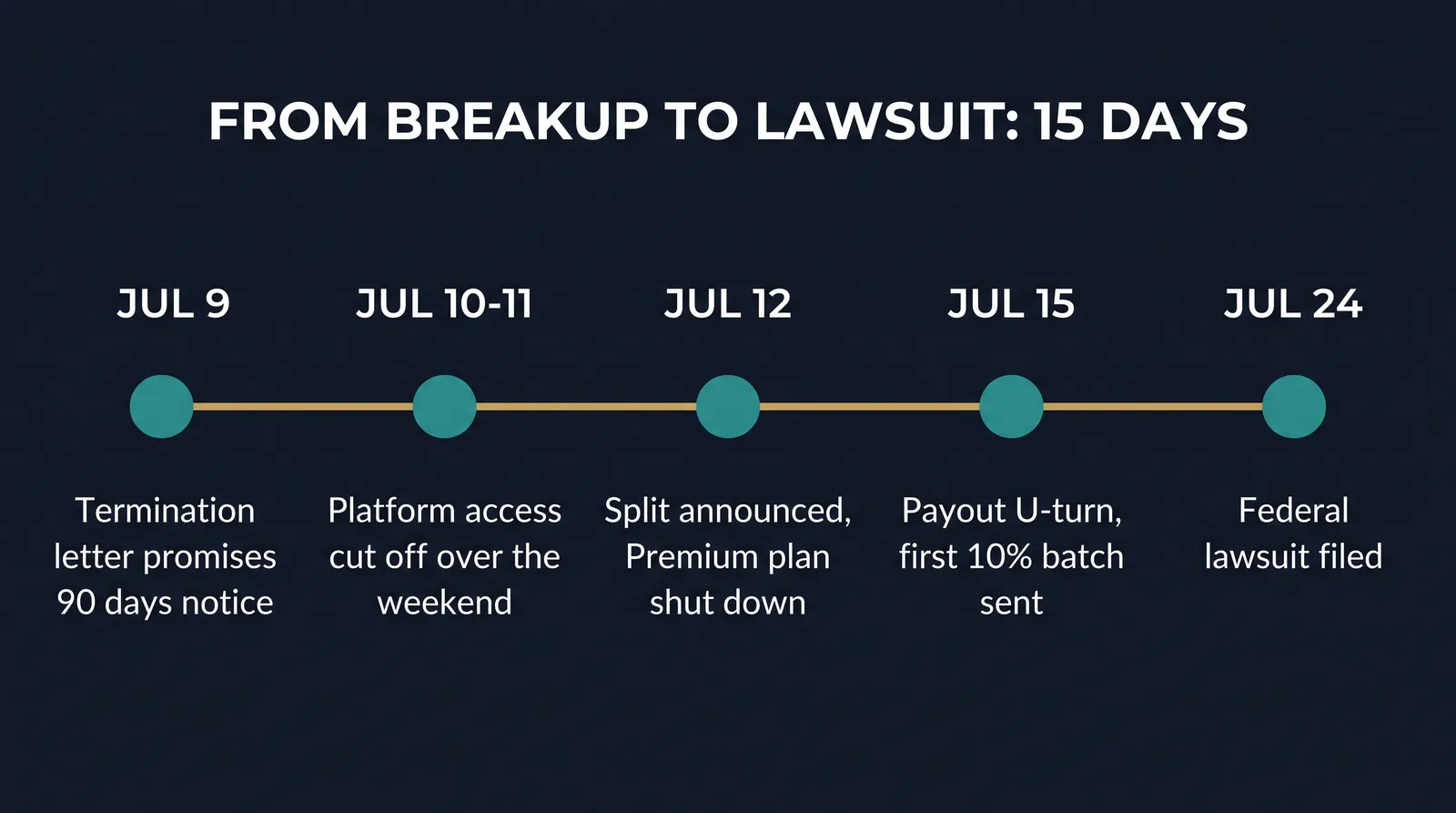
The public dispute always centred on a contested balance of roughly $225,700. NinjaTrader said Alpha was in arrears; Alpha said the figure was a leftover credit from an earlier billing dispute. The lawsuit now puts that disagreement — and much more — in front of a judge.
The Four Claims Alpha Is Bringing
The complaint asserts four causes of action against NinjaTrader Group and Tradovate:
- Misappropriation of trade secrets under the Illinois Trade Secrets Act
- Defamation and defamation per se
- Tortious interference with contract and prospective economic advantage
- Conversion
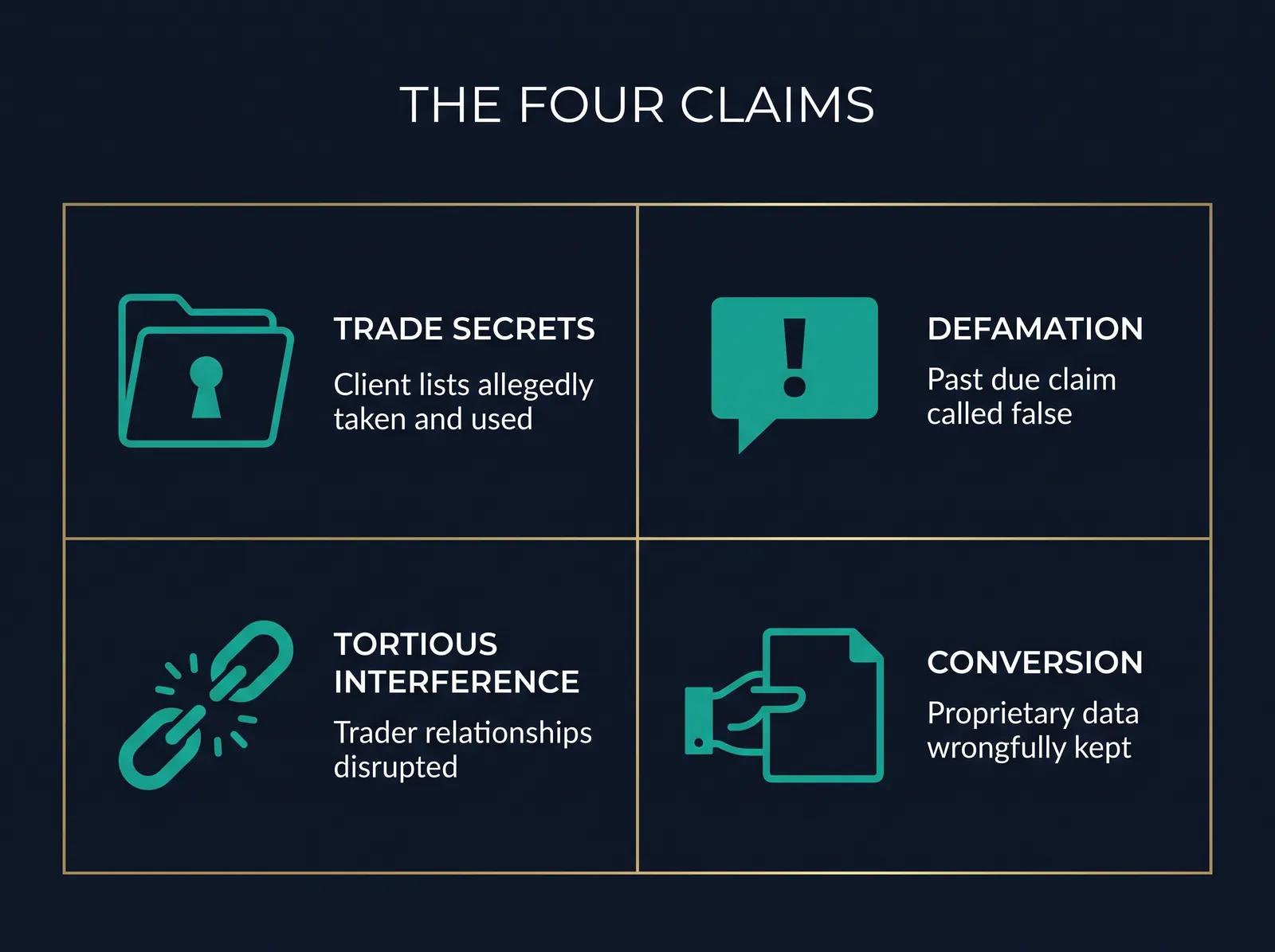
That's a notably aggressive package. This isn't a contract lawsuit about who owes whom $225,700 — Alpha is alleging that its former platform partner took its most valuable asset, its client base, and used it against them.
The trade secrets claim: "They took our client list"
The most explosive allegation in the complaint is that, immediately after cutting off access, Tradovate accessed Alpha's complete client lists and contact information — data Alpha says it only held as Alpha's service provider — and used it to solicit Alpha's traders by email and social media, steering them toward Tradovate-affiliated competitors.
If you traded with Alpha through Tradovate and received a solicitation email in mid-July, that is exactly the kind of contact the complaint points to. Worth keeping a copy, whatever the court ultimately makes of it.
The defamation claim: "More than three months past due"
Tradovate's public statement after the split said Alpha's outstanding balance was "more than three months past due." Alpha's complaint calls that false, alleging it was current on all undisputed amounts and that the $225,700 — which Alpha describes as just over one percent of everything it had paid Tradovate over the life of the relationship — was a disputed credit stemming from billing errors Alpha says it began identifying in November 2025. According to the complaint, that "prior balance" was raised for the first time in six months as the justification for termination. Alpha has separately said the underlying dispute involved roughly $2.4 million in alleged overcharges that was settled in early 2026.
Defamation per se is a meaningful escalation: it covers statements so damaging on their face — like accusing a business of not paying its bills — that harm is presumed.
The broken transition promise
Perhaps the most relatable allegation for traders: the complaint quotes Tradovate's 9 July termination letter as promising "90 days' notice of termination," an "orderly transition," and that Tradovate would "initially only suspend Alpha's ability to add new users."
Instead, per the complaint, Tradovate abruptly terminated all trading access over the weekend of 10–11 July, rendering customer accounts inoperable. Every trader who logged in that Saturday to find a dead platform experienced that gap between the letter and reality firsthand.
What Alpha Is Asking For
The complaint seeks:
- A temporary restraining order and injunction barring Tradovate from contacting Alpha's clients, disclosing confidential information, or making false statements
- Return or destruction of Alpha's client lists and proprietary data
- Compensatory damages (unspecified), plus exemplary/punitive damages
- Attorneys' fees and costs
The injunction request is the part with immediate real-world teeth. If granted, it would force Tradovate to stop any ongoing outreach to Alpha's trader base while the case proceeds.
The Other Side of the Ledger
A complaint is a set of allegations, not findings. NinjaTrader has not yet publicly responded to the lawsuit, and its answer — due in the coming weeks — will tell us how it intends to fight these claims. Its position to date has been consistent: Alpha breached the Evaluation Services Agreement by failing to pay an outstanding balance, and the termination was contractually justified.
There are also hard questions the litigation may force into the open that neither firm has fully answered. Why did the Premium plan — through which Alpha reportedly paid out over $25 million in roughly two months — depend so completely on a single platform provider? And discovery cuts both ways: Tradovate will get to probe Alpha's books just as Alpha probes Tradovate's termination decision.
What This Means for Traders
If you're owed a Premium payout: the lawsuit doesn't change Alpha's instalment commitment — those batch payments are a separate obligation Alpha made directly to traders. Keep documenting everything: approval emails, dashboard screenshots, payment receipts. Litigation timelines are long; your paper trail shouldn't depend on anyone's platform access.
If you received solicitation emails after the split: hold onto them. They're relevant evidence in the trade secrets claim, and they're also a data point about how your contact information moves between firms and platform providers.
For everyone else: this case is now the clearest window we're likely to get into how prop firm–platform relationships actually work — the contracts, the fee flows, the data ownership. Very little of that has ever been public. Discovery may change that.
Worth stating plainly: trading leveraged futures carries a risk of loss, and a firm's legal or platform troubles are a separate risk stacked on top of the market's. A strong payout history is evidence, not a guarantee — as the traders holding approved Premium payouts in July found out.
The Bigger Picture: Platform Risk Just Got a Case Number
Our original piece argued that the real story was concentration risk — too many firms and traders depending on the same few platforms. The lawsuit sharpens that argument. Whichever side prevails, the complaint documents a world where a platform provider could (allegedly) hold a firm's entire client list, flip off access over a weekend, and message those clients directly.
Until the industry answers the data-ownership question, the practical advice from our first article stands: diversify across platforms and firms, learn a backup platform, withdraw profits promptly, and run a due-diligence checklist before funding any account.
We'll keep tracking the docket and update both articles as the case develops. In the meantime, check our prop firm ratings, revisit the due-diligence checklist from our first article, and if you're choosing a new firm, start with the 2026 futures prop firm guide and compare verified on-chain payout data before you fund.
Frequently Asked Questions
Who is suing whom in the Alpha Futures–NinjaTrader dispute?
Alpha Futures, Limited (a UK company) is the plaintiff. The defendants are NinjaTrader Group LLC and Tradovate LLC. The case was filed on 24 July 2026 in the United States District Court for the Northern District of Illinois, Case No. 1:26-cv-08846.
Does the lawsuit affect my pending Alpha Futures payout?
Not directly. Alpha's commitment to pay approved Premium payouts in instalments is a separate obligation from the lawsuit, made directly to traders. Continue to monitor the batch payments and keep records of your approvals, dashboard screenshots and any partial payments received.
What is Alpha Futures accusing NinjaTrader and Tradovate of?
Four things: misappropriating Alpha's client lists (trade secrets), making false statements about Alpha's unpaid balance (defamation), interfering with Alpha's trader relationships (tortious interference), and wrongfully taking Alpha's proprietary data (conversion). All four are allegations that a court has yet to test.
Has NinjaTrader responded to the lawsuit?
Not publicly as of this writing. Its prior position is that Alpha breached their agreement over an unpaid balance and that the termination was contractually justified. Its formal answer is due in the coming weeks, and we'll update this article as filings come in.
How long will the case take?
Federal commercial litigation typically runs one to three years to trial. That said, the temporary restraining order and injunction request could produce a ruling within weeks, and disputes of this kind frequently settle before reaching a courtroom.