
Part three of our Alpha Futures–NinjaTrader coverage. Part one covered the platform split and the Premium payout U-turn. Part two covered Alpha's federal complaint. This one covers the other side of the ledger — NinjaTrader's response — plus the part of this story that has had the least attention: what the on-chain payout record has done since 12 July.
Editor's note: This article summarises a Defendants' opposition brief filed on 18 August 2026 (Dkt. 22) and the complaint filed by Alpha Futures on 24 July 2026. Both are one side's account. Nothing in either document has been tested, weighed or ruled on by the court, and a filing is not a finding of fact. We describe what each party has told the court and attribute every contested statement to the party making it. The payout figures below are drawn from publicly verifiable blockchain transactions and are presented as observed data on two specific payment rails — not as a measure of any firm's total payouts and not as a diagnosis of any firm's financial condition. Nothing here is legal, financial or investment advice.
Disclosure: Some links on this page are affiliate links to prop firms, including firms that compete with Alpha Futures. This never affects our ratings, our rankings, or the payout figures reported here, which come from public blockchain data. See our methodology.
Where We Left Off
The short version, for anyone joining at part three:
- 9 July 2026 — A termination notice is sent to Alpha Futures. Alpha's complaint says it was accompanied by a representation that Alpha would get 90 days' notice and an orderly transition.
- 12 July 2026 — Alpha announces the split publicly and closes the Premium plan. The date and cause of traders losing NinjaTrader and Tradovate access are disputed: Alpha's complaint places it on the weekend of 10–11 July and attributes it to Tradovate; NinjaTrader's brief places it on 13 July and attributes it to Alpha. More on this below.
- Mid-July — Alpha announces that approved Premium payouts will be issued as fee refunds, then reverses that position following trader criticism and states it will pay the approved payouts in batches. Part one has the detail.
- 24 July 2026 — Alpha files a federal complaint in the Northern District of Illinois (Case No. 1:26-cv-08846) alleging trade secret misappropriation, defamation, tortious interference and conversion.
- 18 August 2026 — Defendants file their opposition to Alpha's amended motion for a temporary restraining order and preliminary injunction.
The case is before Emergency Judge Jorge Alonso, District Judge John Robert Blakey and Magistrate Judge Heather K. McShain. The defendants are represented by Katten Muchin Rosenman LLP. The brief is docket entry 22, and the official record is available through PACER.
What Was Actually Filed
This is not yet an answer to the complaint. It is a narrower document: an opposition to Alpha's emergency request to have the court order NinjaTrader to stop contacting Alpha's traders while the case proceeds.
To win that order, Alpha has to clear a well-established bar — imminent irreparable harm, a likelihood of success on the merits, and a showing that money damages would not be enough. NinjaTrader's position, stated in its opening line, is that Alpha "fails to establish any of the three prerequisites."
Underneath that procedural argument, though, the brief does something more consequential: it puts NinjaTrader's version of the entire relationship on the public record for the first time.
"A single email, more than a month ago"
NinjaTrader's first argument is the simplest. Alpha's motion, it says, rests on one email sent in July 2026 — and past conduct, without evidence that it is continuing, cannot support an injunction against future conduct. The brief argues Alpha has not shown "a presently existing actual threat" of further contact.
The billing dispute, with numbers attached
Part two covered Alpha's account of the disputed $225,700: what Alpha describes as a leftover credit arising from billing errors it says it began identifying in November 2025, amounting to "just over one percent" of everything it had paid. NinjaTrader denies that any billing error occurred.
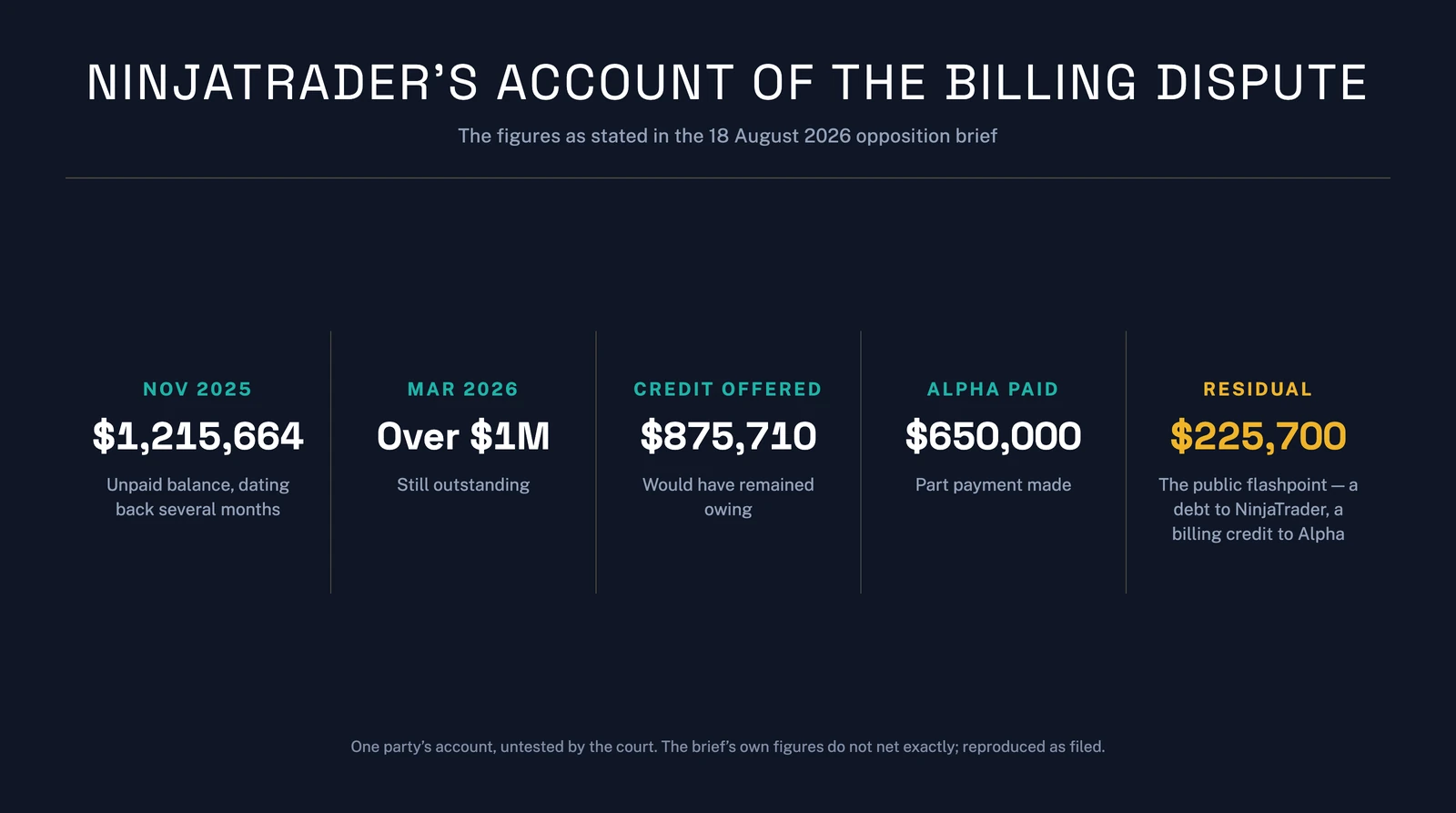
The opposition brief tells the story differently, and attaches figures to it:
- The brief states Alpha had a history of "sporadically paying invoices" dating back to 2025.
- The brief states that by November 2025, Alpha's unpaid balance dated back several months and totalled $1,215,664.05.
- The brief states that by March 2026, Alpha owed more than $1 million.
- The brief states NinjaTrader offered a credit that would have left $875,710 outstanding.
- The brief states Alpha then paid $650,000, leaving the $225,700 that became the public flashpoint. (The brief's own figures do not net exactly; we reproduce them as filed.)
- The brief states NinjaTrader sent a further demand letter on 15 June 2026 and repeated the demand at a meeting with Alpha in London that month.
On the substance of the overcharge claim, NinjaTrader's version is that the contract billed per user with access to the platform, while Alpha wanted to pay only for users who actually logged in. The brief says NinjaTrader told Alpha as far back as May 2025 that it could deactivate dormant users to reduce the bill, and that Alpha chose not to. Its characterisation is blunt: "Alpha did not want to pay the amounts it agreed to in the ESA."
The most aggressive claim: who turned off the platforms
This is the passage that will land hardest with traders, because it directly contradicts the sequence widely reported at the time.
NinjaTrader's brief says its termination letter gave Alpha 90 days and expressly allowed Alpha to keep adding new users if it paid the outstanding balance by 12 July 2026. It then alleges that on 13 July 2026, between 11:00 a.m. and 12:00 p.m. CT, Alpha itself terminated the access of nearly all of its NinjaTrader users.
The brief's framing: rather than pay and use the 90-day window, "Alpha terminated the users' access and then tried to falsely blame NinjaTrader." It also flags Alpha's 12 July social media post — the one telling users that, because of NinjaTrader's notice, Alpha could not issue new accounts from the 12th — and alleges that statement was untrue.
Alpha's complaint says the opposite: that Tradovate abruptly cut all trading access over the weekend of 10–11 July, rendering accounts inoperable, which Alpha says was contrary to an orderly transition it had been promised. These two accounts cannot both be accurate, and the court has not resolved which is. If you were trading with Alpha that weekend, your own login history and screenshots are now genuinely relevant evidence — keep them.
Whose customers are they?
The trade secrets claim gets the most detailed treatment in the brief, and NinjaTrader's answer is essentially that the client list was never exclusively Alpha's. According to the brief:
- 106,660 users subscribed to Alpha's services through NinjaTrader's platform at some point between January 2025 and July 2026. This is a cumulative figure, not a snapshot.
- 17,447 held an active Alpha subscription through the platform on 12 July 2026. The two figures measure different things and should not be read as a churn rate.
- NinjaTrader says it had an independent relationship with 50.3% of all users who subscribed to Alpha through its platform, and that 8,911 of the 17,447 active July users were NinjaTrader customers before they ever signed up with Alpha.
Layered on top: the brief states that every one of those users signed NinjaTrader's own End User License Agreement and privacy policy, which it says authorised NinjaTrader to collect their email address and communicate with them directly. NinjaTrader also argues Alpha submitted no evidence that its list was developed at significant expense or kept under tight security — the kind of showing Illinois courts look for before a customer list qualifies as a trade secret at all.
Truth as a defence
On defamation, NinjaTrader's argument is the oldest one there is: truth is an absolute defence. The brief says the statement that Alpha's balance was more than three months past due was accurate, and points to the $1M+ March balance and the $225,700 residual as the arithmetic. Alpha disputes that the $225,700 is owed at all, characterising it as a credit arising from billing errors.
The brief argues Alpha's objection to the invoices could, under the contract, delay NinjaTrader's right to suspend access — but, it argues, never erased the obligation to pay.
Preemption, unclean hands, and a footnote worth noticing
Three shorter arguments round it out. NinjaTrader says the tortious interference and conversion claims are preempted by the Illinois Trade Secrets Act, which absorbs non-contract claims built on the same alleged misappropriation. It says Alpha comes to court with unclean hands, alleging Alpha breached the agreement by launching and promoting AlphaTrader — a competing evaluation-services platform — without the contractual notice or written approval.
And in a footnote, easy to miss: the brief states that the parties' agreement requires mandatory, binding arbitration. NinjaTrader does not build its opposition around that point, but if it is invoked later, it could pull large parts of this dispute out of the public docket entirely — which would close the window into how these deals actually work that we flagged in part two.
Finally, on harm: NinjaTrader argues Alpha produced no affidavit and no financial record showing lost users, and that Alpha's reputational damage traces to trader reaction to Alpha's own payout decisions rather than to anything NinjaTrader did.
Alpha has not yet filed a reply to the opposition brief. We will cover it when it lands.
What the On-Chain Payout Data Shows
Here is where we can add something the filings cannot: a public, verifiable record of money actually moving to traders.
Capital Critic's payout tracker counts only payouts settled through RisePay/RiseUSD or a direct on-chain wallet transfer. Every figure below is a blockchain transaction anyone can check — and, just as importantly, anything settled by bank wire, card, another processor or an internal balance credit is invisible to us. We have always described this tracker as a verified floor rather than a complete picture, and that caveat does more work in this section than anywhere else we have used it.
Read as of 20 August 2026, Alpha Futures' payout page shows $31.3M paid across 14,699 payouts since 20 September 2024, at an all-time average of $2,127.
The recent trend is the interesting part. Before the numbers, the one thing that explains most of their shape: on Tuesday 11 August 2026, the tracker recorded $350,900 across 124 payouts — nearly half of the entire last-30-day total, in a single day, in a month where most other days show little activity on the two rails we track. That does not look like normal daily withdrawal flow. It looks like what Alpha said it would do: pay approved Premium payouts in batches. Which is, on the face of it, a firm keeping a commitment.
With that in mind:
| Window (to 20 Aug 2026) | Paid on-chain | Payouts | Approx. per day | Avg. payout |
|---|---|---|---|---|
| The 60 days before the last 30 | $11,155,421 | 4,909 | ~$185,900 | $2,272 |
| The last 30 days | $738,748 | 408 | ~$24,600 | $1,811 |
| Last 30 days, excluding 11 Aug | $387,848 | 284 | ~$13,400 (over 29 days) | $1,366 |
Derived from the tracker's 90-day total of $11,894,169 across 5,317 payouts and its 30-day total of $738,748 across 408 payouts. Note that the earlier window overlaps the Premium plan's peak, so it is an unusually high baseline — see the four explanations below.
That is roughly an 87% drop in daily on-chain payout volume between the two periods. Because nearly half the recent total arrived in that single 11 August batch, the day-to-day baseline outside it is lower still — around 93% below the earlier period — though excluding a scheduled batch is a way of isolating routine flow, not a measure of anything going wrong.
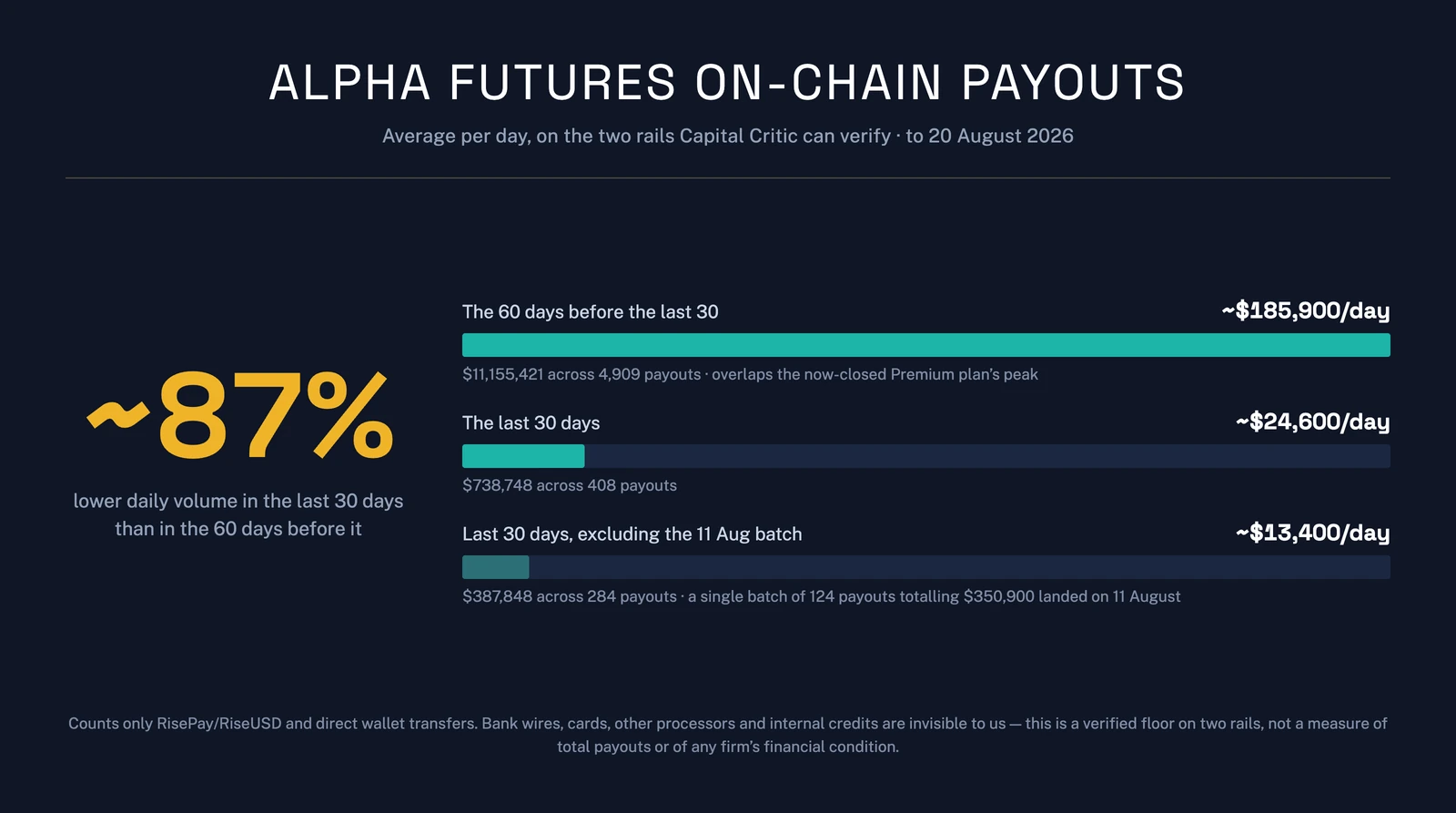
Every figure above comes from our own payout record for the firm, where each one resolves to a blockchain transaction anyone can check for themselves. What none of them can tell you is what settled off-chain.
Four honest explanations, and why we are not picking one
The temptation is to draw a straight line from the lawsuit to the chart. We are not going to, because at least four things changed at once on 12 July:
- The Premium plan closed. Alpha paid out more than $25M through Premium in roughly two months, on figures widely reported at the time. That product no longer exists. On its own, that would account for a large step down in payout volume regardless of any litigation — and it is why the 60-day comparison window above is an unusually high baseline.
- The trader base moved platforms. Users migrated from NinjaTrader and Tradovate to AlphaTrader. Fewer funded traders actively trading in a given week means fewer payout requests, independent of the firm's willingness or ability to pay.
- We only see two rails. The tracker captures RisePay/RiseUSD and direct wallet transfers. If Alpha has moved some or all payouts to bank wire, card, a different crypto processor, or internal balance credits, those payments are real and simply do not appear in our data.
- Litigation can be a distraction, which is not the same as a constraint. A firm fighting a federal case may have management attention and legal costs diverted. That is not evidence of anything about its ability to pay, and nothing in the public record establishes anything about Alpha's liquidity.
So the accurate statement is narrow, and we will keep it narrow: on the two rails we can verify, Alpha Futures' payout volume has been on a clear downtrend since the 12 July split, and unless the firm is settling payouts through methods we do not track, the on-chain picture has not recovered. The 11 August batch is the only meaningful exception in the last month, and it is consistent with the Premium instalments Alpha promised.
That is a description of data. It is not a claim that Alpha cannot pay, will not pay, or is in financial difficulty — we have no evidence of any of those things, and we are not suggesting them. If Alpha has moved to rails we cannot see, the honest answer is that our number understates reality, and we would say so the moment it can be verified. Our methodology page explains exactly what we count and why.
What This Means for Traders
If you have an approved payout outstanding at any firm: keeping records is standard practice regardless of the firm — approval emails, dashboard screenshots, transaction hashes, and confirmations of anything received. On-chain settlement has the incidental benefit of leaving a receipt that exists independently of any single provider's records. The 11 August batch is consistent with what Alpha said it would do.
If you traded through NinjaTrader in July: your own access logs are now contested territory. Two parties have told a federal court incompatible stories about who cut off whom, and on what day. Screenshots with timestamps are worth keeping.
If you are sizing a new account anywhere: this is the case for not judging a firm on a single headline number. A firm can have a genuinely strong multi-year payout record — Alpha's $31.3M across nearly 15,000 on-chain payouts is real — and still hit a stretch where the data looks nothing like it did three months earlier, for reasons that may have nothing to do with the firm's health. Look at the trend, the shape of the distribution, and what rails a firm actually uses. Our futures prop firm comparison and the 2026 futures prop firm guide are built for exactly that.
Worth stating plainly, again: trading leveraged futures carries a risk of loss. A firm's legal or platform troubles are a separate risk stacked on top of the market's, and a strong payout history is evidence, not a promise.
What Happens Next
Three things to watch:
- The TRO ruling. The judge now has both sides' papers on the injunction. This is the near-term decision, and it could come in weeks rather than years.
- The formal answer and any motion to dismiss. The opposition brief previews the defences — ITSA preemption, truth, unclean hands — but the formal response to the complaint is where they get filed properly.
- That arbitration footnote. If the mandatory arbitration clause is invoked, much of this dispute may leave the public docket.
We will keep tracking the docket and the payout data, and we will update all three articles as things develop. If the on-chain numbers turn back up, that will get a post too.
Frequently Asked Questions
What was filed in the Alpha Futures case on 18 August 2026?
A Defendants' opposition brief (Dkt. 22) in Alpha Futures, Limited v. NinjaTrader, LLC, et al., Case No. 1:26-cv-08846 in the U.S. District Court for the Northern District of Illinois. It asks the court to deny Alpha's amended motion for a temporary restraining order and preliminary injunction. It is not the formal answer to the complaint.
Does that filing mean Alpha Futures' claims were rejected?
No. An opposition brief is one party's argument. The court has not ruled on the injunction request, and none of the allegations on either side has been tested at trial.
Who does NinjaTrader say shut off trader access?
NinjaTrader's brief alleges that Alpha terminated access for nearly all of its NinjaTrader users on 13 July 2026, between 11:00 a.m. and 12:00 p.m. CT, and that its own termination letter had given Alpha 90 days. Alpha's complaint alleges the opposite — that Tradovate cut access abruptly over the weekend of 10–11 July. The court has not resolved the conflict.
What has Alpha Futures' on-chain payout volume done since 12 July 2026?
Capital Critic tracks only two payment rails — RisePay/RiseUSD and direct on-chain wallet transfers — so this is a partial view, not a measure of Alpha's total payouts or its financial position. On those rails, daily volume in the 30 days to 20 August 2026 ran roughly 87% below the preceding 60 days, with nearly half the 30-day total arriving in a single batch on 11 August. That earlier period also overlaps the now-closed Premium plan's peak, so it is an unusually high baseline. Payouts settled by bank wire, card or other processors would not appear in our data.
What does the on-chain record show about recent Alpha Futures payouts?
Payouts are still settling on the rails we track, including a batch of 124 payouts totalling $350,900 on 11 August 2026 and individual payouts within the last day at the time of writing. We report what is verifiable on-chain and make no claim about payments settled through channels we cannot see.
Could this case end up in arbitration?
A footnote in the opposition brief states that the parties' Evaluation Services Agreement requires mandatory, binding arbitration. No motion to compel arbitration has been filed in this brief, but if one is filed later, significant parts of the dispute could move out of open court.