
Part four of our Alpha Futures–NinjaTrader coverage. Part one: the platform split and the Premium payout U-turn. Part two: Alpha's federal complaint. Part three: NinjaTrader's opposition brief and the on-chain payout trend. This one is the first time a judge has actually said something.
Editor's note: This article reports a minute entry made by the court on 20 August 2026 (Dkt. 25) and a related referral order the same day (Dkt. 26) in Alpha Futures, Limited v. NinjaTrader, LLC, et al., No. 1:26-cv-08846 (N.D. Ill.). Court orders are public records and we report them as written. A ruling on a preliminary injunction is a decision about emergency relief on a preliminary record — it is expressly not a final ruling on the merits, it does not dispose of any claim, and it does not resolve the parties' competing factual accounts. Allegations in the underlying pleadings remain untested. Nothing here is legal, financial or investment advice.
Disclosure: Some links on this page are affiliate links to prop firms, including firms that compete with Alpha Futures. This never affects our ratings, our rankings, or the payout figures reported here, which come from public blockchain data. See our methodology.
What the Court Decided on 20 August
A motion hearing was held before District Judge John Robert Blakey on 20 August 2026. The result is a minute entry — the court's own docketed record of what happened at a hearing. It is a binding order, but it is brief by design, and a judge may issue a fuller written opinion later. We quote it as written.
It does three separate things.
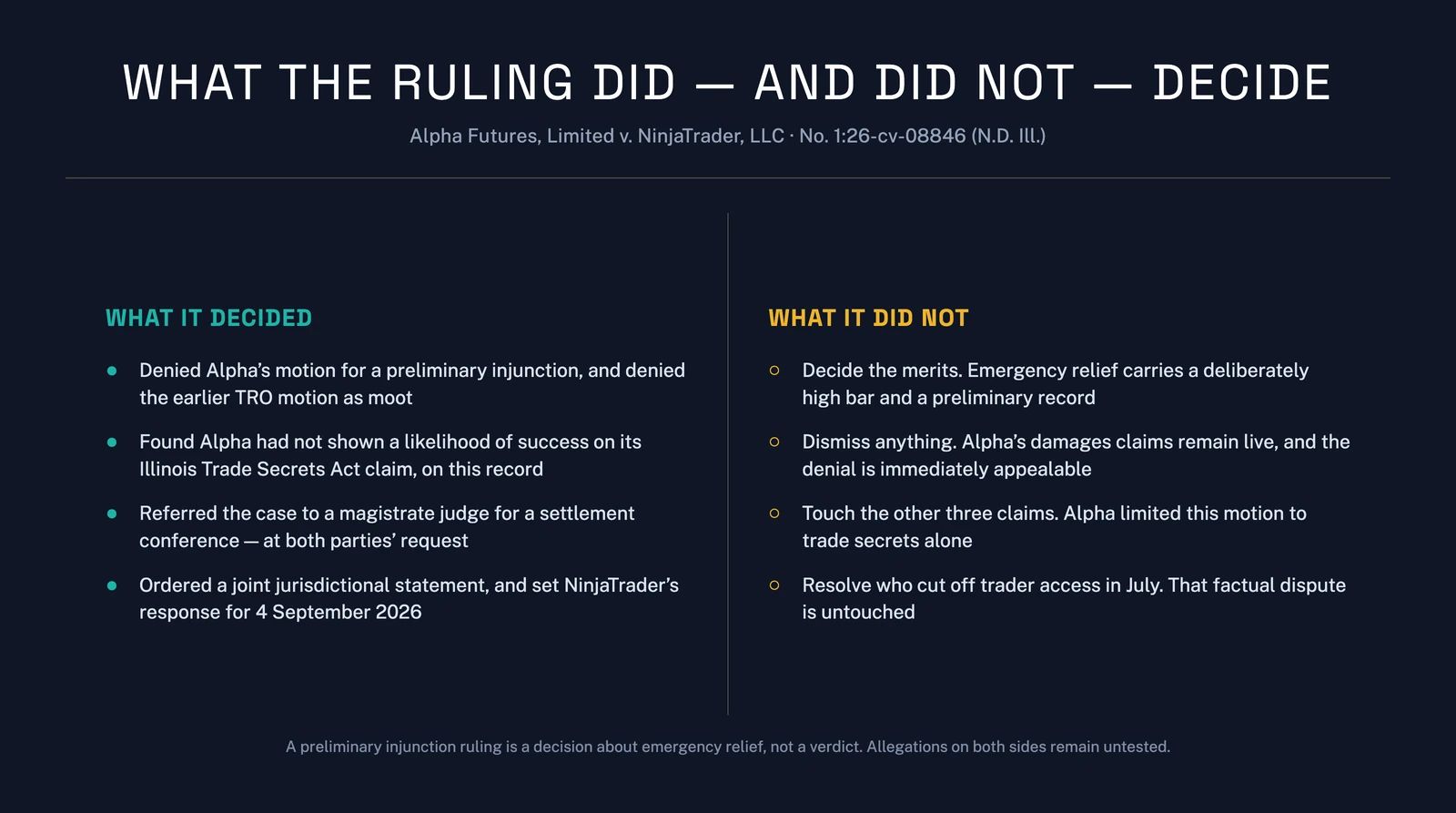
The injunction is denied. The court denied Alpha's motion for a preliminary injunction (Dkt. 15) and denied its earlier TRO motion (Dkt. 5) as moot — meaning that motion no longer required a decision once the preliminary-injunction request was resolved, not that the court rejected it on its substance.
The order sets out the bar. A preliminary injunction is "an extraordinary remedy that may only be awarded upon a clear showing that the plaintiff is entitled to such relief," citing Winter v. Natural Resources Defense Council, Inc., 555 U.S. 7, 22 (2008). In the Seventh Circuit a movant must first clear a threshold — a likelihood of success on the merits, no adequate remedy at law, and irreparable harm if the injunction is not granted (Lambert v. Buss, 498 F.3d 446, 451 (7th Cir. 2007)). Only if that threshold is met does a court go on to balance the harms and weigh the public interest. Here the court did not get past the threshold.
Alpha's request covered only one of its four claims. This is the detail most coverage will skip, and it matters. The order records that Alpha "emphasized in court and in its briefs that it seeks limited injunctive relief at this time, solely as to its Illinois Trade Secrets Act (ITSA) claim." The defamation, tortious interference and conversion claims were not before the court on this motion. Alpha sought emergency relief on trade secrets alone.
The case is going to a settlement conference. In a separate order the same day (Dkt. 26), Judge Blakey referred the case to Magistrate Judge Heather K. McShain under Local Rule 72.1 for the purpose of holding a settlement conference. The order records that the referral was made at the parties' request.
What This Ruling Does Not Decide
Worth putting this before anything else, because "judge denies injunction" will be flattened into "Alpha loses" within about six hours of hitting X.
- It is not a merits ruling. A preliminary injunction is emergency relief with a high bar, decided on a preliminary record. Failing to clear it at this stage does not dispose of the claim.
- The denial is not the last word on the injunction, either. A denial of a preliminary injunction is immediately appealable to the Seventh Circuit under 28 U.S.C. § 1292(a)(1), and a party can renew the request later on a fuller evidentiary record.
- Alpha's damages claims remain live. The order refuses extraordinary relief; it does not dismiss anything.
- The other three claims were not in front of the court. Defamation, tortious interference and conversion were outside this motion because Alpha limited it to ITSA.
- Nothing has been decided about who cut off trader access. That factual dispute — Alpha says Tradovate cut access over the weekend of 10–11 July; NinjaTrader says Alpha terminated its own users' access on 13 July — is untouched by this order.
- NinjaTrader still has to answer. The order directs the defendant to respond to the amended complaint (Dkt. 13) by 4 September 2026.
Why the Trade Secrets Claim Did Not Clear the Injunction Bar
The order sets out the standard: to prevail on an ITSA claim, a plaintiff must show the information at issue was secret, that it was misappropriated, and that it was used in the defendant's business. For a customer list specifically, Illinois law (765 ILCS 1065/2(d)) requires that it be "sufficiently secret to derive economic value, actual or potential, from not being generally known to other persons who can obtain economic value from its disclosure or use," and that it be "the subject of efforts that are reasonable under the circumstances to maintain its secrecy or confidentiality."
The court then identifies two concessions it says Alpha made, and this is the load-bearing passage of the whole order. As the order puts it: Alpha "concedes that Defendant properly had access to customer information through Defendant's own end user agreements, indicating that, in fact, the information does not constitute a trade secret." And Alpha "also concedes that nothing in the parties' ESA precluded Defendant from talking to platform users or using customer information, undermining any claim of misappropriation."
On that basis the court found Alpha "failed to meet its burden of demonstrating a likelihood of success on its ITSA claim and is thus not entitled to the extraordinary relief it seeks."
Those are the court's characterisations of Alpha's position, made on a preliminary record for the purpose of an emergency motion — not findings after evidence.
If you read part three, the reasoning will look familiar. It tracks the argument NinjaTrader made in its 18 August opposition brief: that every user signed NinjaTrader's own end user licence agreement and privacy policy, that those agreements let NinjaTrader contact its own users, and that where a contract defines the duty of confidentiality, the contract is the measure of it. The court's stated reasoning follows that line closely — at least for the limited purpose of the injunction ruling.
The Routine Jurisdiction Check — and Why It Is Still Worth Watching
The same minute entry contains a piece of case management that is easy to skip.
The court directed the parties to meet and confer and file, by 24 August 2026, a joint jurisdictional statement providing the specific facts necessary to support the existence of diversity jurisdiction. It cites Wise v. Wachovia Securities, LLC, 450 F.3d 265, 267 (7th Cir. 2006) and Belleville Catering Co. v. Champaign Market Place, L.L.C., 350 F.3d 691, 692 (7th Cir. 2003) for a rule that commercial filings get wrong constantly: the citizenship of a limited liability company is the citizenship of each of its members — not the state where it was organised, not its principal place of business, and traced through every layer of ownership.
Orders like this are routine in this district, precisely because the point is so often botched, and the usual outcome is simply a fuller jurisdictional filing and the case carries on. But it is worth watching. Alpha is a UK company, so the case rests on the alienage limb of federal jurisdiction (28 U.S.C. § 1332(a)(2)), and if the membership of a defendant LLC turns out to defeat complete diversity, the court would lack subject-matter jurisdiction. Subject-matter jurisdiction can be raised at any point, by any party or by the court itself, and cannot be waived by agreement.
If it did fail, the dispute would not disappear — the case would be dismissed without prejudice and would have to be pursued somewhere else, most obviously state court or, given the clause below, arbitration.
Which brings up the detail we flagged in part three: a footnote in NinjaTrader's brief stating that the parties' Evaluation Services Agreement requires mandatory, binding arbitration. No motion to compel arbitration has been filed. But between a settlement conference, a jurisdictional statement still to be filed, and an unexercised arbitration clause, there are several ordinary routes by which this case could stop generating public documents.
That is our read, not a forecast, and there is nothing improper about any of it — settlement referrals on the parties' joint request are standard case management, they do not stay discovery, and cases routinely continue through all three. But traders hoping this litigation would drag prop firm–platform economics into the open through discovery should hold that expectation loosely. A case that settles never reaches disclosure.
The Payout Data, Updated
We started tracking this in part three because the question kept coming up: has any of this affected what Alpha actually pays traders? Here is the on-chain payout record re-read on 22 August 2026, two days after the ruling.
The same caveat governs everything below, and it is not boilerplate: our tracker counts only payouts settled through RisePay/RiseUSD or a direct on-chain wallet transfer. Bank wires, card payments, other processors and internal balance credits are invisible to us. This is a verified floor on two rails — not a measure of Alpha's total payouts, and not an indication of its financial position.
All-time, the tracker shows $31.3M across 14,746 payouts since 20 September 2024, at an average of $2,126.
| Window (to 22 Aug 2026) | Paid on-chain | Payouts | Approx. per day | Avg. payout |
|---|---|---|---|---|
| The 60 days before the last 30 | $10,975,007 | 4,921 | ~$182,900 | $2,230 |
| The last 30 days | $788,782 | 428 | ~$26,300 | $1,843 |
| Last 30 days, excluding 11 Aug | $437,882 | 304 | ~$15,100 (over 29 days) | $1,440 |
Derived from the tracker's 90-day total of $11,763,789 across 5,349 payouts and its 30-day total of $788,782 across 428 payouts. These are rolling windows: between readings the earlier window sheds high-value Premium-era days and picks up recent lower-value ones, so its total can fall even as its payout count rises. That earlier window also overlaps the now-closed Premium plan's peak, making it an unusually high baseline.
Three observations, and no more than three:
- The trend has not turned. Daily on-chain volume is running roughly 86% below the earlier window — essentially unchanged from the ~87% we reported on 20 August.
- The 11 August batch still dominates. That single day — 124 payouts totalling $350,900 — accounts for just under 45% of the entire 30-day total. Take it out and routine daily flow is around $15,100.
- Payouts are still settling. Between our 20 August and 22 August readings, the tracker's all-time count rose by 47 payouts, from 14,699 to 14,746. We quote the count rather than a dollar figure because the 30-day and 90-day totals are rolling windows — the change between two readings nets new payouts against older ones dropping off the back, so it is not a measure of what settled in between. The tracker also recorded activity within the day before we checked.
We said in part three that we would not draw a straight line from the litigation to the chart, and the ruling does not change that. We set out four alternative explanations in part three — the Premium plan closing, Alpha's trader base moving to AlphaTrader where Alpha has said publicly its users were directed, payouts possibly moving to rails we cannot see, and litigation as a distraction rather than a constraint — and none of them has been ruled out.
What we can say, narrowly: on the two rails we can verify, the downtrend that began after 12 July has not reversed, and the ruling has not visibly changed it in either direction. That is a description of data. It is not a claim that Alpha cannot pay, will not pay, or is in financial difficulty — we have no evidence of any of those things and we are not suggesting them.
What This Means for Traders
Nothing about your payout changed on 20 August. The injunction Alpha sought was about stopping NinjaTrader contacting Alpha's traders. It was never about trader payouts, and its denial does not alter Alpha's stated commitment to pay approved Premium payouts in batches.
On the contact question, the court's summary points one way — provisionally. The order records what it describes as Alpha's own concessions: that NinjaTrader had access to customer information through its end user agreements, and that nothing in the parties' ESA barred it from contacting platform users. That is the court's characterisation on a preliminary record, and Alpha's claims on this point have not been finally decided. Practically: a marketing email from a platform you signed up to is not, by itself, evidence of anything.
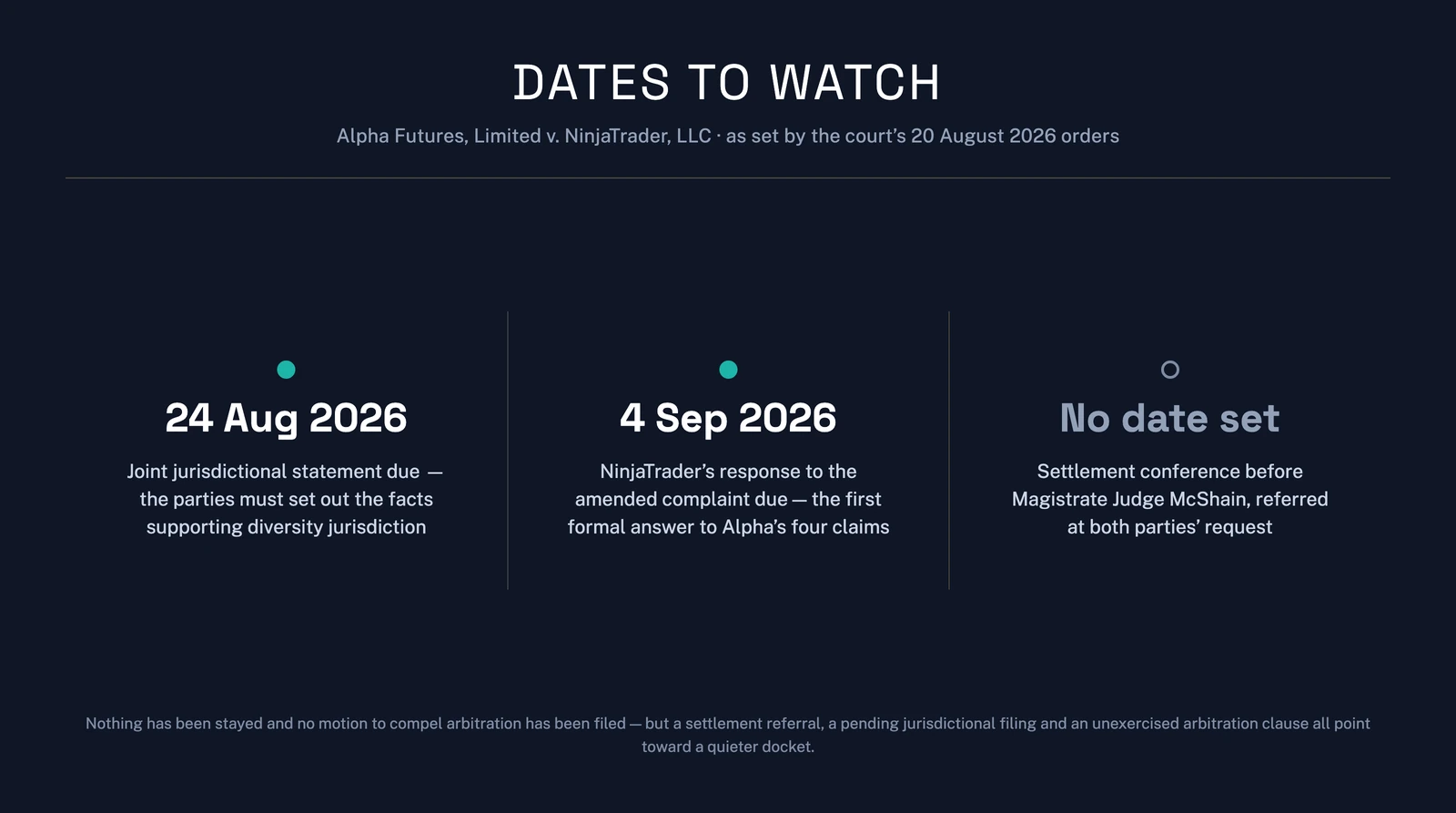
Expect fewer public documents from here — but do not assume the story is over. Settlement talks, a jurisdictional filing and an unexercised arbitration clause all point toward a quieter docket. Equally, nothing has been stayed, no motion to compel arbitration has been filed, and NinjaTrader's answer is still due.
And the durable lesson is still the boring one. Both halves of this story — the platform split and the payout chart — come back to concentration. One platform provider, one payout rail, one firm. Our futures prop firm comparison and the 2026 futures prop firm guide exist so that spreading across a few is less work than it sounds.
Worth stating plainly, again: trading leveraged futures carries a risk of loss. A firm's legal or platform troubles are a separate risk stacked on top of the market's, and a strong payout history is evidence, not a promise.
Dates to Watch
- 24 August 2026 — joint jurisdictional statement due.
- 4 September 2026 — NinjaTrader's response to the amended complaint due.
- No date set — the settlement conference before Magistrate Judge McShain.
We will keep tracking the docket and the payout data and update all four articles as things develop.
Frequently Asked Questions
What did the court decide in Alpha Futures v NinjaTrader on 20 August 2026?
The court denied Alpha's motion for a preliminary injunction and denied its earlier TRO motion as moot. That is a ruling on emergency relief only — Alpha did not lose the case. Its damages claims remain live, nothing has been dismissed, and no final decision has been made on the merits. A preliminary injunction denial is also immediately appealable under 28 U.S.C. § 1292(a)(1).
Why did the court deny the injunction?
The order records that Alpha limited its request to its Illinois Trade Secrets Act claim, and identifies two concessions it says Alpha made: that NinjaTrader properly had access to customer information through its own end user agreements, and that nothing in the parties' Evaluation Services Agreement prevented NinjaTrader from talking to platform users or using customer information. On that basis the court found Alpha had not met its burden of showing a likelihood of success on that claim at this stage.
Which of Alpha's claims did the ruling cover?
Only the Illinois Trade Secrets Act claim. The order records that Alpha sought limited injunctive relief "solely as to its ITSA claim," so the defamation, tortious interference and conversion claims were not before the court on this motion.
Is the Alpha Futures v NinjaTrader case over?
No. NinjaTrader must respond to the amended complaint by 4 September 2026, and the parties owed the court a joint jurisdictional statement by 24 August 2026. At the parties' request, the case has also been referred to a magistrate judge for a settlement conference.
What is the jurisdiction check in the Alpha Futures case?
The court directed the parties to file a joint statement setting out the facts supporting diversity jurisdiction, citing Seventh Circuit authority that an LLC's citizenship is the citizenship of each of its members rather than its state of organisation. Orders like this are routine, and the usual outcome is a fuller jurisdictional filing. If complete diversity could not be shown, the federal court would lack subject-matter jurisdiction and the case would be dismissed without prejudice, to be pursued elsewhere.
Does the ruling affect Alpha Futures trader payouts?
Not directly. The injunction concerned contact with Alpha's traders, not payouts. On the two payment rails Capital Critic tracks, Alpha's on-chain payout volume in the 30 days to 22 August 2026 ran roughly 86% below the preceding 60 days, with just under 45% of the recent total arriving in a single batch on 11 August — a pattern essentially unchanged since before the ruling. This is a partial view of two payment rails, not a measure of Alpha's total payouts and not an indication of its financial position. Payments settled by bank wire, card or other processors would not appear in our data.