

Most traders fail prop firm challenges for one reason: they size positions as if the profit target were the constraint, when the real constraint is the daily loss limit. The traders who pass do the opposite — they risk small, typically 0.25–0.5% of the account per trade, treat the daily drawdown as a hard boundary they never approach, and let the profit target take as many weeks as it needs. This guide sets out that framework in full: the rules that actually decide evaluations, the position-sizing math, and the failure patterns I watched play out across thousands of accounts during my years running prop firms from the inside.
Nothing here is a trick or a loophole. Evaluations are designed to be passed by disciplined risk-takers and failed by everyone else, and the design works.
Key takeaways
- Risk 0.25–0.5% per trade. At that size, a normal losing streak cannot touch your daily loss limit, and a normal winning streak reaches the target on its own.
- The daily loss limit — not the profit target — is what fails most accounts. Build your own personal stop (for example, three losses or −1.5% in a day) well inside the firm's limit.
- Know whether your drawdown is static or trailing before you place a single trade. Trailing drawdown, common in futures evaluations, changes how you must manage open profit.
- Write a one-page trading plan before you pay the fee — setups, sizing, daily stop, and the conditions under which you do not trade. Passing is mostly the act of following it.
- There is no deadline pressure at most modern firms. Many have removed time limits; even where limits exist, rushing is the single most common self-inflicted cause of failure.
- The three moments that kill evaluations are all emotional: the trade after a loss, the day after a losing day, and the final stretch just before the target.
- Check every rule against the specific firm. News-trading restrictions, consistency rules, and weekend-holding policies vary widely — verify them on the firm's page before buying.
What a prop firm challenge is — and why firms run them
A prop firm challenge (also called an evaluation or audition) is a paid test. You trade a simulated account under fixed rules — hit the profit target without breaching the loss limits, and the firm gives you access to a funded account where you keep a large share of the profits, commonly 80–90%. The models vary: two-step evaluations with two consecutive profit targets, one-step evaluations with a single target and usually tighter drawdown, and instant-funding models that skip the test in exchange for higher cost or stricter terms. FTMO is the canonical example of the two-step forex structure; FundingPips runs a similar multi-step model at a different price point.
It is worth being honest about the business model, because understanding it tells you what the test is actually measuring. Challenge fees are revenue. The firm's economics depend on funding only traders whose risk behaviour is predictable, because unpredictable risk-takers are expensive whether the capital is real or synthetically hedged. That is why every rule in the evaluation is a risk rule. The profit target proves you can make money; the loss limits prove you can be trusted not to lose it in one afternoon. Having sat on the firm side of this design, I can tell you the evaluation is not secretly rigged against you — it is openly filtered against impatience. The rules are published. Most people simply do not trade as if they had read them.
The rules that decide everything
Every evaluation is defined by a handful of parameters. The ranges below are typical across the industry; the exact numbers vary by firm and by program, which is why we maintain per-firm rule breakdowns in our review directory rather than repeating marketing pages.
| Rule | Typical range | What it means for you |
|---|---|---|
| Profit target (phase 1) | 8–10% of account | The finish line. It has no deadline pressure at most firms — treat it as an outcome, not a plan. |
| Profit target (phase 2) | 4–5% | Easier target, same loss rules. Most phase-2 failures come from relaxing, not from difficulty. |
| Maximum daily loss | 4–5% | The rule that ends most evaluations. One breach, even by a dollar, usually means immediate failure. |
| Maximum overall drawdown | 8–12% | Your total room for error across the whole evaluation. Static or trailing — the difference is critical (below). |
| Minimum trading days | 0–10 days | Prevents passing on one lucky trade. Plan for a multi-week evaluation regardless. |
| Consistency rules | Varies; some firms cap the share of profit any single day may contribute | Punishes one-day hero trades. If your firm has one, an oversized winning day can invalidate a pass. |
| Prohibited practices | Firm-specific | News-trading restrictions, copy trading between accounts, weekend holding, HFT/latency exploits. Always firm-specific — read the terms, not the homepage. |
Static versus trailing drawdown
Static drawdown is measured from your starting balance: on a $100,000 account with a 10% static limit, your floor is $90,000 and it never moves. Trailing drawdown moves up with your equity: make $3,000 and the floor rises with you, so early profits do not create a permanent cushion. Trailing variants also differ in whether they track closed balance or open equity — an open-equity trail means a winning trade that retraces before you close it can still drag your floor upward and then breach it. Trailing drawdown is standard in much of the futures evaluation world; Topstep is a well-known example of that structure, and our futures prop-firm guide covers the mechanics in detail. If you are moving from a static-drawdown forex evaluation to a trailing futures one, treat it as a different sport until you have re-read the rules twice.
The fine print that actually matters
Three clauses fail otherwise-competent traders: restrictions on holding through major news releases (often a window of minutes around red-calendar events), restrictions on holding over the weekend, and consistency rules that retroactively judge how your profit was distributed. None of these are universal, and firms change them. The correct habit is mechanical: before buying any challenge, open the firm's full terms, list every rule that can end your evaluation, and pin that list next to your screen. Ten minutes of reading is the cheapest edge in this entire process.
The framework for passing
Position sizing: the arithmetic that does the passing
Take a $100,000 two-step evaluation with an 8% profit target, a 5% ($5,000) daily loss limit, and a 10% ($10,000) overall drawdown. At 0.5% risk per trade, one loss costs $500. It would take ten consecutive full-stop losses in a single day to breach the daily limit — a scenario your own daily stop (below) should make impossible — and twenty to breach the overall limit. Now run the other direction: with trades targeting twice their risk (2R), each winner adds roughly $1,000, or 1%. At a modest 45–50% win rate, the math carries you to an 8% target over something like thirty to sixty trades — several weeks of ordinary trading, with no single trade mattering much. That last property is the entire point. The evaluation is passed by making every individual trade unimportant.
To convert risk into position size: dollar risk ÷ stop distance = position size. Risking $500 with a 25-pip stop on a EUR/USD trade means $20 per pip — two standard lots. Wider stop, smaller position; the dollar risk never changes. If you cannot state your dollar risk before entry, you are not sizing a position, you are guessing one.

Stop-loss discipline
Every trade gets a hard stop, placed at order entry, at a level that invalidates the trade idea — not at a round number of pips, and never widened after entry. Widening a stop converts a planned $500 loss into an unplanned one, and unplanned losses are the raw material of daily-limit breaches. Mental stops fail precisely when they are needed, because the moment they are tested is the moment you are least objective. This is not a stylistic preference; in evaluation data, accounts that die by daily-loss breach overwhelmingly die on trades whose losses exceeded the trader's normal per-trade loss. The breach is almost never the tenth disciplined loss. It is the second undisciplined one.
Write the plan before you pay the fee
One page, written before purchase, covering five things: the setups you take (specific enough that a stranger could identify them on a chart), your fixed risk per trade, your personal daily stop, the sessions you trade, and the conditions under which you do not trade at all. The plan's job is to remove decisions from the moments when you are least fit to make them. During the evaluation, the only performance metric that matters is plan adherence — the profit target is a lagging consequence of it.
When not to trade
Set a personal daily stop far inside the firm's limit: three full losses or −1.5%, whichever comes first, then the platform closes for the day. The gap between your stop and the firm's limit is not wasted room — it is the buffer that guarantees no single bad day is fatal. Beyond the daily stop, do not trade: within restricted news windows if your firm has them, outside your planned sessions, on days when you are compromised (ill, sleepless, angry), and in dead markets where your setup simply is not present. Roughly half the skill of passing is the willingness to do nothing. A flat day costs you nothing; most firms no longer even impose time limits, and where minimum trading days exist, a small compliant trade satisfies them.
The three failure points
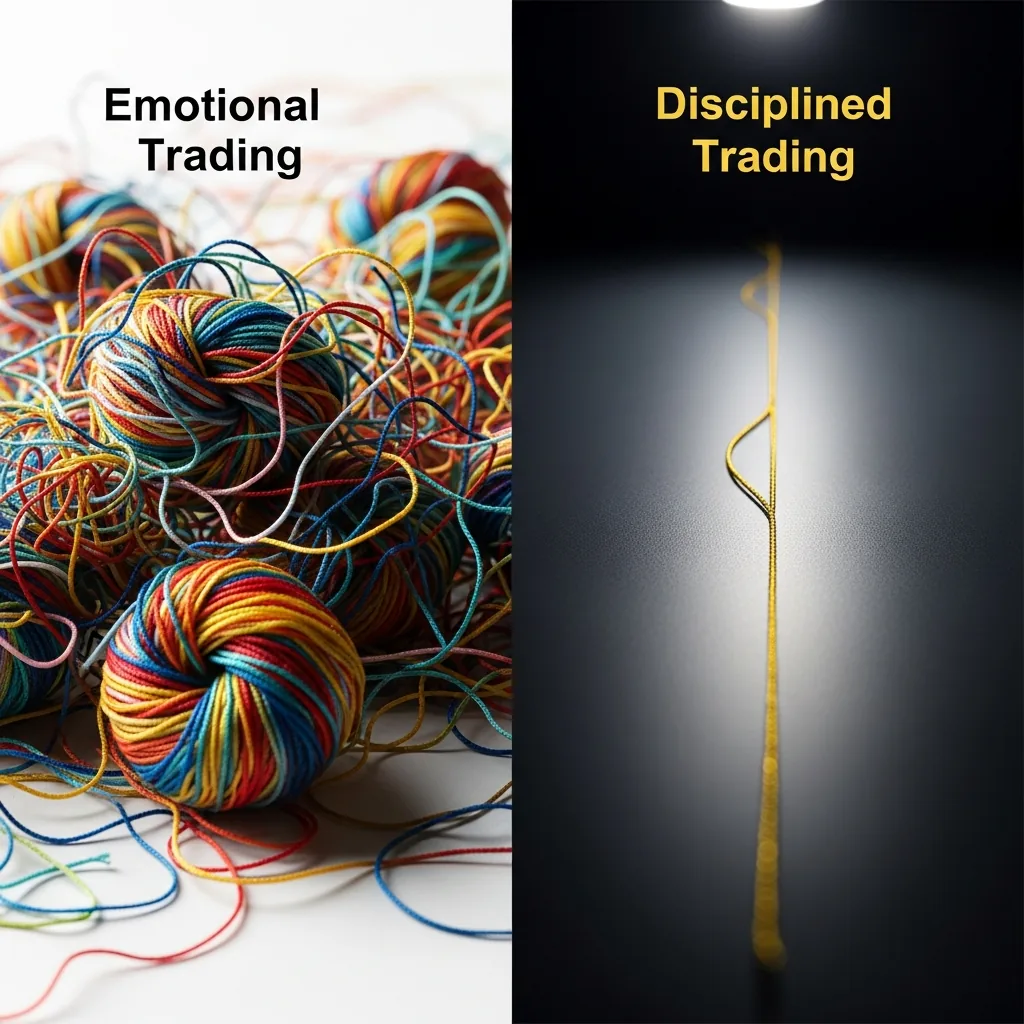
Evaluations are lost at three specific emotional moments, and it is worth naming them in advance because they arrive on schedule.
- The trade after a loss. The urge to win it back immediately, usually at larger size. This is revenge trading, and it is the proximate cause of most daily-limit breaches. The rule that defeats it is structural, not motivational: after any loss, the next trade must be the same size or smaller, and it must be a planned setup, not a reaction.
- The day after a losing day. Starting −2% for the week creates pressure to "catch up," which means over-sizing, which converts a routine drawdown into a terminal one. The correct response to being behind is to change nothing.
- The final stretch. At 6.5% of an 8% target, two failure modes appear: over-sizing to finish today, and its mirror — trading so timidly that you stop taking your own valid setups. Both come from making the target feel close. It is not close; it is simply the same distance covered by the same process. The trade you take at +7.5% should be indistinguishable from the trade you took at 0%.
What the failure data actually shows
I spent over five years inside prop firms — as a director at MyForexFunds and later Chief Growth Officer at E8 Markets — with access to evaluation outcomes at scale, and the most useful thing I can tell you is that the failure data is boring. It is almost never the strategy. Accounts that fail and accounts that pass often contain the same setups, comparable win rates, and comparable markets. What separates them shows up in three variables you can audit in your own trading tonight.
Risk dispersion. Passing accounts risk roughly the same amount on every trade. Failing accounts show a signature pattern: a string of small, disciplined trades, then one position five or ten times normal size — nearly always following a loss. On a risk chart, a failed evaluation usually looks like a flat line with one spike, and the spike is the breach.
Time-of-failure clustering. Breaches cluster late in losing days and late in losing weeks, not early. Traders rarely blow up fresh; they blow up tired and behind, at exactly the moments the previous section describes. The daily loss limit exists because firms know the last hour of a bad day is the most expensive hour in trading.
Activity after drawdown. Passing traders slow down after losses — fewer trades, same size. Failing traders speed up. Trade frequency immediately following a loss is one of the cleanest single predictors of evaluation outcome I ever saw, which is why the "same size or smaller, planned setup only" rule earns its place in your plan.
One more observation from the firm side: rule breaches are treated mechanically, because they have to be. A daily-limit breach of $40 on a $100,000 account fails the evaluation exactly as a $4,000 breach does. Traders sometimes read this as pettiness. From the risk desk it is the entire product — a firm that waives small breaches has no filter, and a firm with no filter does not survive to pay anyone. Assume zero tolerance, because that is what the data pipeline applies.
After the pass: the funded phase
Passing changes your paperwork more than your job. The funded account usually keeps the same daily and overall loss rules — the profit target disappears, replaced by a payout cycle — and some firms add funded-phase specifics: minimum days between payouts, payout caps in early cycles, or consistency requirements that continue past the evaluation. Read the funded-account terms as carefully as the challenge terms, because a funded breach costs you an account you spent weeks earning. Scaling plans, where the firm increases your capital after consecutive profitable cycles, reward exactly the same behaviour that passed the evaluation: flat risk, boring consistency.
The funded phase is also where the industry's real question lives: does the firm actually pay? Marketing totals and screenshot testimonials are unverifiable, which is why Capital Critic indexes payouts settled on-chain — transaction-level data you can check yourself, firm by firm — and documents how that data is collected in our methodology. Before you buy any challenge, payout evidence should carry more weight in your decision than the discount of the week or the size of the headline profit split.

Frequently asked questions
How long does it take to pass a prop firm challenge?
For a disciplined trader risking 0.25–0.5% per trade, a realistic range is three to eight weeks per phase, sometimes longer in slow markets. Most firms have removed time limits from their evaluations, so speed earns you nothing. Traders who pass in a few days are usually over-sized, and over-sized passes tend to become fast funded-phase failures.
What percentage of traders pass a prop firm challenge?
Firms rarely publish pass rates, so treat any precise figure with suspicion. Independent estimates commonly put pass rates below 10–20%, and the share of traders who pass and then receive multiple payouts is lower still. The number varies by firm, program structure, and rule strictness — which is one reason to compare rules per firm rather than assume the odds are uniform.
How much should I risk per trade in a prop firm challenge?
0.25–0.5% of the account per trade, fixed. At that size the daily loss limit is effectively unreachable through normal losing streaks, while a modest edge still reaches the target within weeks. Risking 1–2% per trade roughly doubles to quadruples your speed and does far worse than that to your survival odds, because it puts a routine three-loss day within sight of the daily limit.
Is it better to take a 1-step or 2-step challenge?
Neither is inherently better; they price risk differently. One-step evaluations are faster but typically pair the single target with tighter drawdown, punishing variance. Two-step evaluations cost more time but usually give more room for error, which favours patient risk management. Choose based on your drawdown tolerance and the specific numbers, not the step count — the comparison is easiest made side by side on our firm comparison table.
Can you use EAs or copy trading in a prop firm challenge?
It depends entirely on the firm. Some allow personal EAs but prohibit commercially available ones; copy trading between your own accounts or from other people's is restricted at many firms; and latency or arbitrage-style strategies are prohibited almost everywhere. This is the category of rule most likely to void a payout after the fact, so verify it in the firm's written terms — not in a Discord answer — before you trade.
What happens if I hit the daily loss limit?
At most firms the evaluation fails immediately, even if the breach is tiny and even if the account recovers the same day. Some programs offer paid resets or occasional one-time exceptions, but you should plan as if none exist. The practical defence is a personal daily stop at roughly a third of the firm's limit — if you never approach the boundary, its exact enforcement policy never matters.
Do profits from the challenge phase get paid out?
No — evaluation-phase profits are test results, not withdrawable money. Payouts begin in the funded phase, on the firm's payout cycle and terms. This is why the challenge fee should be judged as the real cost of entry: it is the only money of yours that is ever at risk, and it is genuinely at risk.
Before you buy a challenge
A final note on risk, because this is real money. Challenge fees are non-refundable at most firms, the majority of participants do not pass, and a pass is not a promise of income — funded traders can and do lose their accounts. Only spend what you can afford to lose without consequence, and treat every fee as tuition, not investment.
If the framework here is how you already trade, the remaining work is choosing a firm whose rules fit your style and whose payouts are demonstrably real. That is a data problem, and it is the one Capital Critic exists to solve: compare rules, drawdown structures, and verified payout history across firms on the comparison table, then read the full terms on the firm's page before you pay anyone a fee.