
The tradeifyfx evaluation programs explained simply are simulated CFD trading challenges offering 1-Step and 2-Step assessment models hosted on Match-Trader and DXTrade. Traders must meet specific virtual profit targets of 8% to 10% while respecting a strict 5% daily drawdown limit. Achieving these targets allows you to secure up to a 90% profit split on virtual accounts ranging from $5,000 to $200,000.
Key takeaways
- Diverse Scaling Capital: Tradeify FX offers simulated account sizes ranging from $5,000 to $200,000 with no recurring data feed fees.
- Dual Pathway Models: The 1-Step Evaluation requires a flat 10% profit target, while the 2-Step Evaluation requires 8% in Phase 1 and 5% in Phase 2.
- Drawdown Distinctions: The 1-Step model relies on a dynamic 6% trailing drawdown, whereas the 2-Step model utilizes a safer, fixed 10% static drawdown.
- Zero Day Minimums: There are 0 minimum trading days required, allowing highly skilled traders to pass their evaluation in a single day.
- Modern Platform Alternatives: All challenges are hosted natively on DXTrade and Match-Trader to bypass legacy MetaTrader licensing restrictions.
- Immediate Savings: Traders can access an exclusive 50% Launch discount using the code CRITIC at checkout.
Tradeify FX Prop Firm vs Tradeify Futures: What is the Difference?
The primary difference between Tradeify Futures (see our Tradeify review) and the newer Tradeify FX (see our Tradeify FX review) prop firm is the underlying market structure: Tradeify Futures focuses on centralized, exchange-cleared assets via the CME, while Tradeify FX offers simulated Contract for Difference (CFD) trading across forex, indices, and commodities. While the futures branch utilizes platforms like Tradovate or NinjaTrader, the FX-focused brand operates entirely within simulated environments on Match-Trader and DXTrade.
Market Structure and Asset Classes
Tradeify Futures routes simulated orders based on real-time centralized exchange data from the Chicago Mercantile Exchange (CME). This structure requires purchasing specific data feeds (such as Level 1 or Level 2 data) and trading standardized contracts with fixed tick values. Every contract traded has a direct counterparty on a centralized ledger, meaning market depth, order routing, and execution speed are dictated by exchange queue priority.
In contrast, Tradeify FX is built specifically for simulated CFD trading. Under these models, traders speculate on price movements of global currency pairs, major stock indices, and commodities without buying the underlying assets. Because CFDs are decentralized, there is no centralized exchange, which eliminates the need for paid CME data subscriptions. This structural difference makes the FX platform highly appealing to retail forex traders who prefer liquid, round-the-clock markets. Instead of calculating contract tick values on a centralized order book, CFD traders can execute fractional lots, allowing for much more precise risk management on smaller accounts.
Platform Ecosystems: CME vs. CFDs
The technology stack represents another major divergence between the two brands. The retail prop trading industry has largely moved away from MetaTrader due to licensing restrictions, prompting firms like Tradeify FX to launch natively on alternative platforms. Tradeify FX utilizes Match-Trader and DXTrade, which are modern, web-based interfaces offering seamless execution, built-in charting, and mobile compatibility without requiring external software keys.
Tradeify Futures, on the other hand, is integrated with legacy futures platforms like NinjaTrader, Rithmic, and Tradovate. These platforms are designed specifically for order-book analysis and depth-of-market (DOM) trading, requiring a higher technical barrier to entry. Futures platforms often require local software installations, manual license key configurations, and precise connection settings to stream live data feeds without latency. For retail traders accustomed to clean, modern web applications, the DXTrade and Match-Trader setups provide a significantly flatter learning curve.
| Feature | Tradeify Futures | Tradeify FX |
|---|---|---|
| Asset Class | Exchange-Traded Futures (CME) | Simulated Contracts for Difference (CFDs) |
| Supported Markets | Equity Indexes, Metals, Energies, Interest Rates | Forex, Indices, Commodities |
| Primary Platforms | NinjaTrader, Tradovate, Rithmic | Match-Trader, DXTrade |
| Data Fees | Required (CME data feeds) | None |
| Pricing & Promos | Standard pricing structure | 50% Launch promo with Code CRITIC |
| Max Leverage | Standard exchange margins | Up to 1:50 on major forex pairs |
Account Setup and Pricing Structures
The cost and leverage structures differ significantly due to the mechanics of these assets. Futures traders often face recurring data feed fees to maintain live CME connections during their evaluations. These fees can quickly compound if a trader takes multiple weeks or months to reach their objectives. Tradeify FX removes this barrier entirely, offering all-inclusive virtual funding packages from $5,000 to $200,000 with no hidden data costs or monthly maintenance fees.
Furthermore, the leverage structures are highly distinct. Futures leverage is bound by exchange-mandated intraday margins, which fluctuate based on market volatility and the specific contract traded. On the other hand, tradeify fx leverage is fixed during the simulation, offering up to 1:50 on major forex pairs and 1:20 on indices and commodities. When evaluating tradeify fx rules, managing CFD lot sizes on a centralized dashboard is often simpler for retail traders than calculating contract values on a futures ladder. If you want to get started with the CFD-focused brand, you can access a 50% Launch promo with Code CRITIC for the Tradeify FX evaluation models.
Tradeifyfx Evaluation Programs Explained: 1-Step vs 2-Step Models
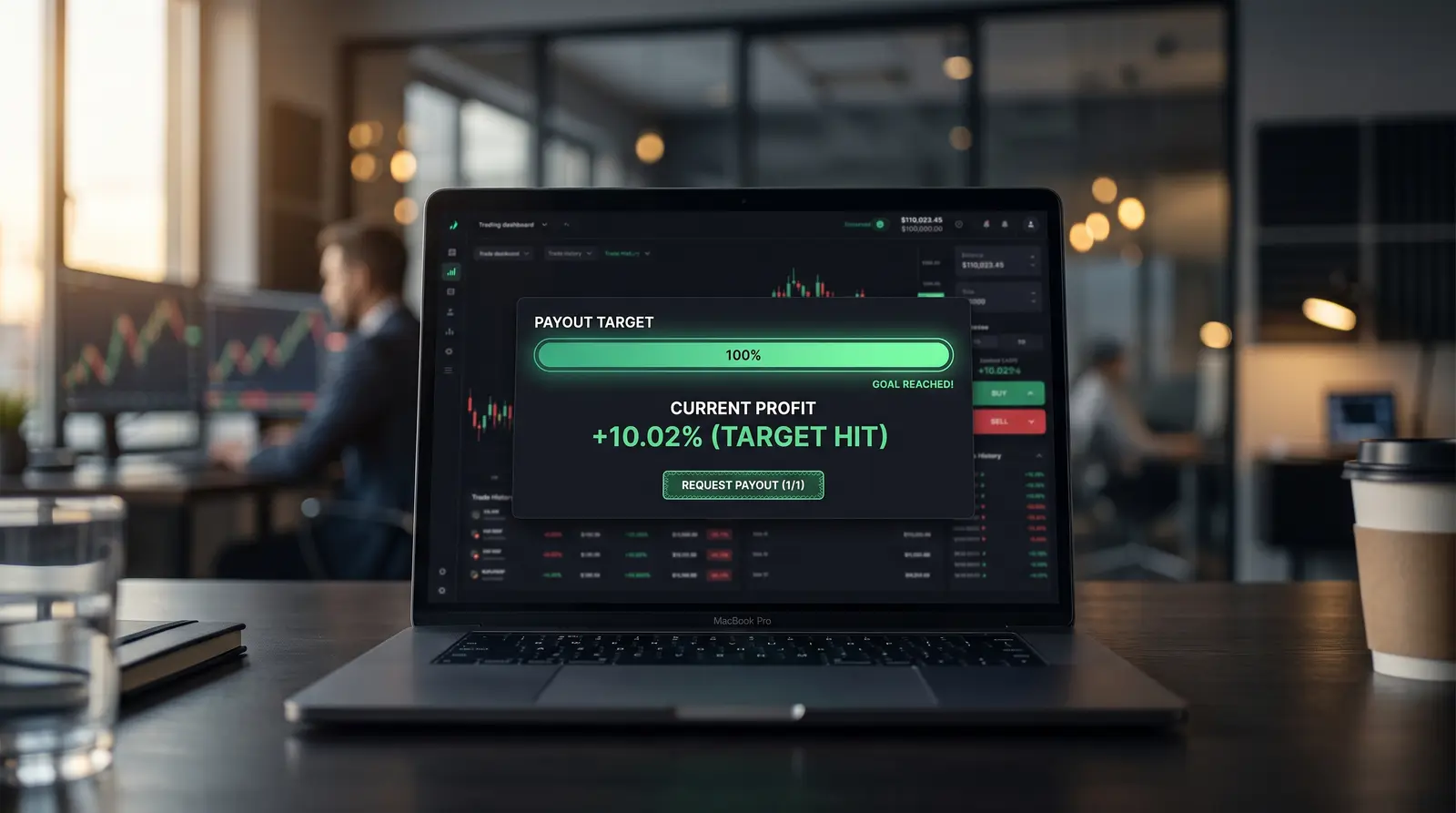
The main differences between the Tradeify FX 1-Step and 2-Step evaluation programs lie in their profit targets, overall drawdown structures, and the number of simulated trading phases. While the 1-Step model requires a flat 10% profit target with a trailing drawdown, the 2-Step model divides the challenge into two phases with lower target percentages and a more flexible static drawdown.
Understanding these structural paths is key to choosing the right environment for your virtual trading style. Here, the Tradeify FX evaluation structures highlight how pricing, targets, and rules stack up across both options.
Comparing Profit Targets and Phases
The primary differentiator when comparing tradeify fx 1-step vs 2-step models is how you reach simulated funded status. Under the 1-Step model, traders have a single phase to hit a tradeify fx profit target of 10%. This means you are only one successful run away from stepping into the simulated funded stage, making it an incredibly fast route for high-momentum traders.
In contrast, the 2-Step model spreads the evaluation across two separate phases. Phase 1 requires an 8% profit target, and Phase 2 requires a 5% profit target. While the 2-Step model requires you to hit two separate targets sequentially, the individual targets are lower and come with a more relaxed static drawdown limit of 10% compared to the 1-Step's tighter 6% trailing drawdown. It rewards patient, systematic traders who prioritize capital preservation over rapid scaling.
No Minimum Trading Days Requirement
A major advantage of the tradeify fx rules is the total absence of minimum trading days. Many retail prop firms force traders to wait five to ten days even after they have successfully reached their objectives, which often leads to overtrading and giving back hard-earned profits. With Tradeify FX, there are 0 minimum trading days required for both evaluation models. If you hit your virtual profit target on your very first day, your account is immediately eligible to progress to the funded stage. This structural feature significantly reduces the time barrier for skilled traders who manage risk efficiently.
Pricing and Virtual Account Sizes
For tradeify fx pricing, costs are determined by the virtual account size you select, ranging from $5,000 to $200,000 in virtual funds. While pricing tiers scale with simulated capital, traders can substantially reduce their entry cost by applying a 50% Launch promo with Code CRITIC at checkout. This competitive pricing structure lowers the barrier to entry, allowing traders of all capitalization levels to test their skills in a professional trading environment.
Side-by-Side Comparison
To help you decide which evaluation track fits your strategy, the table below outlines the core metrics for both models:
| Feature | 1-Step Evaluation | 2-Step Evaluation |
|---|---|---|
| Simulated Capital Sizes | $5,000 to $200,000 | $5,000 to $200,000 |
| Simulated Profit Target | 10% | Phase 1: 8% / Phase 2: 5% |
| Minimum Trading Days | 0 days | 0 days |
| Daily Drawdown Limit | 5% (daily starting balance) | 5% (daily starting balance) |
| Overall Drawdown Limit | 6% (trailing) | 10% (static) |
| Discount Code | 50% off with code CRITIC | 50% off with code CRITIC |
Both evaluation pathways run on modern, high-performance platforms like Match-Trader and DXTrade. This allows traders to execute trades with institutional-grade mechanics without being bound to legacy software.
The Mathematical Breakdown of Tradeify FX Drawdown Limits

Tradeify FX calculates its 5% daily drawdown limit based on the starting balance of each trading day, while the maximum overall drawdown differs structurally depending on whether you choose the 1-Step or 2-Step model. The 1-Step evaluation utilizes a 6% trailing drawdown that tracks your peak open equity, whereas the 2-Step evaluation features a 10% static drawdown that remains anchored to your initial account balance.
How the 5% Daily Drawdown Works
The daily loss limit is calculated identically across both evaluation paths. Every day at 5:00 PM EST, the system checks your trading account's starting balance to establish your daily loss threshold for the next 24 hours.
- Calculation Formula: Daily Loss Limit = Starting Day Balance × 5%
- The Math in Action: Suppose you are trading a $100,000 evaluation. Your daily drawdown threshold is $5,000, meaning your equity cannot drop below $95,000 during that trading day.
- Intraday Adjustments: If you close a trade for a $3,000 profit, pushing your balance to $103,000, your loss limit for that day is still measured from the $100,000 starting point. This means your equity floor remains at $95,000. At the next 5:00 PM EST reset, your daily loss limit is recalculated to $5,150 (5% of $103,000), making your new absolute daily equity floor $97,850.
Trailing vs. Static Drawdown: The Mathematical Difference
When exploring how these evaluation models differ, the overall maximum drawdown is the most critical structural feature. The choice between tradeify fx 1-step vs 2-step models determines whether your overall risk ceiling moves dynamically or remains fixed.
The table below outlines how these drawdown rules behave on a standard $100,000 simulated account:
| Drawdown Metric | 1-Step Evaluation (6% Trailing) | 2-Step Evaluation (10% Static) |
|---|---|---|
| Initial Account Balance | $100,000 | $100,000 |
| Maximum Drawdown Floor | $94,000 (Moves dynamically) | $90,000 (Stays fixed) |
| Peak Simulated Equity Achieved | $105,000 (Including open profit) | $105,000 (Including open profit) |
| Adjusted Drawdown Floor | $99,000 | $90,000 |
| Locking Mechanism | Locks at $100,000 when balance hits $106,000 | N/A (Does not lock) |
The 1-Step Trailing Drawdown Math
According to official Tradeify FX support rules, the 1-Step model utilizes a 6% trailing drawdown that updates based on peak equity (including open profit). If your $100,000 simulated account has an open trade that floats up to $104,000, your new absolute trailing drawdown floor becomes $98,000. Even if you do not close the trade at that level and the market reverses, your account equity cannot drop below $98,000. Once your account balance reaches $106,000, the trailing drawdown permanently locks at the initial starting balance of $100,000, protecting you from further upward trailing.
Keep in mind that the trailing drawdown on the 1-Step evaluation can easily catch traders off guard, as the drawdown limit moves up dynamically with peak open equity, not just closed balance. CFD trading inherently involves high leverage; even in simulated environments, traders must practice sound risk management, as simulated success does not guarantee real-market profitability.
The 2-Step Static Drawdown Math
The 2-Step model offers a more lenient approach. Your maximum overall drawdown is fixed at 10% of your starting balance. On a $100,000 account, your maximum drawdown floor is always $90,000. It never trails higher, regardless of how much profit you accumulate in your simulated account. If you grow your account to $115,000, your drawdown floor remains at $90,000, giving you a massive $25,000 buffer of tradeable equity.
If you are ready to start navigating these tradeify fx rules, you can access a 50% Launch promo with Code CRITIC.
Platform Mechanics: Match-Trader, Leverage, and Restricted Trading Rules

Tradeify FX executes its simulated evaluation programs on the modern Match-Trader and DXTrade platforms, providing traders with virtual leverage of up to 1:50 on major forex pairs and 1:20 on indices and commodities. While the prop firm permits news trading during all evaluation phases, it strictly prohibits copy trading, account sharing, and high-frequency trading (HFT) algorithms.
Modern Trading Platforms: Match-Trader and DXTrade
Following recent retail prop trading industry transitions away from legacy platforms like MetaTrader, Tradeify FX has built its simulated trading environment around DXTrade and Match-Trader. These advanced, web-based interfaces offer seamless execution and feature-rich charting interfaces that mimic real-market conditions.
By utilizing Match-Trader and DXTrade, the firm provides traders with simulated CFD trading feeds. These platforms feature built-in risk-management tools, instant position closing, customizable hotkeys, and real-time equity tracking. This infrastructure is a core part of the Tradeify FX ruleset explained in this article, as it ensures transparent tracking of daily loss limits and profit targets without any server-side lag.
Simulated Leverage Limits
Leverage allows traders to control larger contract sizes with a smaller amount of virtual margin. To protect the simulated capital pool and encourage disciplined risk management, Tradeify FX enforces specific leverage maximums.
| Asset Class | Maximum Leverage | Market Type |
|---|---|---|
| Major Forex Pairs | 1:50 | Simulated CFD |
| Minor Forex Pairs | 1:50 | Simulated CFD |
| Stock Indices | 1:20 | Simulated CFD |
| Commodities | 1:20 | Simulated CFD |
Suppose you are trading a $100,000 evaluation account. With a maximum tradeify fx leverage of 1:50 on major forex pairs, you can open positions worth up to $5,000,000 in nominal value. However, utilizing the maximum leverage is highly risky, as minor market fluctuations can quickly trigger the daily 5% drawdown limit, resulting in a simulated account breach. Experienced traders generally utilize leverage conservatively, keeping position sizes aligned with their defined percentage-based risk parameters.
Permitted and Prohibited Trading Rules
To maintain the integrity of their simulated funding ecosystem, the tradeify fx rules clearly define which trading styles are acceptable and which will trigger a hard breach.
- News Trading: Unlike many traditional prop firms that restrict trading around macroeconomic events, Tradeify FX allows news trading during both the evaluation and funded phases. This means you can trade major releases like the Consumer Price Index (CPI) or Non-Farm Payrolls (NFP) without fear of account suspension.
- Banned HFT Algorithms: High-frequency trading (HFT) algorithms, latency arbitrage, and high-speed grid bots are strictly banned. These strategies exploit platform latencies rather than genuine price movement and do not translate to real-market success.
- Copy Trading and Account Sharing: Copying trades from external third-party accounts or participating in account-sharing schemes is prohibited. All trades must be executed independently by the account owner to prove personal market competence.
For those interested in starting a challenge under these platform rules, you can currently access the Tradeify FX 50% Launch promo with Code CRITIC to save on your evaluation sign-up.
How Tradeify FX Payout Rules and Profit Splits Work
Tradeify FX payout rules allow simulated funded traders to request their first payout 14 days after placing their first trade, with subsequent withdrawals processed on a bi-weekly schedule. Under the firm's scaling structure, simulated profit splits begin at a default of 80% and can increase up to 90% for consistent traders who demonstrate disciplined risk management.
Understanding the mechanics of withdrawals and profit-sharing is crucial before you purchase an account. Below is the step-by-step process required to secure and maximize your earnings under the tradeify fx rules.
Step-by-Step Path to Your First Withdrawal
Transitioning from a simulated challenge to your first payout requires meeting specific milestones. Once the Tradeify FX challenge models are successfully passed, the path to your first payout proceeds as follows:
- Evaluation Mastery: You must first hit your profit targets (10% for the 1-Step or 8% in Phase 1 and 5% in Phase 2 for the 2-Step) without breaching the daily 5% drawdown or overall maximum drawdown limits.
- Verification and Onboarding: Upon reaching your target, you will receive an invitation to complete the Know Your Customer (KYC) identity verification. You will then sign the simulated funded trader agreement.
- The 14-Day Holding Period: Your initial simulated funded trading phase begins. Tradeify FX requires a minimum of 14 days to pass from your first simulated trade in this phase before you can request your initial payout.
- Submit Payout Request: After the 14-day holding period, you can request your payout through the platform's dashboard, transferring your simulated profit share to your preferred payment processor.
- Bi-Weekly Cycles: Once your first payout is processed, subsequent payout requests can be made on a recurring bi-weekly (14-day) schedule.
Profit Splits and Scaling up to 90%
The tradeify fx prop firm uses a performance-based scaling system to reward long-term, profitable trading. When you first receive your simulated funded account, you are placed on an 80/20 profit split, where you keep 80% of your simulated earnings.
If you maintain consistency, respect the daily and maximum drawdown limits, and avoid prohibited practices, you can scale your profit split up to 90%. This reward tier places Tradeify FX among the most competitive firms in the industry, giving traders an excellent incentive to manage simulated risk over a longer-term horizon.
Consistency and Account Compliance
To protect the simulated trading environment, Tradeify FX enforces strict compliance rules during both the evaluation and funded phases. Prohibited behaviors such as account sharing, copy trading, and using forbidden high-frequency trading (HFT) algorithms will lead to immediate simulated account termination and forfeiture of any accrued simulated profits. Maintaining consistent risk sizes and avoiding erratic trading behavior ensures that your bi-weekly payouts are processed smoothly without administrative delays.
| Payout and Split Parameter | Rule & Metric Details |
|---|---|
| Starting Profit Split | 80% of simulated profits to the trader |
| Maximum Profit Split | 90% of simulated profits through performance scaling |
| Initial Wait Time | 14 calendar days from the first simulated trade |
| Subsequent Payout Frequency | Bi-weekly (every 14 days) |
| Minimum Trading Days | 0 days (can pass evaluation in a single day) |
| Launch Offer | 50% Launch promo with Code CRITIC |
Traders should remember that while Tradeify FX offers 0 minimum trading days to pass the evaluation, the 14-day holding period during the funded phase is strictly enforced. If you are ready to test your skills, you can access their challenges with a 50% Launch promo with Code CRITIC.
Verdict
Choosing between the Tradeify FX evaluation programs comes down to your personal risk tolerance and strategic trading speed. The 2-Step Evaluation is the superior choice for conservative, long-term traders because it offers a highly forgiving 10% static maximum overall drawdown that never trails your peak profits, giving you breathing room across its Phase 1 (8% target) and Phase 2 (5% target) challenges. On the other hand, the 1-Step Evaluation is the ultimate option for aggressive, high-performing traders who want to hit a single 10% profit target as fast as possible, provided they can carefully manage the tighter 6% trailing drawdown constraint. Whichever path you choose, starting with the 50% discount code CRITIC makes either of these modern Match-Trader and DXTrade CFD pathways highly competitive in today's retail prop firm landscape.
Frequently Asked Questions
What are the differences between the Tradeify FX 1-Step and 2-Step evaluations?
The 1-Step evaluation requires a single phase to hit a 10% profit target but features a strict 6% trailing overall drawdown. The 2-Step evaluation splits the process into Phase 1 (8% target) and Phase 2 (5% target) but offers a more relaxed 10% static maximum overall drawdown that does not trail your peak equity.
How are the daily and maximum drawdown limits calculated on Tradeify FX?
The daily drawdown limit is exactly 5% of your starting account balance, recalculated every day at 5:00 PM EST. The maximum overall drawdown is either a 6% trailing limit based on peak open equity (for the 1-Step evaluation) or a static 10% limit anchored permanently to your initial starting balance (for the 2-Step evaluation).
What simulated trading platforms does Tradeify FX support?
Tradeify FX supports DXTrade and Match-Trader. These modern, web-based interfaces have replaced legacy MetaTrader platforms, offering traders real-time simulated CFD pricing feeds, highly customizable charting environments, built-in risk management metrics, and smooth trade execution directly from desktop or mobile devices.
How do payouts, consistency rules, and profit splits work on Tradeify FX?
Tradeify FX payouts begin with an 80% profit split, scaling up to 90% for consistent traders. You can request your first payout 14 calendar days after placing your first trade in the simulated funded phase. Subsequent payouts are processed bi-weekly. Copy trading and high-frequency algorithms are strictly prohibited.
Is news trading allowed during the Tradeify FX evaluation phases?
Yes, news trading is fully permitted on Tradeify FX during both the evaluation and funded phases. Traders are free to execute positions around major macroeconomic announcements, such as Non-Farm Payrolls (NFP) and Consumer Price Index (CPI) releases, without violating any account guidelines.