

A FundedNext discount code in 2026 is usually not something you find on a coupon site. The firm has moved most of its discounting into personalised offers that appear inside your own account dashboard, where campaigns have reached as high as 47% on futures products, while public sitewide codes — typically 5% to 25% — have become the smaller half of the picture. This guide covers both channels: how to see what you are actually eligible for, how to tell a live offer from a dead one, and what a discount is genuinely worth once you count the full cost of getting funded rather than just the price on the checkout page.
Key takeaways
- FundedNext runs two discount channels: public sitewide codes, typically worth 5% to 25%, and personalised offers shown in your account dashboard, which have gone as deep as 47% on futures products.
- Not every discount is a code. Some savings are applied automatically by a partner link, with nothing to type at checkout — our FundedNext link is one of those, and it applies 5% off with no code.
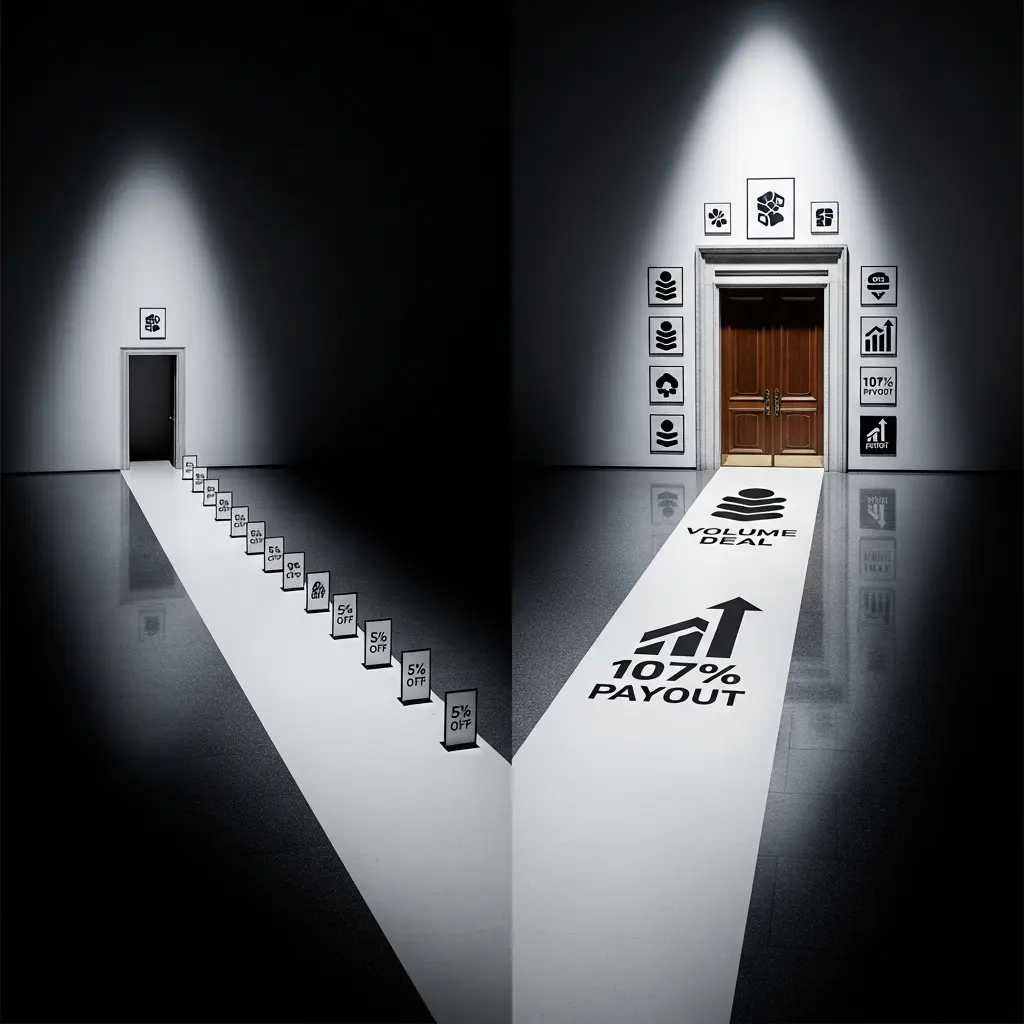
- Discounts come in three shapes: a fixed percentage off the fee, a volume reward such as $194 off your first five account purchases, and a benefit modifier such as the 107% payout, which adds 7% on top of your withdrawals instead of cutting the entry price.
- Promotions almost never stack. If you hold an affiliate coupon, a sitewide sale and a dashboard reward at the same time, you will be asked to pick one.
- First-purchase discounts are usually one-time and tied to your identity, so spending a 25% code on a $6,000 or $10,000 account leaves nothing for the $50,000 account you actually wanted.
- Resets, re-buys and internal upgrades are normally excluded, which is why the entry fee is the smallest part of the real cost of getting funded.
- Futures campaigns are consistently more aggressive than forex campaigns — roughly 30% to 47% against 10% to 25% — and both spike during global holidays and industry events.
The two discount channels FundedNext actually runs
For most of the retail prop era, hunting for a discount meant trawling coupon aggregators and affiliate pages for a generic sitewide code that might take 5% or 10% off a challenge fee. Occasionally a campaign landed at 25%, and that was treated as the ceiling. Those public codes still exist, and they are still typically worth somewhere between 5% and 25%, but they no longer represent the best price available on the platform.
The deeper discounting has moved into a personalised channel. Log into your account with FundedNext and the offers surface on a dedicated page in the dashboard, keyed to your account rather than broadcast to the internet. Those offers are generated from what the firm knows about you: which product family you have bought before, whether you passed or breached, how long it has been since your last purchase, and which account sizes you have looked at. The result is that two traders can open the same page on the same day and be shown two entirely different prices.
There is a third route that is easy to miss because it involves no code at all. Some partner links apply a saving automatically when you land on the checkout, with no promo field to fill in. That is how the Capital Critic link above works: it applies 5% off, and there is no code to type. If you are looking for a code to accompany it, there is not one — the discount is carried by the link itself. This matters more than it sounds, because a trader who assumes every discount must be a code will keep pasting expired coupons into a checkout that has already applied a better price.
| Channel | Typical depth | How it is applied | Who can use it |
|---|---|---|---|
| Public sitewide codes | 5% to 25% | Code typed into the promo field at checkout | Anyone, until the campaign ends |
| Personalised dashboard offers | Up to 47% on futures campaigns | Claimed from your account's offers page | Only the account the offer was issued to |
| Partner link discount | 5% off via the Capital Critic link | Applied automatically by the link — no code exists | Anyone arriving through the link |
| Benefit modifiers | 107% payout (an extra 7% on withdrawals) | Attached to the account at purchase | Whoever the campaign is aimed at |
Why the personalised channel replaced the public one
The shift is not a marketing fashion. A public 25% code is claimed by everyone who sees it, including every buyer who was going to purchase at full price anyway. The firm pays the full discount to acquire customers it had already acquired. A personalised offer solves that: the deep price goes to the trader who has been hesitating for six weeks, while the trader who buys a new account every month sees a smaller one, or none.
There is a second, quieter reason. Public codes leak. Once a sitewide code exists it is scraped, republished and attached to the firm's own brand searches within hours, which hands part of the acquisition margin to coupon sites that contributed nothing. Keeping the best price behind a login puts the firm back in control of who gets what.
The third reason is product-level flexibility. A public code has to apply to a whole catalogue or be riddled with exclusions that generate support tickets. A dashboard offer can be aimed at one product family without repricing anything else, which is exactly how the firm runs aggressive futures campaigns while forex pricing stays comparatively stable. If you have followed how discounting has evolved across the sector, you will recognise the pattern from our wider guide to prop firm discount codes, where the same migration from open coupons to gated offers shows up at firm after firm.
Working both tiers: a practical sequence
Treat the two channels as one decision, not two. The sequence that consistently produces the best price is unglamorous:
- Decide the product and the account size first. Choose the challenge you actually intend to trade before you look at any discount. Reversing this order is how traders end up owning an account size their risk process cannot handle.
- Open your dashboard offers page. Note the depth, the expiry, and — critically — which product family each offer is restricted to.
- Check the public campaign. Look at the firm's own site and any partner link you have, and record what each one would take off the exact configuration you chose in step one.
- Compare in dollars, not percentages. A 25% offer capped at a small account can be worth less than a 10% offer with no cap.
- Use one, and only one. Stacking is not available, so the comparison in step four is the whole decision.
If you have no personalised offer showing and no active public campaign, that is a legitimate result — it is not evidence that you have missed a secret code. Deep discounting is cyclical, and the firm's own site is the only authoritative place to see what is live right now. We keep a running view of what firms are advertising across the sector on our current firm offers page for exactly this reason.

The three kinds of discount, and what each one is worth
Percentages are not the only currency here, and the headline number is a poor guide to value. FundedNext promotions fall into three mechanically different types, and they reward completely different kinds of trader.
| Type | What it does | Typical range | Best suited to | Main weakness |
|---|---|---|---|---|
| Fixed percentage | Cuts the challenge fee at checkout | 5% to 25% on forex; higher on futures campaigns | Anyone buying one account, once | Saves nothing after the purchase |
| Volume-based | Fixed dollar reward across multiple purchases | $194 off your first five account purchases | Traders already committed to running several accounts | Encourages buying more than you need |
| Benefit modifier | Improves the account's terms instead of its price | 107% payout — an extra 7% on withdrawals | Traders who expect to reach payout repeatedly | Worth exactly nothing if you never withdraw |
Fixed percentage discounts
This is the familiar mechanic: a percentage comes off the challenge fee at checkout, typically in the 5% to 25% band for standard campaigns. It is predictable, it is easy to compare, and it is the only one of the three that pays out with certainty — you get the saving the moment the payment clears, regardless of how you trade afterwards.
One point of arithmetic causes persistent confusion, and it is worth being blunt about. A percentage discount applies to the fee you pay, not to the capital you are given. A 25% figure attached to a $50,000 account is sometimes described as freeing up $12,500, because 25% of $50,000 is $12,500. That is not what happens. Your saving is 25% of the challenge fee for that account, which is a fraction of that number. What is true, and is the useful version of the same observation, is that the same percentage is worth far more in dollars on a larger account than on a small one, because larger accounts carry larger fees. A quarter off a $50,000 challenge returns substantially more cash than a quarter off a $6,000 challenge, which is why the size you apply a one-time discount to is a real decision rather than an afterthought.
Volume-based savings
Volume rewards are fixed-dollar rather than proportional. The recurring FundedNext example is $194 off your first five account purchases — a bundle price aimed at traders running several accounts in parallel, typically to diversify across strategies or to avoid concentrating a whole month's income on one set of drawdown rules.
The analytical trap is obvious once stated: a volume reward is only a saving if you were going to buy the volume anyway. Buying a fourth and fifth account to unlock a fixed reward converts a discount into an expense. Run the test in the direction that protects you — decide how many accounts your capital and your risk process justify, then check whether a volume tier happens to reward that number. Never the reverse.
There is a second consideration that traders discover late. Multiple accounts multiply the cost of a bad week. A single rules breach across correlated positions can end several challenges on the same afternoon, and no volume discount is large enough to cover replacing them. If you are weighing a multi-account approach seriously, the sizing logic is worth reading alongside our analysis of futures prop firm discounts and scalable trading, which deals with the same tension between cheap entry and sustainable scaling.
Benefit modifiers and the 107% payout
The most interesting FundedNext promotion is not a discount at all. The 107% payout modifier does not reduce what you pay — it replaces the standard 100% payout structure with one that adds an additional 7% on top of your withdrawals. An extra 7% on your profits, applied every time you get paid, for as long as the account survives.
That changes the maths from a one-off saving to a recurring one, and it is worth working through explicitly. The figures below are round numbers chosen to make the arithmetic legible, not FundedNext's live prices — check those on the firm's own site before you buy.
- Option A: a 15% discount on an illustrative $500 challenge fee. You save $75, once, at checkout.
- Option B: the 107% payout modifier at full price. You save nothing today, and earn an extra 7% on every dollar you withdraw.
- The crossover: $75 divided by 7% is roughly $1,071. Withdraw more than that over the life of the account and the modifier has beaten the discount. Withdraw $10,000 and it is worth $700 against the discount's $75.
For a consistently profitable trader, the modifier is not close — it wins by a wide margin over the lifespan of an account, and it keeps winning. But the comparison hides a probability that has to be stated honestly: the discount is certain and the modifier is contingent. A percentage off the fee is banked the moment you pay. The 7% uplift is worth precisely zero to the majority of participants, who breach the rules before they reach a first withdrawal. The correct way to value a benefit modifier is to multiply it by your honest assessment of whether you will get paid at all, and most traders overestimate that number substantially.
Payout terms are also the part of a prop offer that is easiest to advertise and hardest to verify, which is why we track firm payouts on-chain rather than from marketing pages. A modifier that adds 7% to a payout is only meaningful if the underlying payouts are actually being made, on time, at the advertised split.
Choosing between them
A workable decision rule, in order of priority:
- If this is a trial run — you are testing the platform, the data feed or your own consistency — take the certain percentage discount. Contingent value is worth little when the plan is to find out whether you can trade the rules at all.
- If you have a funded track record and expect repeated withdrawals from this account, take the payout modifier and pay full price for the entry.
- If you are already committed to multiple accounts for reasons that exist independently of the promotion, check whether the volume tier applies to the exact basket you were buying anyway.
- If the offers are restricted to different products — a deep futures campaign against a modest forex one — decide the product first and treat the discount as a tiebreaker, never as the reason to switch markets.
Applying a discount and verifying it before you pay
Most lost savings are not lost to expired campaigns. They are lost at checkout, to a code that silently failed, a product restriction nobody read, or a purchase made in the wrong order.
The checkout sequence, step by step
- Configure the account first. Select the product family — forex or futures — the challenge model and the account size before you touch a promo field. Discounts are frequently scoped to a product family, and a code that fails may simply be the wrong code for the cart.
- Claim the dashboard offer from the dashboard. Personalised offers are usually activated from the offers page in your account rather than typed in as free text. If an offer is listed there, start from there.
- Enter a public code exactly as published. Codes are commonly case-sensitive and whitespace-sensitive. A trailing space copied from a social post is a routine cause of a rejection that reads like an expiry.
- Read the line item, not the banner. Confirm the order summary shows a discount line and a reduced total before you authorise payment. "Code applied" text without a changed total means nothing was applied.
- Check the currency and any processing fees. A percentage comes off the fee, not off anything the payment processor adds afterwards.
- Keep the receipt. If a discount fails to apply and you notice after payment, the receipt is the only thing support can act on.
Verifying that an offer is actually valid
Third-party coupon lists are, as a category, unreliable. They are optimised to rank for searches, not to be accurate, and a page listing a code from a campaign that closed two quarters ago looks identical to one listing a live code. Before you build a purchase around a discount you found off-platform, check it against these:
- Expiry. Campaigns run to fixed dates and are frequently pulled early once a budget is exhausted.
- Product scope. Futures-specific campaigns do not apply to forex challenges, and vice versa. This is the single most common reason a genuinely live code fails.
- Account-size caps. Deep first-purchase offers are often capped — a 25% code valid on accounts up to $50,000 will not carry to a larger account.
- First-purchase restriction. Many of the best codes are new-customer only and will not apply to a second account.
- Region and payment method. Some campaigns are restricted by geography or by the processor you check out with.
If any doubt remains, the firm operates 24/7 support over live chat, and asking whether a specific code applies to a specific configuration takes less time than a failed checkout and a refund request. Get the answer before you pay, not after. The same instinct applies to everything else on a firm's terms page: verify from the source rather than from an aggregator, because firm terms change far more often than the pages describing them do.
Getting full value from a first purchase
This is where the largest amounts of money are quietly wasted. A substantial share of traders spend their single best discount — a 25% first-time offer, for instance — on a small, low-capital account bought as a test: a $5,000 or $10,000 challenge picked because it was the cheapest way to see whether the platform suited them. Because these offers are commonly locked to your identity and strictly one-time, the code is then gone. When the same trader scales to a $50,000 or $100,000 account a month later, there is nothing left to apply, and the discount that would have been worth the most in dollars was spent where it was worth the least.
The obvious conclusion — always buy the biggest account you can — is wrong, and worth resisting. Applying a one-time 25% code to a $50,000 challenge produces a far larger dollar saving than applying it to a $6,000 one, but only if you can actually trade a $50,000 account under its drawdown rules. A cheap entry into an account you are not ready for is a false economy in the most literal sense: you have paid a discounted price for a faster failure, and the fee is gone either way. The larger account also carries a larger absolute drawdown limit expressed in dollars, which flatters the risk until the first bad session.
The defensible version of the rule is narrower. Buy the largest account your existing, evidenced risk process can trade — evidenced meaning you have already traded that size, on that instrument set, under those rules, on a simulated or smaller account — and apply the one-time discount there. If that size is $10,000 today, spend the code on $10,000 and accept that you paid full price later. The alternative is buying $50,000 worth of pressure to save a few hundred dollars.
What a FundedNext discount cannot do
Understanding the ceiling on these promotions is as valuable as finding them, because it stops you building a plan on savings that will not materialise.
Stacking: you get one, not three
There is no combination play here. If you are holding a 10% coupon from an affiliate you follow, and a sitewide sale is running, and your dashboard is showing a loyalty reward, you will almost without exception be forced to choose one. Checkout systems at this firm apply a single promotional instrument per order.
The practical consequence is that the comparison has to be done in dollars against your exact configuration before you commit. A 25% offer that is capped at a small account size can be worth less than a 10% offer with no cap. A payout modifier can be worth more than either, or nothing at all, depending on whether you get paid. Run the three numbers for the specific cart you are about to buy; do not rank the percentages in the abstract.
Exclusions: resets, re-buys and the cost of continuing
Discounts are aimed at acquisition, which means they are aimed at the first transaction. The costs that follow it are usually excluded:
| Cost | Usually discounted? | Why it matters |
|---|---|---|
| First challenge purchase | Yes | The one transaction every campaign targets |
| Reset after a breach | Typically not | Charged at standard price, exactly when you least want it |
| Re-buy of a new challenge after failing | Not on first-purchase codes | The single largest repeat cost for most traders |
| Internal upgrade to a larger account | No | Passing $10,000 and moving to $25,000 is a new purchase at full price |
| Switching product family | No | Moving from a forex challenge to a futures one starts again |
| Payout split | Not by a discount | Only a benefit modifier such as the 107% payout changes this |
Read that table as a statement about where your money actually goes. If you fail one challenge and reset once, the fee you paid at full price after the discount expired will dwarf the amount the discount ever saved you. This is the reason we consistently argue that entry price is a weak reason to choose a firm, and rule quality is a strong one — a point we made at length when comparing this firm against its most obvious rival in our FundedNext and FTMO head-to-head.
The one-shot problem, restated
It is worth repeating because it is the most expensive misunderstanding on this page: a first-purchase code cannot be used for a $10,000 account today and then reused when you upgrade to a $50,000 challenge next month. These codes are commonly bound to your individual identity and are one-time by design. There is no reactivation, and support cannot reissue what has already been consumed. Plan the purchase you want to make, then spend the code on it.

Where FundedNext promotions are heading
The end of the open-coupon era
The single biggest change traders noticed was the disappearance of reliably available public codes. For a period, a sitewide coupon was almost always live somewhere, and the only question was whether you could find a 10% or a 25% one. That reliability is gone. Public campaigns now run in bursts around specific commercial moments and go quiet in between, while the consistent discounting has moved behind the login.
The practical effect on how you should search is significant. Typing the firm's name and "discount code" into a search engine now returns a large volume of pages describing campaigns that are no longer running. The two sources that are actually current are your own dashboard and the firm's own site. Everything else, including this page, is context rather than a live price feed.
Futures campaigns are consistently more aggressive
The gap between the two product families is wide enough to be a strategy in itself. Standard forex campaigns typically hover in the 10% to 25% band — a 15% offer is a normal, respectable forex promotion. Futures products are frequently launched with isolated campaigns running from around 30% up to 47%.
| Product family | Typical campaign depth | Campaign style |
|---|---|---|
| Forex challenges | 10% to 25%, with 15% a common headline | Steadier, broader, more often sitewide |
| Futures products | 30% to 47% | Isolated, aggressive, product-specific bursts |
| Seasonal peaks, both families | Spikes of 30% or more | Global holidays and major industry events |
The reason is competitive rather than generous. Futures prop is the more contested corner of the market, with more firms fighting over a smaller, more price-sensitive pool of traders, and discounting is the cheapest available weapon. That does not make a 47% futures offer bad — it makes it a signal that you are shopping in a crowded market where the rules, the data feed cost and the payout terms deserve more scrutiny than the price does. Comparing those terms side by side across firms is what our firm comparison table exists for.
What to expect through the rest of 2026
Three patterns are stable enough to plan around:
- Seasonal spikes. Expect the deepest campaigns — 30% or more — around global holidays and significant industry events, when every firm in the sector is bidding for the same attention at the same time.
- Continued futures aggression. As long as futures prop remains the most competitive product line, its campaigns will keep outrunning forex campaigns by a wide margin.
- More personalisation, not less. The dashboard channel gives the firm better economics and better control, so the sensible assumption is that the best price you will ever be offered is one that was calculated for you specifically.
The one behaviour that reliably improves your pricing is patience. Offers escalate for accounts that browse and do not buy, which means the trader who waits a fortnight is frequently shown a better price than the trader who bought on the first visit. That is not a trick and it is not guaranteed, but it is how the mechanism is designed to work. Firm-level context on the accounts and terms this pricing applies to sits on our FundedNext firm profile.
What a discount is worth against the real cost of getting funded
The discount conversation is distorted by the fact that the entry fee is the only cost anyone quotes. It is not the cost of getting funded — it is the cost of one attempt.
Work it through with round, illustrative numbers. Take a $500 challenge fee and a trader who, realistically, passes on their third attempt. Ignoring resets, the cost of reaching a funded account is $1,500. Apply a 15% first-purchase discount and the first attempt costs $425 instead of $500, so the total becomes $1,425 — a 5% reduction in the cost of getting funded, from a discount advertised as 15%. Apply a 47% campaign to that first attempt and the total falls to $1,235, an 18% reduction. Both are real savings. Neither is the number on the banner, because the discount only ever touches one line of a multi-line bill.
Now change a different variable. If a firm's rules and evaluation model mean the same trader passes on the second attempt rather than the third, the total is $1,000 at full price — better than the discounted three-attempt outcome by a wider margin than any coupon delivered. That is the entire argument in one calculation: pass probability dominates entry price. A consistency rule you cannot trade around, a drawdown calculation that ratchets against you, or a data feed that costs money every month will each cost you more than a 47% code will ever save.
This is what makes a cheap entry a false economy often enough to be worth naming. The specific failure modes are consistent:
- Buying the wrong product because its campaign was deeper. A 47% futures offer is not a reason to trade futures if your edge is in currencies.
- Buying a larger account because the percentage scales. The discount scales with size; so does the pressure and so does the dollar drawdown you have to respect.
- Buying multiple accounts to reach a volume tier. Correlated positions across several accounts can breach all of them in one session.
- Choosing a firm on price alone. The entry fee is a single payment; the payout terms and the rules apply to every trade you place afterwards.
Frequently asked questions
Does FundedNext have a discount code right now?
Sometimes, but not dependably. Public sitewide codes come and go and are typically worth 5% to 25% when they are live, while the deeper savings sit in the personalised offers on your account's dashboard. The Capital Critic partner link is a separate route: it applies 5% off automatically, and there is no code to enter because the discount is carried by the link itself.
Where do I find my personalised FundedNext offers?
They appear on the offers page inside your logged-in account, not on any public page. What is shown there is generated from your own purchase and account history, so two traders will often see different prices on the same day. If nothing is showing, no personalised offer is currently issued to your account — there is no code that unlocks one.
Can I use two FundedNext discount codes at once?
No. Promotions do not stack, so an affiliate coupon, a sitewide sale and a dashboard reward held at the same time will force you to choose one. Compare all three in dollars against the exact account you are buying, since the largest percentage is not always the largest saving once caps and product restrictions are applied.
Do discount codes work on resets or re-buys?
Usually not. Discounts are aimed at the first purchase, so resets after a breach and re-buys of a new challenge are normally charged at standard price. Internal moves — upgrading from a $10,000 account to a $25,000 one, or switching from a forex challenge to a futures one — are treated as new purchases at full price too.
Is the 107% payout modifier better than a percentage discount?
It depends entirely on whether you reach a withdrawal. The modifier replaces the standard 100% payout structure and adds an extra 7% on top of your withdrawals, so on an illustrative $500 fee it overtakes a 15% discount once lifetime withdrawals pass roughly $1,071. For a consistently profitable trader it wins by a wide margin; for a trader who breaches before their first payout it is worth nothing, while the discount would have been banked at checkout.
Why are FundedNext futures discounts bigger than forex ones?
Because futures prop is the more crowded market. Forex campaigns typically run from 10% to 25%, while isolated futures campaigns have run from around 30% up to 47%. Read a very deep futures offer as evidence of competitive pressure rather than as a verdict on quality, and check the rules and payout terms with more care, not less.
Can I reuse a first-purchase code when I upgrade my account?
No. First-purchase offers are commonly locked to your individual identity and are strictly one-time, so a code spent on a $6,000 or $10,000 account is gone when you scale to $50,000 later. Decide the account size you actually intend to trade before you spend the code, because there is no way to reclaim it afterwards.
The bottom line
Getting the best FundedNext price in 2026 is a process rather than a search: configure the account you actually want, check your dashboard offers, compare them in dollars against any public campaign or partner link, and spend your one-time discount on the purchase that matters most. Remember that the discount touches one line of the bill and the rules touch every trade after it.
A closing note that belongs on every page like this one. Challenge fees are real money and they are not recoverable — most participants who buy an evaluation never reach a payout, and a discount does not change that arithmetic, it only reduces the size of the loss when it happens. Trade only with money you can afford to lose entirely, and treat any promotion as a reason to pay less for a decision you had already made, never as a reason to make it.
If price is what brought you here, the more useful exercise is checking whether this firm is the right one at all. We rate firms on rules, payout reliability and cost across the sector, and the full firm review directory is the place to do that comparison before a code expires and takes the urgency with it.