

A Take Profit Trader discount code reduces the evaluation subscription you pay before you ever touch funded capital, and the better ones also waive the activation fee charged at the funded stage. But at the time of writing, Capital Critic has no verified, active Take Profit Trader code to publish, and we do not print codes we cannot confirm at checkout — most of what circulates on coupon aggregators is expired, exaggerated, or invented to farm affiliate clicks. What follows is how discounting actually works at a firm that bills evaluations as a subscription, and when a cheaper entry quietly costs more than it saves.
Key takeaways
- We have no active Take Profit Trader code to give you right now. When a firm has a verified, working offer, we list it. When it does not, the honest answer is silence — not a recycled coupon.
- The headline percentage is the least important number on the page. Your real cost is the evaluation subscription multiplied by the months you hold it, plus the activation fee — roughly $130 — at the funded stage.
- A waived activation fee usually beats an extra 5% off the evaluation. One is a fixed sum removed from your bill; the other is a rounding error on a two-figure subscription.
- Recurring discounts compound; one-time discounts do not. A 40% reduction that applies for the life of the subscription outperforms a 60% cut on a single first payment as soon as you hold the account more than a couple of months.
- Genuine futures-prop promotions cluster in the 30%–40% band. A banner advertising 75% or 90% off is not a better deal; the discount almost never survives checkout.
- Cheap entry is a false economy when it changes your behaviour. A discount that talks you into three accounts you cannot supervise, or a larger size than your strategy justifies, costs more than it saved.
- Verify on the firm's own checkout, every time. A code that does not visibly reduce the total before you enter payment details is not a discount; it is a tracking link.
What a Take Profit Trader discount code actually changes
Prop firm marketing trains traders to look at one figure: the percentage on the banner. It is the wrong figure. At a futures firm structured the way Take Profit Trader is, the price is not a single transaction — it is a subscription that runs for as long as you hold the evaluation, followed by a one-off activation charge when you convert to a funded account. A code can reduce the first payment, reduce every payment, or remove the activation fee. Those three outcomes are worth wildly different amounts, and the banner percentage tells you almost nothing about which one you are getting.
Where the money actually goes in a futures evaluation
Break a funded-account attempt into its parts. There is the recurring evaluation fee, billed monthly for as long as the evaluation is open. There is the activation fee at the funded step — the charge that converts a passed evaluation into a live, payout-eligible account, which at Take Profit Trader sits in the region of $130. There are platform and data costs. And there is the cost most traders never write down: the second and third attempt after a rule breach ends the first.
That last line dominates real-world spend. Nobody budgets for it because nobody plans to fail, yet most evaluation attempts across this industry end in a breach rather than a payout. Any assessment of a discount that ignores the probability of buying the same product twice understates what you will actually spend.
| Cost component | When it hits | Does a discount usually touch it? |
|---|---|---|
| Evaluation subscription | Monthly, from purchase until you pass or stop | Yes — this is what most percentage codes reduce |
| Activation fee (funded step) | Once, on conversion to a funded account — roughly $130 | Sometimes — and this is the most valuable waiver available |
| Platform and data fees | Monthly, depending on the platform selected | Rarely |
| Repeat attempts after a breach | Every time you restart | Only if the discount is recurring or reusable |
Current pricing and account rules are published on the firm's own site, the only source we treat as authoritative for either — check takeprofittrader.com for live figures before you buy. Our record of its account models sits on the Take Profit Trader firm profile, and how we collect that data is set out in our methodology.
Why the savings matter more than the savings
The reason to care about a discount is not the money in isolation. It is what the money buys: attempts. Evaluation costs are the entry fee to a process with a low pass rate, and the biggest predictor of whether a disciplined trader eventually gets funded is whether they can afford to still be trying after the first attempt fails. Reduce the per-attempt cost by a third and you extend that runway by roughly half.
It also changes how you trade. A trader who paid full price, is three months in and watching the monthly charge tick over will take marginal setups to justify the sunk cost. A lower cost base means less pressure to force a result inside an arbitrary window. At the evaluation stage, cost discipline and trading discipline are close to the same thing.
None of this means a discount improves your odds of passing. The rules do not soften because you paid less, and the drawdown does not widen. What changes is your capacity to absorb an expected failure without leaving the process. That is the whole benefit.
Separating a real offer from a decorated one
Anyone who has searched for prop firm coupons has met the same page a dozen times: a banner screaming 75% off, a code, a copy button, and a checkout that applies nothing. That is not a stale cache. The percentage is a headline written to win a click, and the link underneath is an affiliate tracker that pays whether or not any discount exists.
The tell is structural. A genuine promotion has a mechanism you can describe in one sentence — it reduces the subscription price, removes the activation fee, or does both for a defined period. A decorated one has only a number. If a page cannot tell you what the discount applies to, when it expires and whether it recurs, it does not know.
Beyond the percentage: how discount structures differ in value
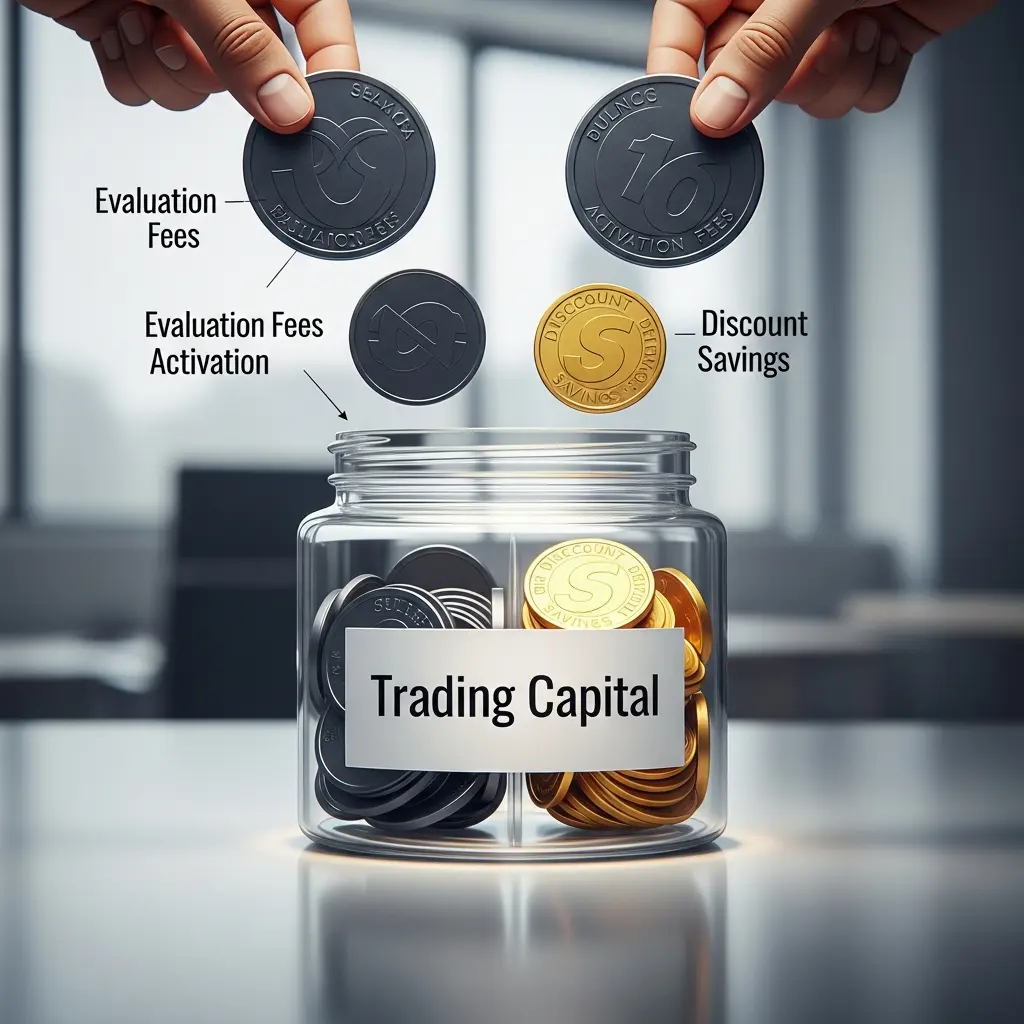
Two codes advertising the same percentage can differ in value by a factor of three. The variable is structure — what the discount attaches to and how long it lasts. These four structures appear in futures prop pricing, ranked by real value over a realistic holding period rather than by banner size.
| Structure | What it does | Typical real value | Best case for using it |
|---|---|---|---|
| One-time percentage off | Reduces the first subscription payment only | Lowest — worth one month of the reduction and nothing after | You expect to pass fast, or you are testing the firm |
| Recurring ("for life") percentage | Reduces every subscription payment for as long as the plan runs | Highest over time — compounds with every month held and every account run | Any holding period beyond a month or two |
| Activation fee waiver | Removes the fixed charge at the funded step, roughly $130 | High, but conditional — worth exactly nothing if you never pass | You have passed before, or you are close to converting |
| Combined percentage plus waiver | Reduces the subscription and removes the fixed fee | The genuine upper tier of this market | Always, when it is real and verifiable |
The headline number versus the total you pay
The comparison traders get wrong most often: one code offers 50% off an evaluation; the one next to it offers "only" 30%. The 50% looks decisive. But if it applies once, to the first payment, while the 30% applies to every payment for the life of the plan, the second code overtakes the first before the end of month two. Over a year, or across two accounts, it is not close.
The correct method is dull and takes ninety seconds. Write down the subscription price. Multiply it by the months you realistically expect to hold the evaluation — not the number you hope for. Add the activation fee if you expect to reach the funded stage. Apply each code to that total and compare the final figures. Whichever number is smaller wins, regardless of which banner was louder.
The activation fee arithmetic
The activation fee matters because it is a fixed sum rather than a percentage. Roughly $130 does not shrink when you discount your subscription — it sits there, unmoved, waiting at the funded step. That makes fee waivers structurally different from percentage offers, and explains a counterintuitive result: a smaller percentage bundled with a waived activation fee is frequently cheaper, in absolute terms, than a bigger percentage that leaves the fee intact.
The table below works that through. The subscription price used here is a round illustrative placeholder of $100 per month — not a quoted Take Profit Trader rate; take the live figure from the firm's own checkout. The shape of the result holds at any subscription price.
| Scenario (3 months held, then funded) | Subscription cost | Activation fee | Total | Saved vs full price |
|---|---|---|---|---|
| No discount | $300 | $130 | $430 | — |
| 40% off the first payment only | $260 | $130 | $390 | $40 (9%) |
| 40% off every payment, fee unchanged | $180 | $130 | $310 | $120 (28%) |
| 30% off every payment plus waived activation fee | $210 | $0 | $210 | $220 (51%) |
Read the bottom two rows again. The 30% offer beats the 40% offer by $100 over a single evaluation cycle, because the smaller percentage came attached to the removal of a fixed cost. That is the case against shopping by headline number. It also explains why upper-tier promotions — the ones close to a 50% reduction in true cost — are almost always combinations rather than single large percentages. A 50% benefit inclusive of waived fees is a coherent claim; 50% with no mechanism attached is a number.
One condition applies — the caveat discount pages skip. A waived activation fee is worth precisely $0 to a trader who never reaches the funded stage, and most participants do not. Weight a waiver by your realistic probability of converting rather than treating it as guaranteed value — it is worth most to traders who have passed an evaluation before, and least to first-time buyers.
Recurring savings versus a single large cut
Stretch the same model over a year and the gap stops being marginal. A discount that applies for the life of the subscription is not a coupon; it is a permanently lower cost base that applies again to every account you open under the same plan.
| Scenario (12 months held, then funded) | Subscription cost | Activation fee | Total | Saved vs full price |
|---|---|---|---|---|
| No discount | $1,200 | $130 | $1,330 | — |
| 60% off the first payment only | $1,140 | $130 | $1,270 | $60 |
| 40% off every payment | $720 | $130 | $850 | $480 |
A 40% recurring discount produces eight times the saving of a 60% one-time cut over twelve months, on the same illustrative pricing. Run two accounts and the gap doubles again, because the recurring reduction applies to both while the one-time cut applied to one payment on one plan. That is why we treat "for life" as a materially different product category rather than a marketing adjective. The same logic runs across the industry — we set out the general version in our guide to prop firm discount codes.
Verifying a Take Profit Trader discount code before you trust it

Verification is not a nice-to-have here; it is the topic. Published prop firm codes skew heavily toward the expired and the fictional, and the cost of trusting the wrong one is a purchase made at full price under the impression it was discounted.
What a legitimate offer looks like
Real, high-value discounts on futures evaluations have historically clustered in a narrow band: roughly 30% to 40% off the evaluation, occasionally paired with a waived activation fee. That band reflects what a firm can sustain given its servicing costs, payout obligations and acquisition economics. A promotion inside it is plausible on its face. One far outside needs a stated reason — a launch, a seasonal window, a bundle — and if no reason is given, the absence is the answer.
A legitimate offer also has boundaries: it applies to something specific, it has a start and an end, and it either recurs or it does not. Vagueness signals a fabricated code, because a real one comes from the firm's own promotional calendar and therefore has terms. If nobody can tell you the terms, nobody has seen them.
How to check a code in ninety seconds
Take the code to the firm's own checkout, enter it, and watch the total. If the displayed total does not change, the code does not exist, regardless of how many sites published it. Then check whether the reduction persists on the renewal line rather than only the first charge — that detail separates the highest-value structure from the lowest. Finally, read what the checkout says about the activation fee — a waiver is often applied at a different step and may not show until conversion.
| Signal | Reads as legitimate | Reads as fabricated |
|---|---|---|
| Stated mechanism | Names what is reduced — subscription, activation fee, or both | A bare percentage with no object |
| Magnitude | Sits in the 30%–40% band, or higher only with a stated reason | 75% or 90% with no explanation |
| Expiry | Has a date, or is explicitly open-ended | "Limited time" with a rolling countdown that never ends |
| Recurrence | Says clearly whether it applies once or for the life of the plan | Silent — you find out on the second invoice |
| Checkout behaviour | Total visibly drops before payment details | Nothing changes; the page blames "regional restrictions" |
Why aggregator inflation happens
Once you see the incentive you stop being surprised by the behaviour. Coupon aggregators are paid per click and per conversion. A page titled "Take Profit Trader 90% Off" out-clicks a page titled "Take Profit Trader: no current promotion", so the inflated title wins the traffic, and the affiliate link underneath pays out on any purchase, discounted or not. Nothing in that chain rewards accuracy or punishes a code that fails at checkout — the visitor usually assumes they made a mistake and buys anyway.
The practical defence is to anchor your expectations. If genuine offers in this segment land around 30% to 40%, every 90% headline becomes self-identifying noise. It is also why we would rather publish "no verified offer" than fill the gap — the alternative is joining the pool of pages that made this a hard question in the first place.
How rule changes affect what a discount is worth
Discount value is not fixed by the discount. It is set jointly by the price and by how long the thing you bought survives — the mechanism most discount coverage misses, and the reason a firm's rule updates belong in a cost conversation.
Rule flexibility and cost efficiency are the same lever
Every rule that ends an evaluation early — a drawdown definition, a consistency requirement, a daily loss limit, a restriction on holding through an event — converts one purchase into two. Loosen those constraints and the average account lives longer, which means fewer repurchases per funded account and a lower effective cost per attempt with no change to the sticker price. Rule flexibility is a discount that does not announce itself as one.
Now combine the two levers. A recurring subscription discount lowers what each month costs; more forgiving rules increase how much value you extract before the account ends. Together they compound: you pay less per month and need fewer restarts. This is why we assess a firm's rule set and its pricing as one question, and never rank firms on entry price alone.
We deliberately do not restate specific rule thresholds inside an article about pricing. Rules change, articles do not, and a stale drawdown figure is worse than no figure. Take the current rule set from Take Profit Trader's own site and read it against the cost model above.
Why a rule update raises the value of an ordinary promotion
An unchanged percentage can be worth more this quarter than last. If a firm relaxed a constraint that previously ended accounts early, an account bought today lives longer than the same account bought before the change, so a recurring discount applies across more months. The promotion did not improve. The asset it discounts did.
It runs in reverse too. A tightened rule shortens an account's expected lifespan and quietly reduces what any recurring discount is worth. If a firm advertises a larger discount while tightening its evaluation criteria, the net position may be worse, not better. Judging a promotion without reading what changed around it is how traders end up paying less for something worth considerably less. For a like-for-like view of two firms with similar pricing structures, our Topstep and Take Profit Trader comparison works through the rule sets in detail.
Building the discount into a long-term cost plan

A discount used once is a small saving. A discount structure understood properly becomes a permanent line in your budget. The traders who get the most out of prop firm pricing are not the ones who find the biggest code; they decide in advance what they will spend in a year and make the pricing structure serve that number.
Why recurring savings compound
The arithmetic above showed a recurring 40% reduction producing roughly $480 of annual saving on illustrative pricing, against $60 for a large one-time cut. Extend that across how traders actually operate — several attempts, sometimes more than one account at once, over a multi-year horizon — and the recurring structure is a different category of outcome. Every additional month and every additional account multiplies the recurring benefit while leaving the one-time benefit where it was.
This is why we weight a "for life" reduction heavily even when its headline number is the smaller one. The correct comparison is never percentage against percentage; it is total expected spend against total expected spend, over the period you intend to trade.
Timing, and the funded-stage question
Timing matters in two ways, and neither is the one traders assume. First: when a discount is recurring, the moment you start the plan sets your cost base for as long as that plan runs. Starting an evaluation the week before a promotion goes live and the week after are not equivalent decisions — one locks a lower rate for the life of the account. If a recurring offer is live and you intended to start anyway, starting inside the window is simply better.
Second: fee-waiver value is concentrated at the funded step. The activation fee is the largest single fixed charge in the sequence, so a waiver is worth most to a trader close to converting and nothing to one who is not. That argues against a common mistake — buying an extra evaluation purely because a waiver is available. A waiver reduces the price of a step you were going to take; it is not a reason to take a step you were not.
The last consideration is what happens after conversion, since the point is being paid. We track prop firm payouts on-chain where the transactions are publicly verifiable, and the record for firms we cover sits on our payout verification page. A cheap entry into a firm with a weak payout record is not a saving.
Putting the saving into your P&L
The last step turns a discount into something structural: treat the saving as capital, not as money you did not spend. If a recurring discount reduces your annual outlay by roughly $500, that $500 is not simply absent from the credit card bill — it is $500 of additional risk capital that can fund another evaluation attempt, cover a month of platform costs during a drawdown, or support scaling into a larger account tier.
The question then changes from "how much can be knocked off this purchase" to "what does a funded-account programme cost to run for a year". That is how a business thinks about its cost base. The broader version — a cost plan across several futures firms rather than one purchase — is covered in our piece on mastering futures prop firm discounts for scalable trading.
What is actually on offer at Take Profit Trader right now
The direct answer, stated as plainly as we can: Capital Critic has no verified, active Take Profit Trader discount code to publish at the time of writing. Not a smaller one, not a partial one, not one behind a link. If we had a working code we would print it, because that is the entire purpose of a page like this. We would rather this section be short and true than long and useful-looking.
The table below sets out the offer types in this segment, what each is worth, and what we can confirm for this firm — the honest version of the "codes list" this page would otherwise carry.
| Offer type | What it typically looks like in this segment | Value if genuine | Capital Critic verified status |
|---|---|---|---|
| Evaluation subscription discount | Historically clusters around 30%–40% off | Moderate to high, depending on whether it recurs | None verified — no active code confirmed |
| Recurring "for life" discount | Applies to every payment while the plan is active | Highest over any realistic holding period | None verified — no active code confirmed |
| Activation fee waiver | Removes the roughly $130 funded-stage charge | High, conditional on actually converting | None verified — no active code confirmed |
| Combined discount and waiver | The upper tier — a near-50% cut in true first-cycle cost | Highest available in this market | None verified — no active code confirmed |
| Aggregator "75% off" or "90% off" claims | A headline with no stated mechanism | Typically zero at checkout | Not an offer — treat as advertising |
When that changes, it will change in one place first: our current firm offers page, where verified promotions — and their absence — are recorded. That is a deliberately unglamorous way to run a discount page, and the only version we are willing to publish.
Frequently asked questions
Is there a working Take Profit Trader discount code right now?
Not one that we have verified. Capital Critic has no confirmed active Take Profit Trader discount code at the time of writing, and we do not publish codes we cannot see working at checkout. Codes for this firm on coupon aggregators should be assumed expired or fabricated until you have watched one reduce your total on the firm's own payment page.
How much do genuine prop firm discounts usually take off?
Real, high-value promotions on futures evaluations have historically clustered between about 30% and 40% off the evaluation price, sometimes combined with a waived activation fee. Offers above that range almost always come with a stated reason such as a launch or a seasonal window. A page advertising 75% or 90% off with no mechanism attached is advertising, not a discount.
Is a bigger percentage always the better deal?
No, and this is the most common expensive mistake on this topic. A 30% discount that applies to every payment and waives the roughly $130 activation fee can cost materially less in total than a 40% discount that applies once and leaves the fee intact. Compare the total you will pay under each option over your realistic holding period, not the two percentages.
What is the Take Profit Trader activation fee?
It is the one-off charge applied when a passed evaluation is converted into a funded, payout-eligible account, and at Take Profit Trader it sits in the region of $130. Because it is a fixed sum, it is untouched by a percentage discount on the subscription — which is why an offer that waives it is often worth more than one that adds a few points to the subscription reduction.
Does a discount make an evaluation easier to pass?
No. A discount changes what you pay and nothing else — the drawdown limits, daily loss rules and consistency requirements are identical whether you paid full price or not. A lower cost base changes your ability to absorb an unsuccessful attempt without leaving the process, and the pressure you put on yourself to force a result before the next billing date.
When is a cheap evaluation a false economy?
When the price changes your behaviour. A discount that persuades you to open three accounts you cannot supervise, to buy a size your strategy does not support, or to choose a firm with a weaker payout record, has cost you more than it saved. Select the firm on rules and payout reliability first, then apply whatever discount exists to that decision.
Where should I check for a Take Profit Trader offer before buying?
Start with the firm's own site and checkout, the only authoritative source for both price and rules, and treat anything that does not reduce the visible total as non-existent. Then use a source willing to publish an empty result rather than fill it — verified promotions across the firms we cover, and their absence, are recorded on our offers page.
A note on risk before you spend anything
Evaluation and activation fees are real money, spent up front, with no guarantee of return. Most people who buy a prop firm evaluation never reach a payout, and a discount does not change that — it only changes the price of finding out. Treat these fees as capital you can afford to lose entirely.
If cost is the deciding factor, compare the full picture rather than one firm's promotional page: rules, fee structure, account models and verified payout history together. Our firm comparison table is built for that, and every figure in it comes from the firms' own live pricing, checked rather than copied.