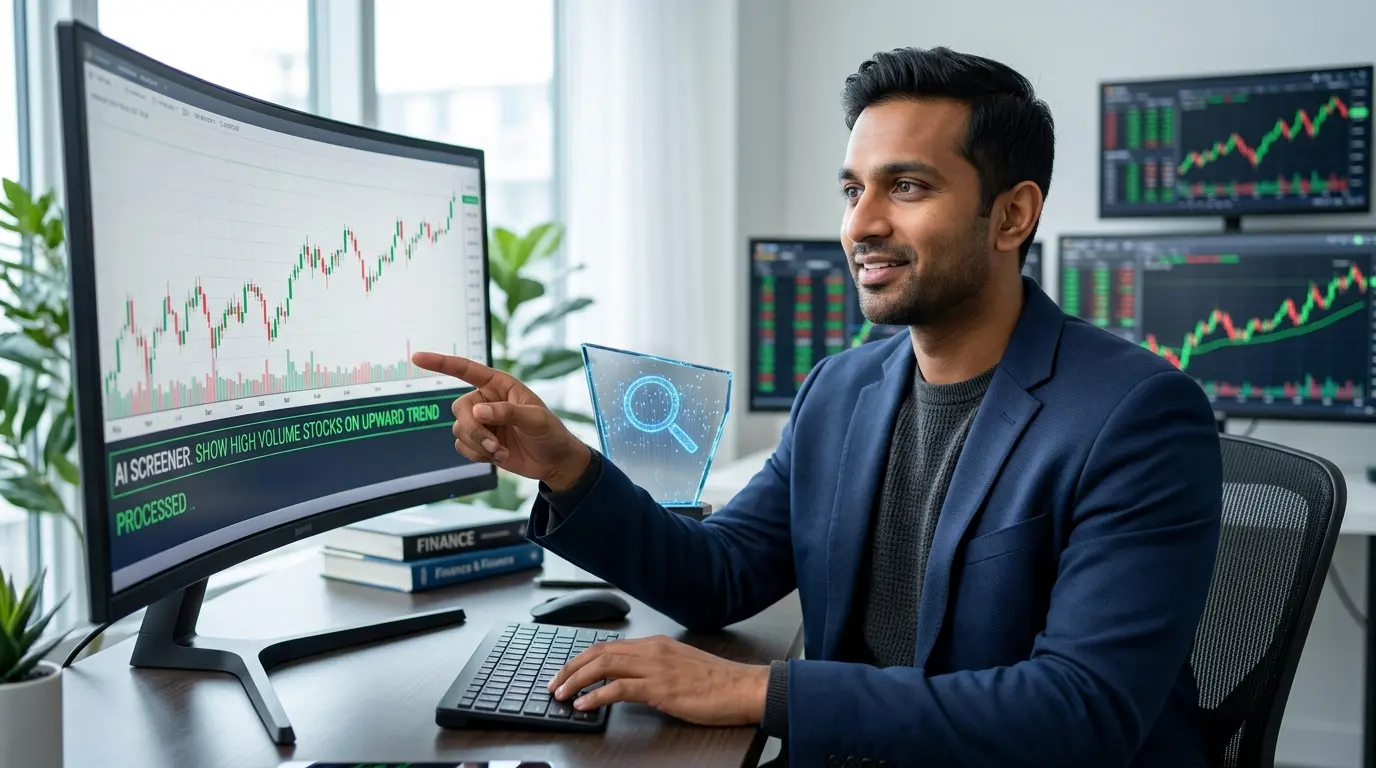
On August 17, 2026, charting platform TradingView launched its AI Screener, a natural-language tool integrated into its core Stock Screener that automatically generates custom filters, data columns, and sorting rules from plain-text prompts. The release allows retail stock, index, and futures traders to instantly convert complex scanning parameters—such as finding breakout candidates with low debt and high momentum—into executable filters without manually configuring individual parameters. By lowering technical barriers for routine market scans, TradingView aims to streamline pre-market prep and technical filtering across global equities and linked index derivatives.
Key Takeaways
- TradingView launched its AI Screener on August 17, 2026, enabling plain-language prompt conversion into dynamic stock filters.
- The tool automatically populates technical and fundamental criteria, custom columns, and sorting preferences within TradingView's Stock Screener.
- Retail equity and index futures traders gain faster trade-idea generation, reducing pre-market scanning setup times.
- This deployment reflects a broader industry transition toward AI-assisted charting interfaces across retail trading platforms.
What Happened: TradingView Integrates Plain-Language AI Screening
On August 17, 2026, charting platform TradingView introduced the AI Screener, an automated workflow feature embedded directly inside TradingView's existing Stock Screener module, according to reports published by LeapRate and FX News Group. The feature allows users to type natural-language instructions—such as requesting dividend-paying mid-cap technology stocks trading near 52-week highs—and automatically generates the corresponding numeric filters, structural data columns, and sorting rules.
Previously, traders using TradingView's Stock Screener were required to locate and set specific criteria across hundreds of fundamental indicators, technical oscillators, and market cap metrics manually. The AI Screener parses prompt syntax, interprets conditional trading requirements, and instantly applies multi-variable parameters across supported asset lists. While initially focused on equities, the feature establishes a conversational query engine designed to handle multi-asset parameters.
Why It Matters for Traders: Speed, Filtering, and Algorithmic Workflows
For retail equities traders, index futures speculators, and prop-firm challenge traders, efficient scanning directly impacts execution quality and opportunity discovery. The primary advantage of TradingView's AI Screener lies in reducing the time required to translate discretionary trading hypotheses into functional watchlists during volatile market openings.
In modern electronic trading, speed in identifying structural market shifts—such as relative strength during index pullbacks or volume surges in specific market sectors—is critical. Discretionary traders often miss late-breaking opportunities because building precise multi-criteria screeners manually during active sessions introduces delay. By converting descriptive prompts into active criteria instantly, TradingView reduces setup latency, allowing traders to spend more time evaluating price action, key levels, and risk parameters.
Furthermore, TradingView's update arrives amidst a wider technological race among major trading platform providers to integrate conversational artificial intelligence into retail execution environments. Recent developments across the industry include cTrader CLI AI integration for automated strategy development and Match-Trader's AI skills release for broker workflow integration. As platform vendors embed machine learning directly into chart packages, traders are increasingly expected to leverage automated tooling to keep pace with algorithmic market structures.
However, traders must remain cautious regarding prompt accuracy and filter logic. Generative search tools can misinterpret ambiguous phrasing, potentially omitting valid tickers or including assets that fail subtle risk thresholds. Verifying that generated filter parameters strictly reflect intended mathematical bounds remains an essential step before executing orders based on AI-generated watchlists.
What to Watch Next: Asset Expansion and Competitive Platform Responses
Following the August 17 launch of the AI Screener within the Stock Screener module, traders should monitor several key operational developments:
- Asset Class Expansion: Observe whether TradingView extends plain-language AI screening to Forex pairs, crypto assets, and futures contracts, where volume profile and macroeconomic filters are heavily utilized.
- Broker Execution Integrations: Track whether TradingView connects prompt-driven screening directly to direct order placement via linked brokerage endpoints.
- Platform Competition: Monitor how alternative trading environments respond. Competitors evaluated in our MT4 vs MT5 platform comparisons and retail broker platforms are actively developing rival prompt-based scanning interfaces.
- Data Depth and Analytics: Watch for potential updates allowing complex pine-script logic or custom indicator criteria to be generated via conversational prompts within the screener tool.
Frequently Asked Questions
What is the TradingView AI Screener?
The TradingView AI Screener is a tool launched on August 17, 2026, that allows traders to build custom stock filters using natural language prompts. Instead of setting numerical parameters manually, users describe their criteria in plain text, and TradingView automatically generates matching filters, table columns, and sorting criteria.
Does the TradingView AI Screener provide trade recommendations?
No, the TradingView AI Screener does not generate trade signals or direct financial recommendations. It functions solely as a workflow automation tool that filters asset databases based on user-defined prompt criteria, requiring traders to perform independent technical and risk analysis before trading.
Which asset classes are supported by TradingView's AI Screener?
At launch on August 17, 2026, TradingView implemented the AI Screener functionality within its Stock Screener module for equity markets. Traders should monitor future platform updates for expansion into foreign exchange, cryptocurrency, and futures contracts databases.
Trading carries a substantial risk of loss; past performance and prior market reactions do not guarantee future results. This is market commentary, not advice.