

Futures trading hours run on a 23/5 schedule, not 24/7: the market opens Sunday at 5:00 p.m. Central Time, closes Friday at 4:00 p.m. Central Time, and pauses for one hour every weekday afternoon between 4:00 p.m. and 5:00 p.m. CT. That hour is not downtime the exchange forgot to remove — it is the daily clearing and settlement window that keeps the system solvent, and it resets the trade date for every open position. Everything else traders call "futures hours" sits on top of that skeleton: product-specific schedules that differ sharply by asset class, liquidity that swings enormously within a single session, and a 49-hour weekend hole in which the world keeps generating news that nobody can price. Understanding the difference between when the market is open and when the market is tradeable is the whole point of this guide.
Key takeaways
- Futures are a 23/5 market: Sunday 5:00 p.m. CT open, Friday 4:00 p.m. CT close, with a mandatory 60-minute halt from 4:00 p.m. to 5:00 p.m. CT every weekday. That is roughly 115 tradeable hours out of the 168 in a week.
- The daily break exists to run settlement, mark every position to market and collect variation margin. It is a solvency mechanism, not an inconvenience.
- Equity indices, metals and energy follow the standard 23/5 electronic schedule. Grains and livestock still trade on schedules inherited from the pit — roughly 8:30 a.m. to 1:20 p.m. CT for grains and 8:30 a.m. to 1:05 p.m. CT for livestock — because they settle into physical delivery.
- Open does not mean liquid. The 9:30 a.m. to 4:00 p.m. ET U.S. cash equity session anchors real depth; a 3:00 a.m. ET book in the same contract can be a fraction of it, with wider spreads and worse fills.
- The weekend is the only true halt. From Friday 4:00 p.m. CT to Sunday 5:00 p.m. CT there is no centralised price discovery, and the Sunday reopen prices 49 hours of news in one move.
- U.S. equities are drifting toward the futures model — Nasdaq has signalled an overnight session opening at 9:00 p.m. ET — which adds hours without adding institutional volume, so spreads in those windows widen rather than tighten.
- For prop firm traders, the clock is a rules problem before it is a strategy problem: daily loss limits, drawdown recalculation, news lockouts and flat-by-close requirements are all keyed to specific times in a specific time zone.
The 23/5 model: what the futures week actually looks like
New futures traders — particularly those arriving from crypto, where the order book genuinely never sleeps — routinely assume the market is open around the clock. It is not, and the difference matters the first time a stop sits unfilled through a settlement halt or a weekend. The futures market is a globally integrated, exchange-cleared system operating on a strict 23/5 cycle: five trading days, twenty-three hours each, with one hour removed daily and the entire weekend removed wholesale.
The week begins Sunday at 5:00 p.m. CT. From that moment the electronic order book runs continuously — bids, offers and executions flowing through the Asian, European and U.S. sessions — until the last weekday session closes on Friday at 4:00 p.m. CT. Between those two points, the only scheduled interruption is the daily maintenance and settlement window from 4:00 p.m. to 5:00 p.m. CT, plus a short product-specific halt in equity index contracts each afternoon.
The weekly clock, hour by hour
Every time below is Central Time, because that is the exchange's clock and the one every product schedule is published in. If you convert everything into your local zone once and write it down, you eliminate an entire category of avoidable mistakes.
| Window (CT) | Status | What it means for you |
|---|---|---|
| Sunday 5:00 p.m. | Weekly open | The first print of the week. Prices 49 hours of accumulated news; spreads are wide for the first several minutes. |
| Sunday 5:00 p.m. – Monday 4:00 p.m. | Session 1 (23 hours) | Continuous trading through Asia, Europe and the full U.S. day. |
| Monday–Thursday 4:00 p.m. – 5:00 p.m. | Daily halt | Settlement, mark-to-market, margin calculation and system maintenance. No trading. |
| Monday–Thursday 5:00 p.m. | New trade date opens | The next 23-hour session begins immediately after the halt. |
| Friday 4:00 p.m. | Weekly close | Final print of the week. Whatever you are holding, you hold until Sunday. |
| Friday 4:00 p.m. – Sunday 5:00 p.m. | Closed (49 hours) | No centralised price discovery. Positions are frozen and exposed to gap risk. |
Five sessions of 23 hours gives roughly 115 tradeable hours a week against 168 hours on the calendar. That is a lot of access — far more than the cash equity market offers — but it is emphatically not continuous, and the 53 hours that are missing are not randomly distributed. They are concentrated exactly where risk accumulates fastest: overnight into settlement, and across the weekend.
Why the daily halt exists — and why you should want it
The 60-minute break is where the exchange and its clearing house do the work that makes an anonymous, highly leveraged marketplace possible. During that hour the day's settlement price is established, every open position is marked to market, gains and losses are moved between accounts as variation margin, and the clearing house re-runs its risk models against the new exposures. Then a new trade date opens and the cycle restarts.
| Function during the halt | What happens | Why it matters to a trader |
|---|---|---|
| Daily settlement price | The exchange fixes an official closing price for each contract month. | This is the number your P&L, your margin requirement and most prop firm drawdown calculations are measured against. |
| Mark-to-market | Every open position is revalued at the settlement price. | Unrealised losses become real cash movements overnight, not at some future exit. |
| Variation margin | Cash moves between losing and winning accounts through the clearing house. | This is why counterparty risk is effectively removed — and why undercapitalised accounts get liquidated quickly. |
| Risk model re-run | Initial margin requirements are recalculated for the new session. | Margin can rise between sessions after a volatile day, reducing the size you can carry. |
| New trade date | The 5:00 p.m. CT reopen belongs to the next business day. | A trade placed at 5:30 p.m. CT on Monday is a Tuesday trade — which matters enormously for daily-loss-limit rules. |
Traders who have just watched a setup form at 3:55 p.m. CT tend to resent the halt. That resentment is misplaced. Without a daily settlement, leverage of this magnitude across this many participants would have no mechanism for removing accumulated losses from the system before they compound. The hour you cannot trade is the reason the contract you are trading is worth anything.
There is a second, narrower interruption worth knowing: equity index futures observe a short halt in the late afternoon, from 3:15 p.m. to 3:30 p.m. CT, before resuming until the 4:00 p.m. CT settlement. It catches people out constantly, because it lands in the middle of what feels like an active post-cash-close window.
Asset-specific futures trading hours: the schedule is not universal
The 23/5 cycle is the backbone of the modern futures market, but treating every contract as if it shares one schedule is a mistake that produces unfillable orders and unmanageable overnight risk. Product hours are set by what the contract actually is. A stock index is a number; a bushel of wheat is a physical object that has to arrive somewhere.
The standardised core: indices, metals, energy and rates
Equity indices such as the E-mini S&P 500 (ES) and the Nasdaq-100 (NQ), precious metals such as Gold (GC), energy products such as WTI Crude Oil (CL), Treasury futures and major FX futures all follow the standard electronic schedule: Sunday 5:00 p.m. CT to Friday 4:00 p.m. CT, with the daily 4:00 p.m. to 5:00 p.m. CT halt.
| Contract | Symbol | Electronic hours (CT) | Scheduled interruptions |
|---|---|---|---|
| E-mini S&P 500 | ES | Sun 5:00 p.m. – Fri 4:00 p.m. | Daily 4:00–5:00 p.m.; plus 3:15–3:30 p.m. halt |
| E-mini Nasdaq-100 | NQ | Sun 5:00 p.m. – Fri 4:00 p.m. | Daily 4:00–5:00 p.m.; plus 3:15–3:30 p.m. halt |
| E-mini Dow | YM | Sun 5:00 p.m. – Fri 4:00 p.m. | Daily 4:00–5:00 p.m.; plus 3:15–3:30 p.m. halt |
| E-mini Russell 2000 | RTY | Sun 5:00 p.m. – Fri 4:00 p.m. | Daily 4:00–5:00 p.m.; plus 3:15–3:30 p.m. halt |
| Gold | GC | Sun 5:00 p.m. – Fri 4:00 p.m. | Daily 4:00–5:00 p.m. |
| Silver | SI | Sun 5:00 p.m. – Fri 4:00 p.m. | Daily 4:00–5:00 p.m. |
| WTI Crude Oil | CL | Sun 5:00 p.m. – Fri 4:00 p.m. | Daily 4:00–5:00 p.m. |
| Natural Gas | NG | Sun 5:00 p.m. – Fri 4:00 p.m. | Daily 4:00–5:00 p.m. |
| 10-Year T-Note | ZN | Sun 5:00 p.m. – Fri 4:00 p.m. | Daily 4:00–5:00 p.m. |
| Euro FX | 6E | Sun 5:00 p.m. – Fri 4:00 p.m. | Daily 4:00–5:00 p.m. |
You can technically place an order in any of these at 2:00 a.m. CT and get filled. Whether that fill is one you would have accepted at midday is a separate question, and it is the question that decides most overnight outcomes. The market being open is a statement about infrastructure. It is not a statement about the depth of the book behind your order.
Pit legacy: agricultural and livestock contracts
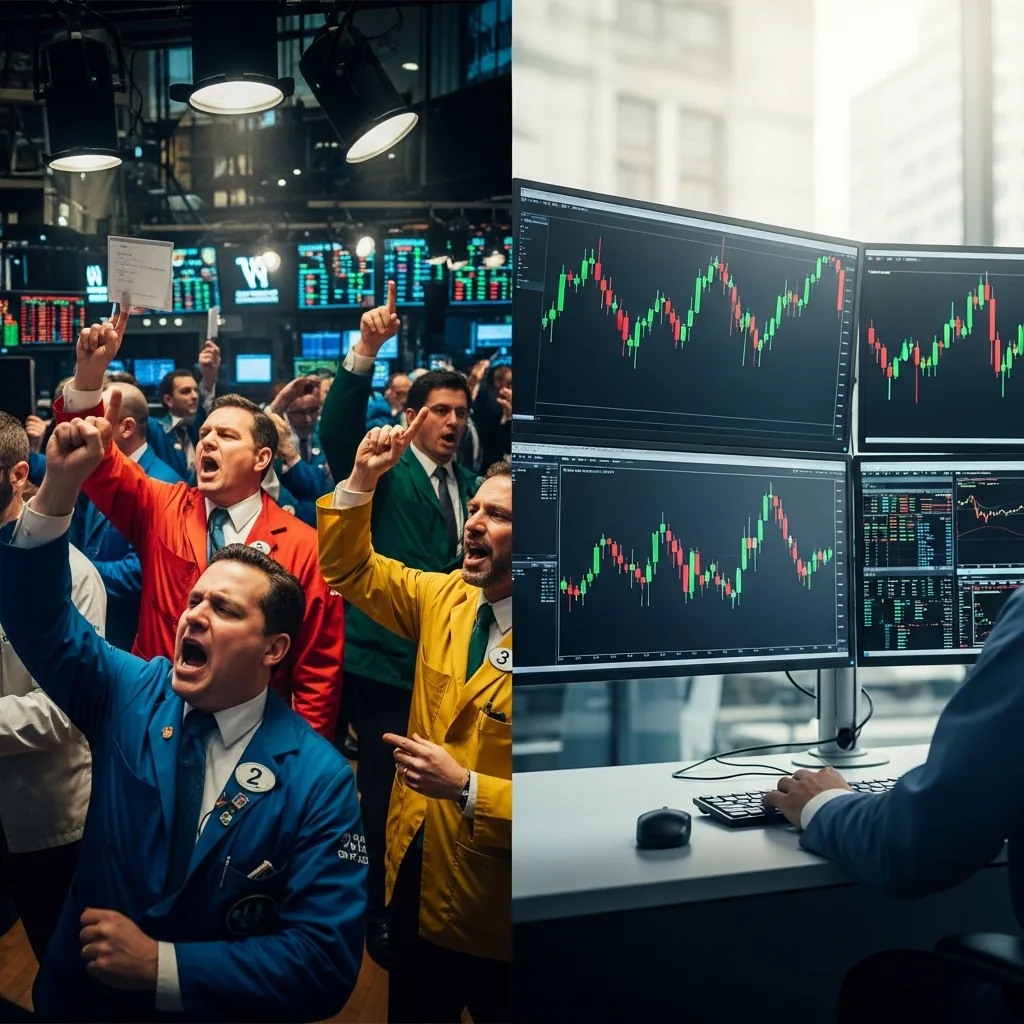
Grains, oilseeds and livestock keep a distinctly pit-shaped personality. Grain futures run a split schedule — an overnight electronic window plus a daytime session that mirrors the old floor hours of 8:30 a.m. to 1:20 p.m. CT. Livestock contracts do not have a meaningful overnight session at all; they open at 8:30 a.m. CT and close in the early afternoon.
| Contract | Symbol | Overnight session (CT) | Day session (CT) |
|---|---|---|---|
| Corn | ZC | Sun–Fri 7:00 p.m. – 7:45 a.m. | Mon–Fri 8:30 a.m. – 1:20 p.m. |
| Soybeans | ZS | Sun–Fri 7:00 p.m. – 7:45 a.m. | Mon–Fri 8:30 a.m. – 1:20 p.m. |
| Wheat | ZW | Sun–Fri 7:00 p.m. – 7:45 a.m. | Mon–Fri 8:30 a.m. – 1:20 p.m. |
| Live Cattle | LE | None | Mon–Fri 8:30 a.m. – 1:05 p.m. |
| Feeder Cattle | GF | None | Mon–Fri 8:30 a.m. – 1:05 p.m. |
| Lean Hogs | HE | None | Mon–Fri 8:30 a.m. – 1:05 p.m. |
The reason is structural rather than sentimental. A wheat contract is a claim on 5,000 bushels of physical grain that must be inspected, stored, loaded and delivered against warehouse receipts by people who work business hours. Coordinating that at 3:00 a.m. serves nobody. The commercial hedgers who set the price in these markets — elevators, processors, packers — operate on the same daytime clock, and the daily close at 1:20 p.m. or 1:05 p.m. CT lines up with when the cash market for the underlying commodity actually functions.
The practical consequence is severe if you ignore it. A grain position carried into the 7:45 a.m. CT gap between sessions cannot be exited for 45 minutes, and the reopen at 8:30 a.m. CT frequently prices an overnight weather model or an export sale in a single move. A livestock position carried past 1:05 p.m. CT is held overnight with no session at all to manage it in.
Check before you assume
Product hours change. Exchanges revise schedules, holiday calendars introduce early closes and full closures, and daylight saving transitions land on different dates in the U.S. and Europe, which shifts the relationship between the exchange clock and everything else for a couple of weeks each year. Before you trade a contract you have not traded before, confirm three things: the exact session hours, the holiday schedule for the coming month, and the last trading day and settlement method of the contract month you are in.
That last one is not strictly an "hours" question, but it produces the same category of accident. A cash-settled index contract and a physically-delivered commodity contract behave very differently in their final week, and the trader who discovers this by accident usually discovers it expensively.
Liquidity peaks and dead zones: open is not the same as tradeable
The most costly misreading of the 23/5 schedule is the assumption that all 23 hours offer the same opportunity. Liquidity is not a constant background condition. It concentrates and disperses on a predictable daily rhythm driven by when the institutions that actually move size are at their desks.
The U.S. cash equity session is the anchor
Despite everything electronic markets have made possible, the U.S. cash equity market still keeps banker's hours: 9:30 a.m. to 4:00 p.m. ET. That window remains the gravitational centre of the entire complex. Index futures, the options complex, ETF creation and redemption, institutional rebalancing and the bulk of published research all orbit it. When the cash market is open, the futures order book is deep, the spread in a contract like ES is at its tightest, and a market order of reasonable size executes at a price close to the one you saw.
| Window (ET) | Typical depth | Character |
|---|---|---|
| 6:00 p.m. – 2:00 a.m. | Thinnest | Asian session. Drifting, low-participation trade; single orders can move price disproportionately. |
| 2:00 a.m. – 7:00 a.m. | Moderate | London opens; European macro data prints. Genuine directional moves begin here. |
| 7:00 a.m. – 8:30 a.m. | Building | U.S. pre-market. Earnings releases and positioning ahead of data. |
| 8:30 a.m. – 9:30 a.m. | Sharp spikes | Major U.S. macro releases. Depth evaporates seconds before the print and returns after. |
| 9:30 a.m. – 11:00 a.m. | Peak | Cash open. Highest volume, tightest spreads, most reliable execution of the day. |
| 11:00 a.m. – 1:30 p.m. | Declining | Midday lull. Ranges compress, breakouts fail more often. |
| 1:30 p.m. – 3:00 p.m. | Rebuilding | Afternoon trend development; Fed announcements land at 2:00 p.m. on decision days. |
| 3:00 p.m. – 4:00 p.m. | Second peak | Cash close and market-on-close imbalances. High volume, fast reversals. |
| 4:00 p.m. – 5:00 p.m. | Falling away | Post-close earnings reactions; equity index futures halt 4:15–4:30 p.m. |
| 5:00 p.m. – 6:00 p.m. | Closed | Daily settlement halt (4:00–5:00 p.m. CT). |
The overnight session: open, quiet, and quietly dangerous
The overnight book is where the gap between "official hours" and "effective liquidity" becomes an actual cost. With institutional participation minimal, the same instrument that traded a one-tick spread at 10:00 a.m. ET can show a wider, thinner ladder at 3:00 a.m. ET. Three things change simultaneously, and they compound:
- Spreads widen. The cost of entering and exiting rises before your idea has had a chance to be right or wrong.
- Slippage increases. Stop orders become market orders when triggered, and a market order into a thin book fills through several price levels rather than one.
- Price becomes less informative. A move on low volume carries less information than the same move on high volume, so overnight breakouts fail at a higher rate and technical levels hold less reliably.
Attempting to scalp an equity index at 3:00 a.m. ET with the same size, the same stop distance and the same expectations you use at 10:00 a.m. ET is not an aggressive strategy. It is the same strategy applied to a market that no longer supports it. Having sat on the firm side of thousands of evaluations, the failure data is remarkably boring: it is almost never the strategy that breaks an account, it is position sizing that stays constant while conditions do not — most often after a loss, and most often in a session the trader had no business trading at full size.
Adjusting to the liquidity curve
The fix is unglamorous and it is mostly arithmetic. If your normal size during peak hours is 5 contracts, your overnight size is 1 or 2 — not because overnight trading is forbidden, but because the effective cost of each round turn is higher and the price of being wrong is less controllable. Everything else in the plan adjusts with it.
| Variable | Peak session (9:30 a.m. – 11:00 a.m. ET) | Overnight (6:00 p.m. – 2:00 a.m. ET) |
|---|---|---|
| Position size | Full plan size — e.g. 5 contracts | 1 to 2 contracts |
| Entry orders | Market orders acceptable | Limit orders only |
| Stop placement | Structural, tight to the level | Wider, outside the noise band the thin book creates |
| Profit targets | Normal expectancy | Reduced — ranges are narrower until a session opens |
| Trade frequency | Highest | Selective; wait for London or a scheduled release |
| Strategy type | Momentum, breakout, mean reversion all viable | Range and level-to-level trade favoured; breakouts unreliable |
Widening a stop while keeping size constant increases risk rather than managing it, so the two adjustments have to be made together — smaller size and wider stop, sized so the dollar risk per trade is unchanged or lower. If you want the full framework for converting account size into per-trade risk, our guide to the 1% rule and risk management for funded traders covers the mechanics in detail.
The weekend gap: 49 hours the market cannot price
The daily halt is one hour. The weekend is forty-nine, and it is the only period in which futures markets stop completely. Between the Friday 4:00 p.m. CT close and the Sunday 5:00 p.m. CT reopen, centralised exchange activity ceases entirely. Geopolitics, central bank commentary, corporate news and physical-market events continue as normal. None of it reaches a price until Sunday evening.

How the gap forms
When trading resumes at 5:00 p.m. CT on Sunday, the market performs a compressed act of catching up. Two days of information have to be expressed in a single reopening price, and the participants doing that expressing are the thinnest crowd of the week. The result is a printed gap: the Sunday open sits above or below the Friday settlement with no trades in between.
The critical mechanical point is that a gap defeats stop orders. A stop is an instruction to become a market order at a price. If the market never trades at that price — because it jumped over it while closed — the order executes at the first available price on the other side of the gap. Consider a $100,000 account with a 5% daily loss limit, holding a position with a stop placed 20 points away in an index contract at $50 per point, so $1,000 of intended risk per contract. If Sunday reopens 60 points against that position, the fill occurs at the gap, and the realised loss is $3,000 per contract rather than $1,000. Nothing malfunctioned. The stop simply had nowhere to work.
Managing gap exposure
There are only a handful of genuine responses, and choosing between them is a business decision rather than a technical one.
| Approach | What it does | Cost or trade-off |
|---|---|---|
| Flat by Friday close | Eliminates gap risk entirely | Forfeits any weekend continuation move; forces exits on trades that are working |
| Reduce size into the weekend | Scales the exposure down rather than removing it | Still exposed, just proportionally less; requires discipline to actually execute on Friday |
| Options hedge on the underlying exposure | Caps the downside of the gap | Premium cost erodes the edge; adds a second instrument to manage |
| Offsetting position in a correlated market | Partially neutralises directional exposure | Correlations break precisely during the shock events that cause large gaps |
| Carry the position unhedged | Keeps full participation in the continuation | Accepts an unquantifiable tail; unacceptable under most prop firm drawdown rules |
Note that for most funded traders the decision is made for you. A large share of futures prop firms simply prohibit holding positions over the weekend, and many require flat well before the Friday settlement. That rule frustrates swing traders, and I understand why — but from the firm's side it is the single cheapest way to remove the one risk that no evaluation metric can model. A trailing drawdown that resets against a settlement price cannot account for a 60-point gap, so firms remove the exposure rather than try to price it.
Where the gap creates opportunity
Not every gap is a shock. A substantial proportion are liquidity artefacts — the product of a thin Sunday book overreacting to a headline that the Monday session, with proper participation, reprices back toward the Friday settlement. This is the basis of gap-fill trading: fading the Sunday extreme in the expectation that price reverts toward the prior close once genuine volume arrives.
It is a real behaviour, and it is also a trap in the specific case where the gap reflects a genuine repricing rather than an overreaction. The discipline is in the distinction: a gap on no identifiable news, in a quiet macro week, is a different proposition from a gap following a weekend policy announcement. Trading the first without confirming it is not the second is how traders convert a statistical tendency into a large single loss. Waiting for the Monday cash open to confirm — rather than acting at 5:15 p.m. CT on Sunday into the thinnest book of the week — costs a few hours of entry and removes most of the ambiguity.
As the wider market drifts toward 23/5 hours in other asset classes, the discipline required to manage the weekend gap remains one of the clearest dividing lines between traders who survive and traders who do not. It is a rule you follow on the Fridays when it feels unnecessary, so that it protects you on the one Friday when it is.
The evolving landscape: equities are moving onto the futures clock
For decades the boundary was clean. Futures ran 23/5; U.S. cash equities ran 9:30 a.m. to 4:00 p.m. ET with a limited pre- and post-market. That boundary is now dissolving. Retail and institutional participants alike are demanding global synchronisation, and the exchanges are responding by extending equity trading toward the model futures traders have used for years.

The overnight equity session
Nasdaq has said it intends to extend trading in U.S. equity securities toward a full five-day, near-continuous model, with an overnight session opening at 9:00 p.m. ET — hours before the traditional cash open, and squarely inside the Asian trading day. In practical terms that means a single-name equity and its index future would trade in broadly the same windows, closing the structural gap between the two markets.
| Market | Current schedule | Direction of travel |
|---|---|---|
| CME futures (index, metals, energy, rates) | Sun 5:00 p.m. CT – Fri 4:00 p.m. CT, daily 1-hour halt | Stable; the 23/5 model is the reference point others are moving toward |
| U.S. cash equities, regular session | 9:30 a.m. – 4:00 p.m. ET | Unchanged as the liquidity anchor |
| U.S. cash equities, extended | Limited pre- and post-market windows | Expanding toward an overnight session opening 9:00 p.m. ET |
| Grains and livestock futures | Pit-legacy day sessions, 8:30 a.m. CT start | Largely static; physical delivery constrains any extension |
More hours does not mean more liquidity
Here is the part that gets lost in the announcements. Extending the hours a market is open does not conjure the institutional volume that makes a market tradeable. Even as equity markets move toward a 23/5 model, the absence of institutional participation during overnight windows means spreads can widen dramatically relative to the regular session. Availability rises; quality of execution does not.
The consequence is a market that is easier to access and harder to trade well. A retail participant can now react to an Asian-hours headline in a U.S. single-name stock — into a book that may be a fraction of its daytime depth, with a spread that consumes a meaningful share of the expected move before the idea has been tested. The same asymmetry that has always existed in overnight futures is being exported into equities, and it will catch a generation of traders who have only ever known the cash session.
What this means if you trade under a prop firm mandate
For funded and evaluation traders, extended hours are simultaneously an opportunity and a compliance problem. The opportunity is obvious: more windows in which to find a setup, and more ability to react to global news without waiting for a U.S. open. The compliance problem is that nearly every prop firm rule is defined against a clock, and those clocks do not all agree.
| Rule | What it keys off | What to confirm before you buy an account |
|---|---|---|
| Daily loss limit | A defined trading day, usually anchored to the 5:00 p.m. CT reopen | Exactly when the counter resets, and in which time zone it is published |
| Trailing drawdown | Either intraday peak equity or end-of-day settlement | Which of the two — this is the single largest difference between firms |
| Session close requirement | A fixed time before the daily halt | The exact flatten time, and whether the platform auto-liquidates or you are penalised |
| Weekend holding | Friday close | Whether it is permitted at all, and by when you must be flat on Friday |
| News lockout | Scheduled macro releases | Which releases, the buffer either side, and whether it applies in evaluation, funded, or both |
| Holiday and early-close days | Exchange calendar | Whether daily limits are pro-rated on shortened sessions |
Two accounts advertised with identical drawdown percentages can behave completely differently depending on whether the drawdown recalculates on intraday equity or on the daily settlement. An intraday-peak trailing drawdown punishes you for giving back an unrealised gain at 2:00 a.m. when the book is thin; a settlement-based one does not. That distinction is worth more than most of the headline numbers firms advertise, and it is exactly the kind of thing our firm comparison tables exist to make visible. If you want to see how we verify what a firm actually does rather than what it claims, the Capital Critic methodology lays out the process.
Building a session plan you can actually follow
Once the schedule is clear, the useful work is turning it into a written plan. The traders who pass evaluations consistently are, in my experience, not the ones with the most sophisticated entries. They are the ones who decided in advance which hours they trade, at what size, and under what conditions they stop — and then did not renegotiate that decision at 1:00 a.m.
A workable session plan answers five questions:
- Which windows do you trade? Pick one or two and specify them in your own local time as well as CT. Most retail traders overestimate how many sessions they can cover attentively.
- What is your size in each window? Full size in the peak window, reduced size in the shoulder windows, minimum size or no size overnight.
- When do you stop? Both a daily loss figure and a number-of-trades ceiling. The second one prevents the slow bleed that the first one does not catch.
- What is your Friday rule? A fixed time by which you are flat, decided before the week starts rather than while a profitable position is running.
- What does your firm's rulebook say about all of the above? Every answer above has to survive contact with the account rules you are trading under.
That last point is not a formality. If you are choosing a futures prop firm, the schedule interacts with the rules in ways that are not obvious from a pricing page — which is why it is worth reading full write-ups such as our Earn2Trade review or the Top One Futures review before committing, and browsing the wider firm review directory for the model that matches how you actually trade. If the end goal is getting paid rather than passing, our on-chain verified payout data is the least subjective evidence available on which firms actually distribute money to traders.
Frequently asked questions
Are futures trading hours really 24/7?
No. Futures trade on a 23/5 schedule, not 24/7. The market opens Sunday at 5:00 p.m. CT and closes Friday at 4:00 p.m. CT, with a mandatory one-hour halt from 4:00 p.m. to 5:00 p.m. CT every weekday for settlement and clearing. That works out to roughly 115 hours a week, with the entire weekend closed.
What time do futures markets open and close each day?
For the core CME products — equity indices, metals, energy, rates and FX — each session runs from 5:00 p.m. CT to 4:00 p.m. CT the following day. Equity index contracts also observe a short additional halt from 3:15 p.m. to 3:30 p.m. CT. Agricultural and livestock contracts follow different, shorter schedules built around the old floor hours.
Why is there a one-hour break in futures trading every afternoon?
The break exists so the exchange and clearing house can settle the day. During that hour the official settlement price is established, every open position is marked to market, variation margin moves between accounts, and margin requirements are recalculated for the next session. It is a solvency mechanism — it removes accumulated losses from the system daily instead of letting them compound.
Do all futures contracts trade the same hours?
No, and assuming they do is a common and expensive error. Financial futures and the major energy and metals contracts follow the standard 23/5 electronic schedule. Grains run a split schedule with a day session from 8:30 a.m. to 1:20 p.m. CT, and livestock contracts trade only 8:30 a.m. to 1:05 p.m. CT with no overnight session, because those contracts settle into physical delivery.
What are the best hours to trade futures?
For equity index futures, the deepest liquidity and tightest spreads occur between 9:30 a.m. and 11:00 a.m. ET when the U.S. cash equity market is open, with a second peak from 3:00 p.m. to 4:00 p.m. ET into the cash close. The 8:30 a.m. ET macro data window and the 2:00 a.m. to 7:00 a.m. ET European session offer genuine movement with less depth. Overnight windows are open but materially thinner, so execution quality falls even when the chart looks tradeable.
What happens to futures prices over the weekend?
Nothing trades, but the world keeps moving. From the Friday 4:00 p.m. CT close to the Sunday 5:00 p.m. CT reopen there is no centralised price discovery, so 49 hours of news gets priced into a single reopening print. That produces gaps, and a gap will execute your stop at the first available price beyond it rather than at your stop price.
Can I hold futures positions over the weekend at a prop firm?
Often not. Many futures prop firms prohibit weekend holds outright and require positions to be flat before the Friday close, because a weekend gap can breach a trailing drawdown before any risk control has a chance to act. Rules vary meaningfully between firms, so confirm the exact flatten time and whether it differs between the evaluation phase and the funded account.
The bottom line
The 24/7 framing is not just imprecise, it is actively misleading about where the risk sits. Futures give you 23 hours a day, five days a week, and within those hours the quality of the market varies enough that treating them as interchangeable is its own form of leverage. The traders who do well with this schedule are the ones who know exactly what time the settlement halt starts, exactly what time their firm's daily loss counter resets, and exactly what size they are permitted to carry into a thin book at 3:00 a.m. That is not glamorous knowledge. It is just the knowledge that stops accounts from failing for reasons that have nothing to do with whether the trade idea was any good.
One honest note before you act on any of this. Evaluation fees are real money that you can lose without ever trading a funded account, and most people who attempt a prop firm challenge do not pass it. Trading futures with leverage can produce losses quickly, particularly across gaps, and nothing in this guide is a promise of income or a suggestion that you increase size. Risk only what you can genuinely afford to lose, and treat the fee as a cost you may not recover.
If you are choosing where to trade this schedule, start with the firms whose rules fit the hours you can actually be at your desk. Comparing evaluation structures, drawdown mechanics and current pricing across firms on Capital Critic's live offers page is a faster way to find that fit than reading marketing pages one at a time.