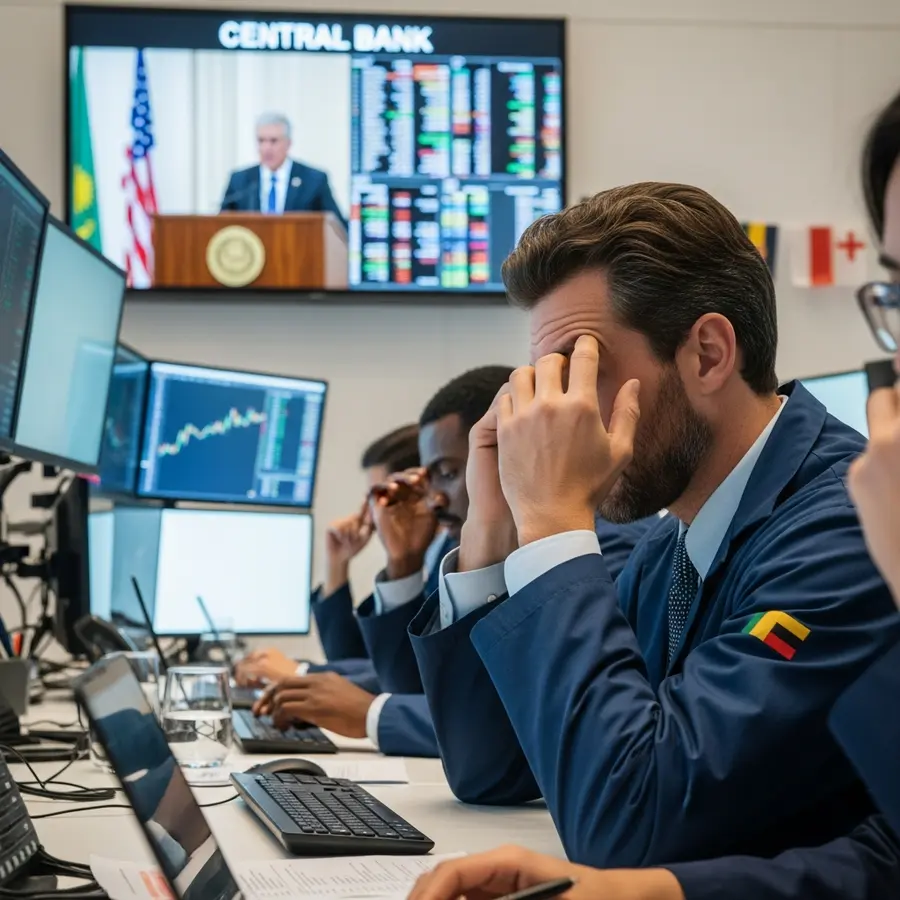
Traders are bracing for an aggressive volatility spike as US stock indices and the US dollar face a dual test from an upcoming Federal Reserve monetary policy decision and a deluge of tech-led corporate earnings. With macro and micro catalysts colliding simultaneously, according to Investing.com, the market setup is prompting defensive positioning and strict risk management across forex and futures markets as participants rapidly reprice risk.
Key takeaways
- US index futures are pricing in elevated volatility as the Federal Reserve interest rate decision intersects with major technology sector earnings.
- Forward guidance from the Federal Reserve remains the primary driver for US dollar currency pairs and Treasury yield futures.
- Heavyweight technology earnings will disproportionately impact Nasdaq 100 liquidity and dictate after-hours price action for index futures.
- Market participants are tightening stop-loss orders to navigate potential whipsaw conditions during the Federal Open Market Committee press conference.
The mechanics behind the Federal Reserve and earnings collision
According to Investing.com, US stocks currently face a critical test driven by a looming Federal Reserve decision and a heavy slate of technology sector earnings. Because the Federal Reserve decision and the technology earnings deluge are occurring simultaneously, market participants cannot rely on traditional single-catalyst risk models. The central bank's policy update provides the overarching macro framework—dictating the cost of capital and US dollar strength—while the technology-led earnings deluge provides the micro fundamentals that justify current equity index valuations.
Without explicit economic data points to front-run in the days prior, algorithmic trading systems and retail participants alike are forced to wait for the actual Federal Reserve statement. The Federal Reserve dictates the broader liquidity environment, but technology companies hold such massive weightings in the S&P 500 and Nasdaq 100 that a single mega-cap earnings miss can override the broader macroeconomic sentiment. Options markets are subsequently pricing in massive implied moves, elevating the cost of hedging for institutional players and widening the baseline spreads for retail futures traders.
Why the dual catalysts matter for forex and futures traders
For active futures and forex traders, a combined Federal Reserve decision and technology earnings deluge represents a classic dual-sided risk environment. The heavy concentration of technology stocks in major indices means that the earnings deluge has an outsized impact on the broader market. When technology giants report quarterly results, Nasdaq 100 futures frequently experience immediate liquidity vacuums and aggressive spread widening. This micro-level volatility forces market makers to pull resting orders, leading to slippage for traders caught on the wrong side of the tape.
The Federal Reserve decision introduces a completely different layer of structural volatility. A hawkish or dovish shift from the Federal Reserve alters the US dollar's trajectory instantly, forcing rapid repricing in major currency pairs like EUR/USD, GBP/USD, and USD/JPY. Yield differentials shift based on the Federal Reserve's forward guidance, which in turn impacts the discount rates applied to those same technology company valuations. A stronger US dollar, driven by hawkish Federal Reserve rhetoric, also creates foreign exchange headwinds for multinational technology companies, compounding the risk. Traders are heavily focused on repricing the Fed based on these shifting interest rate expectations and the resulting currency impacts.
Session timing remains the critical mechanical factor for day traders navigating this environment. Federal Reserve decisions typically trigger immense initial volatility during the standard New York trading session, creating immediate liquidity vacuums at the exact moment the statement is released. This initial shock is quickly followed by the Federal Reserve press conference, where verbal guidance from the Federal Reserve Chair frequently reverses the initial market reaction. Conversely, technology earnings typically release immediately after the closing bell, extending the volatility window well into the electronic trading session. This mirrors broader macroeconomic complexities, similar to how Middle East tensions and the earnings flood are colliding to create unpredictable and extended market catalysts that trap offside positioning.
What to watch next
Traders will scrutinize the Federal Open Market Committee statement language regarding domestic inflation stickiness and labor market stability. Any deviation from expected Federal Reserve policy will trigger immediate repricing across short-term interest rate futures and US dollar pairs. Following the central bank event, traders will shift focus entirely to the after-hours tape for US index futures once the technology sector earnings cross the wires. The market will watch closely for any forward-looking guidance on consumer demand, artificial intelligence infrastructure spending, and profit margin sustainability.
Frequently asked questions
How does a Federal Reserve decision impact index futures?
Federal Reserve interest rate changes alter the discount rates applied to future corporate cash flows, directly impacting equity valuations. The immediate reaction in US index futures is often highly volatile as algorithmic trading models rapidly reprice the yield curve based on the central bank's statement and subsequent press conference.
Why do technology earnings matter for broader US stocks?
Technology companies hold massive market capitalization weightings in major benchmarks like the S&P 500 and the Nasdaq 100. A significant earnings beat or miss from a single mega-cap technology firm can heavily drag the entire index, frequently overriding broader macroeconomic market sentiment and forcing index-wide rebalancing.
How should traders navigate overlapping macro and micro catalysts?
Many professional traders reduce position sizing or step aside entirely during the actual release of Federal Reserve decisions and major earnings reports. Trading the aftermath, once market liquidity returns to normal levels and the initial spread widening settles, is heavily favored by market participants to manage risk and avoid unnecessary slippage.
Trading carries a substantial risk of loss; past performance and prior market reactions do not guarantee future results. This is market commentary, not advice.